



Related Posts
Online Message
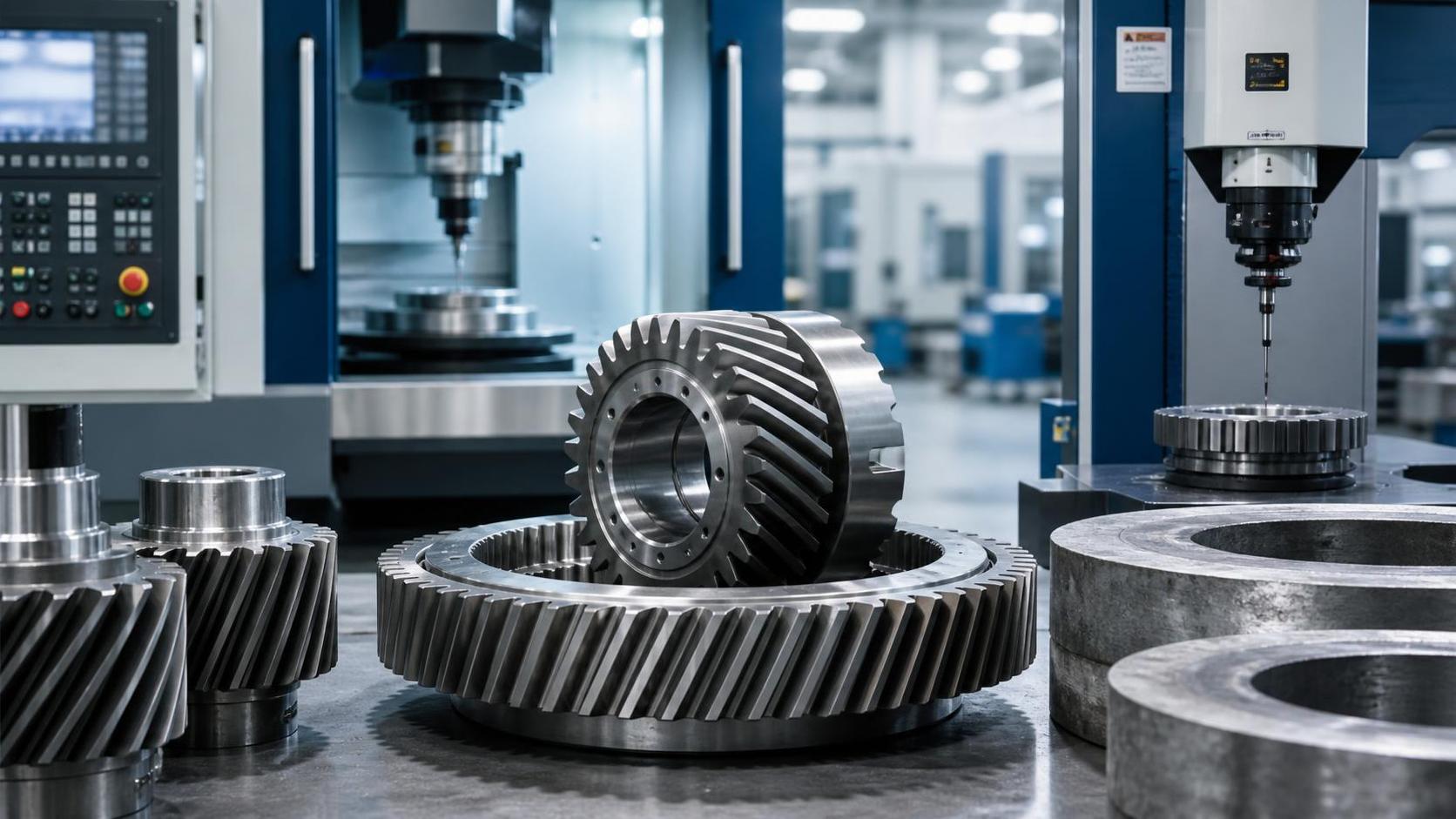
A gearbox program can look stable on paper until the first prototype gears arrive. The drawing may be complete, the assembly date may be booked, and purchasing may have a quoted unit price in hand. Then a practical issue appears: tooth geometry needs adjustment after contact-pattern testing, the selected steel has an unexpectedly long lead time, or the prototype machining route cannot be repeated economically at production volume.
This is where gear sourcing becomes more than a quotation exercise. A part that works as a one-off prototype may still be difficult to forge, heat treat, inspect, or machine consistently in larger batches. For automotive drivetrains, wind-power gearboxes, marine equipment, reducers, and industrial transmission systems, a poor supplier choice can create repeated drawing revisions, delayed validation, excess machining allowance, and cost pressure just when the project needs to move faster.
Choosing a custom gear manufacturer for scale-up means assessing whether that supplier can support the changing needs of the part—from early feasibility discussions through stable production—not simply whether it can make a sample. The most useful evaluation begins by separating the visible part requirements from the manufacturing risks hidden behind them.
Start with the failure mode, not the supplier list
Many sourcing efforts begin with a broad request for quote sent to several gear shops. This can be appropriate for a mature, low-risk part, but it often produces quotations that are difficult to compare. One supplier may assume machined bar stock, another may allow for a forged blank, and a third may quote only the gear cutting operation while treating heat treatment and final inspection as separate work. The lowest number may therefore describe a different scope rather than a better production route.
Before approaching suppliers, clarify what is actually uncertain in the program. Is the immediate concern prototype delivery? Is the tooth form still under development? Is the load case likely to change after bench testing? Does the component need a forged preform to control material flow and reduce waste later? Or is the main concern holding repeatable geometry after heat treatment?
The answers affect the kind of manufacturer that is suitable. A machine shop with strong gear-cutting capability may be a reasonable choice for early experimental parts. A manufacturer with forging and machining coordination becomes more relevant when geometry, material utilization, production cost, and repeatability all matter at the same time. The correct decision is not about finding one universally superior process. It is about choosing a route that fits the present stage without creating a costly changeover later.
The prototype quote can hide the production problem
Prototype gears are often made from readily available stock because that route is flexible. It permits changes to bore dimensions, spline details, hub thickness, or tooth modifications without investing in dedicated tooling. That flexibility is valuable during design validation. The risk comes when the prototype method is treated as the automatic production method.
For some gear families, machining a near-net forged blank can reduce unnecessary stock removal and improve material use compared with producing every feature from solid stock. It may also make it easier to control the starting geometry for later machining. However, forging introduces its own questions: draft requirements, parting-line location, flash management, grain flow considerations, die life, and dimensional allowance. These points should be discussed before the design is locked, not after a high-volume price has already been committed.
A useful conversation with a potential custom gear manufacturer is not “Can you make this drawing?” but “Which features drive your process selection, and what would change between the first run and a recurring production order?” A capable supplier should be able to explain the relationship between blank form, machining datum strategy, heat treatment condition, gear cutting, and final inspection. Vague assurances are less useful than a clear explanation of where the process has flexibility and where it does not.
For ring-shaped components or parts that benefit from a controlled starting form, a Forged Ring may be relevant as a preform option. It should not be selected merely because forging sounds economical. The bore, wall section, downstream machining requirements, material grade, and expected order pattern all need review before deciding whether it is an appropriate route.
Read the drawing as a manufacturing document
Gear drawings are sometimes released with enough information for design intent but not enough context for efficient manufacturing. A supplier can fill in assumptions, but unspoken assumptions are a common source of cost changes and delivery friction. During supplier discussions, provide the latest controlled drawing together with the information that explains the application.
At minimum, the manufacturer needs to understand the gear type, module or diametral pitch, pressure angle, helix angle where applicable, tooth count, face width, accuracy expectations, material specification, heat-treatment requirement, and critical interface dimensions. For bevel, spiral, planetary, and spline-related components, the mating relationship can matter as much as the single-part dimensions. If the gear will run in a matched set, say so early. A supplier evaluating one member in isolation may choose datums or inspection methods that do not support the final assembly requirement.
It is also important to distinguish between functional tolerances and inherited drawing habits. A very tight runout or bore tolerance may be necessary because it controls mesh behavior. In other cases, it may have been copied from an older design without a current functional justification. Asking the design team to identify the truly critical characteristics can prevent a quotation from carrying unnecessary processing steps.
This does not mean loosening requirements casually. It means connecting each tight specification to a function: torque transmission, backlash control, noise behavior, bearing fit, seal location, concentricity, or assembly positioning. When a requirement is function-based, the supplier can propose a more reliable method for achieving it.
Look for process ownership across the handoffs
Scale-up problems often occur between processes rather than inside one process. A forged blank may arrive with variable stock allowance. Machining may establish a datum that shifts after heat treatment. Gear cutting may be completed correctly, yet final distortion may move the bore-to-tooth relationship outside the assembly requirement. If different subcontractors handle each stage without shared responsibility, diagnosing the source of variation becomes slow.
When evaluating a supplier, ask who controls each handoff. The answer does not have to be “everything is done in one building.” External specialists can be appropriate. What matters is whether there is a defined process owner, documented incoming checks, traceability between operations, and an agreed response when a part does not meet specification.
The discussion should cover more than the production sequence. Ask how the supplier establishes datums from blank through finishing, when inspection occurs, what characteristics are checked before a part moves to the next stage, and how nonconforming material is separated. For gears, the timing of inspection matters. Checking only at final release may discover a problem after most of the value has already been added.
Heat treatment deserves particular attention. It can affect hardness, case depth where relevant, distortion, and machinability of subsequent operations. A supplier does not need to disclose proprietary details to explain its approach, but it should be able to state how it plans for dimensional movement, which dimensions are intentionally left for finishing, and how it verifies the final condition.
Cost comparisons need a common basis
Unit price is necessary, but it is not enough for a prototype-to-production decision. A lower prototype price can lead to a higher program cost if the process must be redesigned after validation. Conversely, an early investment in tooling or process development may not be justified if demand remains uncertain or if the design is likely to change.
Instead of asking suppliers for one number, request a quote that makes the cost drivers visible. The quotation should clarify whether it includes raw material, forging or blank preparation, machining, gear cutting, heat treatment, inspection, packaging, and delivery terms. It should also identify assumptions about annual volume, batch size, tooling, scrap treatment, and any price sensitivity tied to material availability.
Pay attention to the gap between prototype and production pricing. A large gap is not automatically a warning sign; it may simply reflect the shift from flexible machining to a more efficient blank-forming route. The key question is whether the supplier can explain the transition point. If no one can describe what triggers a process change, the project may be carrying avoidable uncertainty.
It helps to evaluate cost in layers. First is the part price. Second is the cost of change: new tooling, revised fixtures, engineering time, qualification parts, and potential schedule disruption. Third is the operating cost of poor consistency, including assembly rework, sorting, delayed builds, and inventory held as a buffer against uncertainty. These later costs rarely appear on an RFQ, but they can dominate the decision when a gear is central to a drivetrain or gearbox assembly.
Ask for evidence that fits the part you are buying
Generic statements about capability are less useful than evidence connected to your component. A manufacturer may have experience with gears but not with your size range, tooth geometry, material family, or required sequence. The goal is not to demand a long presentation; it is to understand whether the proposed route has been considered realistically.
Useful questions include:
- Which operations are expected to be most sensitive for this geometry?
- What blank condition and machining allowance are being assumed?
- How will tooth profile, lead, runout, bore relationship, and other relevant characteristics be inspected?
- At what point would tooling become advisable, and what design information must be frozen first?
- Which material or heat-treatment variables could affect the delivery plan?
- How are drawing revisions controlled once prototype parts have been released?
The quality of the answers is often more revealing than the format. A reliable custom gear manufacturer will usually identify open questions instead of pretending that every item is settled. That is useful during procurement because early uncertainty can be managed. Hidden uncertainty tends to emerge later as an exception request, a revised price, or a delayed shipment.
Do not confuse inspection equipment with a quality plan
It is reasonable to ask about measurement capability, but equipment alone does not ensure consistent output. The more important issue is whether the inspection plan matches the functional risk of the gear. For instance, measuring a few external dimensions may not be enough when tooth geometry, pitch variation, runout, or the relationship between splines and gear teeth affects performance.
Request clarity on the inspection records expected at each stage. For prototypes, a more detailed dimensional report may be appropriate because it supports design learning. In regular production, the plan may focus on defined critical characteristics, lot traceability, and process verification. The reporting burden should be proportionate to the risk. Excessive paperwork can add cost without improving control, while insufficient records make root-cause analysis difficult when an assembly issue appears.
Also discuss sample approval in practical terms. Determine which dimensions or gear characteristics must be accepted before production starts, who reviews deviations, and whether any special measurement method needs alignment between the buyer and supplier. A disagreement about how a feature is measured can consume more time than the actual machining correction.
Build the scale-up path before placing the first order
The safest sourcing decision is usually staged. Early orders should confirm material availability, manufacturability, inspection interpretation, and the supplier’s responsiveness to controlled revisions. As the design stabilizes, the focus can shift toward repeatability, batch planning, blank optimization, tooling decisions, and delivery rhythm.
Set review points that correspond to real engineering milestones rather than arbitrary dates. After initial prototypes, review whether the drawing still reflects the tested design. Before a production-oriented batch, confirm the intended manufacturing route and identify any features that create excessive machining or inspection effort. Before recurring releases, make sure revision control, packaging expectations, lot identification, and communication paths are clear.
This approach also protects against a common procurement mistake: treating every supplier question as resistance. Sometimes a question signals weak capability, but often it exposes a decision that has not yet been made internally. A request to clarify datum selection, heat-treatment sequence, or material substitution rules may prevent a much larger issue later.
Make the final choice around change control
When several suppliers appear technically capable, the deciding factor is often their ability to manage change without losing control of cost or quality. Gear programs rarely move in a straight line. Prototype testing can alter tooth modifications. A mating part can change. Demand forecasts can shift. A material source can become constrained. The selected supplier should be able to explain how it documents these changes and how it distinguishes an approved revision from an informal shop-floor adjustment.
For a critical component, choose the manufacturer that makes the production path understandable: where the blank comes from, which operations establish the important relationships, where variation is checked, and what changes as volume rises. That level of transparency gives purchasing and engineering a better basis for comparing offers than an attractive prototype price alone.
A well-chosen custom gear manufacturer does not remove every development risk. It helps make those risks visible early enough to evaluate them, budget for them, and decide whether the part should remain flexible or move toward a production-ready process. That is the difference between buying a gear sample and building a supply route that can support the next stage of the program.
Please give us a message