



Related Posts
Online Message
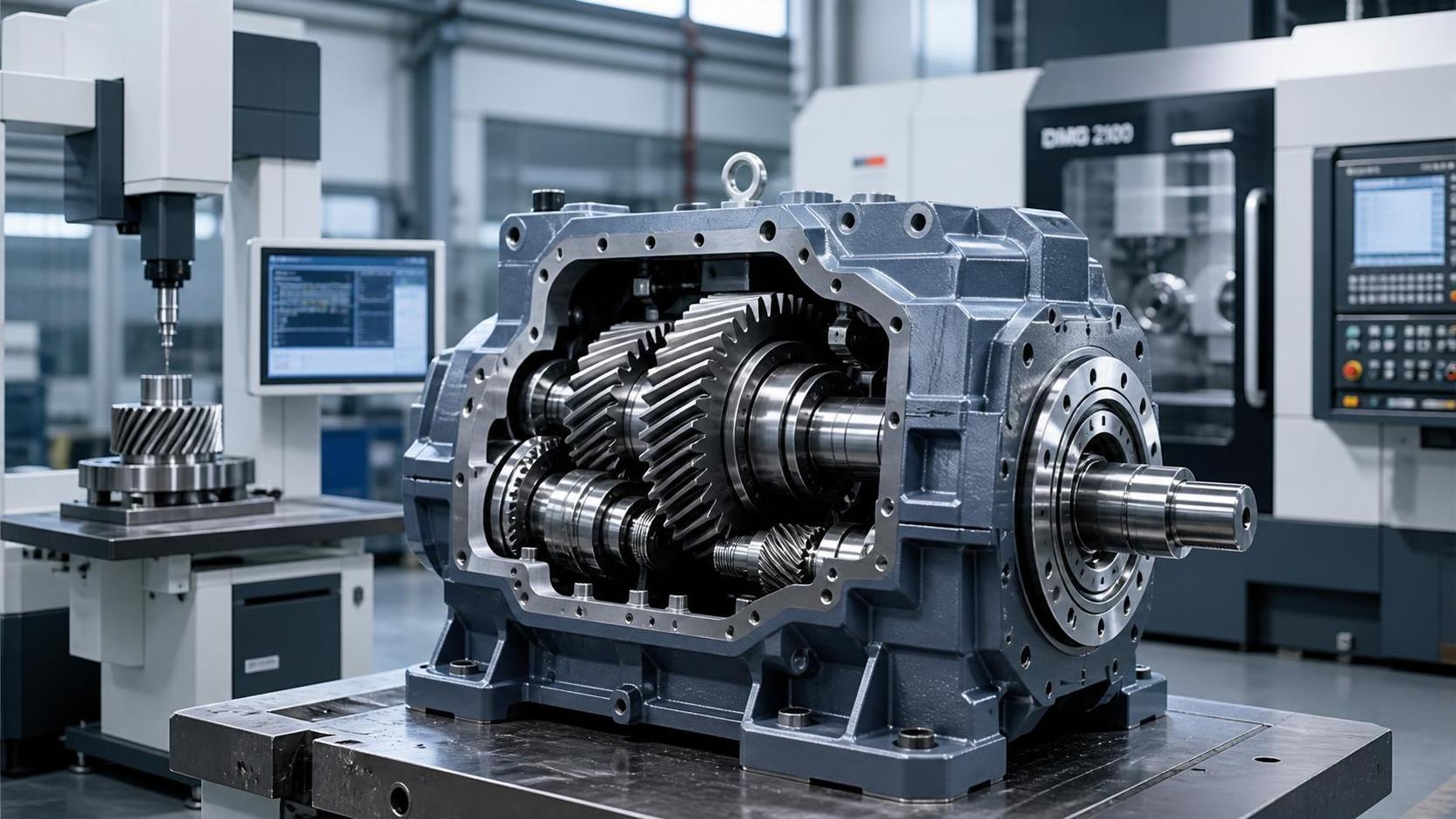
Comparing Helical Gearbox Manufacturers for Efficiency and Service Life
When comparing helical gearbox manufacturers, procurement teams must look beyond the unit price. Gear precision, raw-material control, heat-treatment consistency, machining capability, inspection discipline, and response after delivery all influence the real cost of a transmission system. A gearbox that appears economical in a quotation can become expensive if it runs hot, produces abnormal noise, requires frequent adjustment, or causes an unplanned shutdown.
This is particularly relevant in automotive production, wind power, marine equipment, material handling, and general industrial machinery, where a helical gear stage often operates continuously under changing torque. The practical question is not simply which supplier can manufacture a gear or reducer at the lowest price. It is whether that supplier can produce parts that maintain mesh quality, load capacity, and dimensional stability throughout the intended service interval.
A useful comparison begins by separating purchase price from lifecycle cost. The first is visible on the order sheet. The second includes energy loss, machining rework, rejected components, replacement lead time, maintenance labor, and the commercial effect of equipment downtime. For buyers, this distinction makes the supplier assessment more disciplined and less dependent on a single quoted figure.
Why Gear Quality Has a Direct Cost Effect
Helical gears transmit power through angled teeth, creating smoother engagement than many straight-tooth arrangements. That advantage, however, depends on correct tooth geometry and assembly conditions. If the helix angle, lead, tooth profile, runout, center distance, or contact pattern is poorly controlled, the theoretical benefits of a helical design can be diluted. The result may be excess vibration, uneven tooth loading, noise, or higher operating temperature.
Procurement teams do not need to become gear designers, but they should understand what must be confirmed before awarding a project. A supplier should be able to work from the relevant drawings and technical specifications, clarify the application load case, and identify which dimensions or process stages are function-critical. For a gearbox component, those stages often include forging, rough machining, heat treatment where specified, finish machining, gear cutting or grinding, and final inspection.
One common sourcing mistake is treating a gear as a standalone commodity. In reality, its performance is connected to the shaft, bearings, housing stiffness, lubrication method, and mating gear. A small variation that seems acceptable in isolation can become costly when accumulated across an assembled transmission. This is why capable manufacturers ask technical questions rather than immediately pricing an incomplete drawing package.
Compare the Manufacturing Route, Not Just the Finished Part
The route used to create the gear blank has consequences for both cost and reliability. Machining a blank from bar or billet may be appropriate for prototypes, small quantities, or specialized geometries. For repeat production, precision forging can reduce unnecessary material removal and create a blank closer to the required form. The right choice depends on part geometry, volume, material, required properties, and downstream machining allowances.
Buyers should ask suppliers how they determine forging allowance, how they manage material traceability, and whether the proposed blank is designed for the actual machining and gear-forming process. “Less machining” is not automatically better if insufficient allowance creates surface or dimensional risk. Yet excessive stock also adds cutting time, tool wear, scrap exposure, and energy consumption. The best route is the one that provides stable quality with a sensible material and process balance.
Liaocheng Jiucheng Auto Parts Co., Ltd., established in 2015, combines R&D, production, and sales around high-end gear forging and machining. Its scope includes automotive gears, wind-power gearbox parts, mechanical and marine gear components, as well as precision forgings, bevel gears, spiral gears, reducer gears, planetary gears, shafts, and spline shafts. For a buyer, this kind of process breadth matters because the discussion can begin with the part’s complete manufacturing path rather than being limited to one operation.
The company operates an 8,000-square-meter factory with a 6,000-square-meter workshop area that includes precision forging and mechanical processing workshops. Its stated fixed assets are RMB 20 million. These figures alone do not prove suitability for every project, but they are relevant starting points when assessing whether a supplier has the physical basis to coordinate forging and machining under one operating structure.
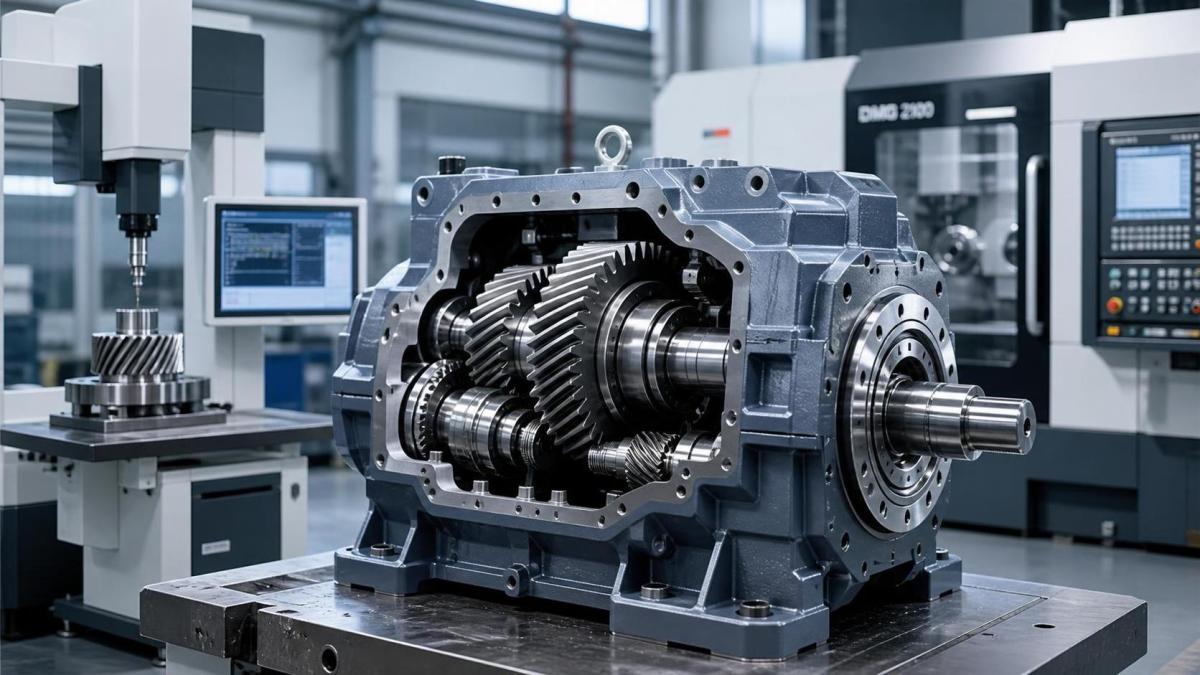
Efficiency Is More Than a Published Gearbox Figure
In an operating gearbox, efficiency is influenced by tooth contact, surface condition, lubricant selection, bearing losses, seal drag, alignment, speed, and load. It should therefore be approached as a system outcome. A procurement specification that only requests a nominal reduction ratio and torque rating leaves too much room for interpretation, especially in high-duty applications.
Ask how the supplier will verify the tooth-form requirements stated on the drawing, how runout and concentricity will be controlled, and what records can accompany the delivery. If the final gearbox assembly is handled elsewhere, it is equally important to define the responsibility boundary. A component manufacturer may control the gear and shaft dimensions, but the assembler must still manage backlash, bearing preload, housing accuracy, and lubrication.
For cost reviews, energy use should be considered over operating hours rather than treated as an abstract sustainability point. A modest loss repeated across many hours of motor operation can matter, particularly in continuously operating equipment. It is reasonable to request technical support on the manufacturing factors that influence transmission smoothness, while recognizing that final energy performance must be confirmed at the assembly and application level.
Service Life Begins with Material and Process Control
Long service life is rarely secured by one inspection at the end of production. It is built through stable control of incoming material, blank formation, machining references, heat-treatment requirements where applicable, tooth finishing, cleaning, preservation, and packing. The exact control plan should follow the drawing, material grade, customer standards, and application conditions; buyers should be cautious when a supplier promises a universal service-life outcome without first reviewing those details.
Material documentation and lot identification are especially important when gears will face cyclic loading. The buyer should clarify what traceability is required, which properties need verification, and whether samples, first-article inspection, or agreed measurement reports are needed. For wind-power or marine uses, environmental exposure, service access, load variation, and maintenance intervals may create requirements very different from those of an automotive auxiliary drive or a factory conveyor.
A supplier’s quality organization should also be evaluated in practical terms. Jiucheng reports a team of 55 employees that includes a senior engineer, mechanical engineers, a quality engineer, eight quality inspectors, and an electrical engineer. The useful procurement follow-up is not merely the headcount. Ask which checks occur in process, which are final-release checks, who handles nonconforming product, and how measurement data is retained and communicated when a drawing revision occurs.
Look at the Gearbox as a Connected Driveline
Helical gearbox performance is often compromised outside the gear mesh itself. A shaft with inadequate dimensional control can affect bearing seating and gear location. Spline fit can influence torque transfer and assembly behavior. Misalignment at a coupling may impose additional radial or axial forces that were not considered in the original gear calculation. Procurement specifications should therefore identify the mating interfaces and their critical datums.
Where a project includes related transmission components, it can be useful to review shaft and gear requirements together. For example, a Drive Shaft should not be sourced only by overall length and diameter. Buyers should also confirm spline geometry, shoulder locations, runout requirements, bearing fits, surface requirements, and the reference surfaces used during inspection. This prevents a frequent handoff problem: each component meets a partial drawing requirement, but the assembled system does not run as intended.
This connected view is one reason that manufacturers with experience across gears, reducer components, transmission shafts, and spline shafts can be worth evaluating. It does not remove the need for clear specifications, but it can make design-for-manufacture conversations more productive before production begins.
Questions That Reveal Supplier Capability
A short, technically focused review often reveals more than a broad supplier presentation. Before comparing quotations from helical gearbox manufacturers, buyers can ask:
- Which operations are completed in-house, and which are subcontracted?
- What technical documents are needed before a reliable quotation and manufacturing review can be completed?
- How are forging stock, machining datums, and critical gear dimensions controlled across batches?
- What inspection records can be provided for the agreed characteristics?
- How are engineering changes, sample approvals, and nonconforming parts managed?
- What packaging and corrosion-protection method is suitable for the shipping route and storage period?
These questions are also useful when evaluating delivery risk. A low price may depend on a sequence of external processes, each with its own queue, transport step, and quality handoff. That model can work, but it should be visible in the sourcing decision. Integrated forging and machining capability may reduce some coordination points, while outsourced special processes may still require clear controls and realistic lead-time planning.
Using Cost Data Without Making a False Comparison
A meaningful cost comparison uses the same technical baseline. Confirm the material, blank route, machining scope, heat-treatment scope where specified, inspection level, packaging, quantity assumptions, and delivery terms before ranking quotes. Otherwise, two prices may refer to different products. The lowest offer may exclude documentation, protective packing, special inspection, prototype tooling, or the engineering work needed to stabilize repeat production.
Jiucheng states that its precision-forging approach is intended to reduce or eliminate some turning operations and improve raw-material utilization. The company reports material utilization 50% higher than traditional processes, a 20% reduction in comprehensive production cost, and electricity savings of more than 30%. Such figures should be reviewed in the context of the relevant process comparison and part family; they should not be assumed to apply unchanged to every gearbox component. Still, the underlying sourcing point is sound: process selection can affect material consumption, machining time, and energy use well before final assembly.
For long-running programs, request a cost breakdown discussion rather than simply seeking an annual price reduction. It may identify a better forging shape, a revised machining datum, an improved packing method, or a batch size that reduces avoidable work without weakening the part specification. The strongest savings are usually designed into the process, not extracted after quality problems appear.
A Practical Decision for the Next RFQ
The right gearbox manufacturing partner is not necessarily the largest supplier or the supplier with the lowest first quote. It is the one whose manufacturing route, technical communication, inspection capability, and delivery discipline fit the risk level of the application. Automotive and wind-power supply experience can be relevant indicators of process maturity, but each new part should still be assessed against its own drawing, operating loads, interfaces, and release requirements.
Before issuing an RFQ, assemble the ratio or gear data, torque and speed range, duty cycle, material requirement, mating-part information, critical dimensions, acceptance criteria, forecast volume, and required delivery window. Then compare suppliers on the clarity of their technical response as well as their price. That approach gives procurement teams a more reliable basis for selecting components that support efficient operation and a credible service life.
Please give us a message