



Related Posts
Online Message
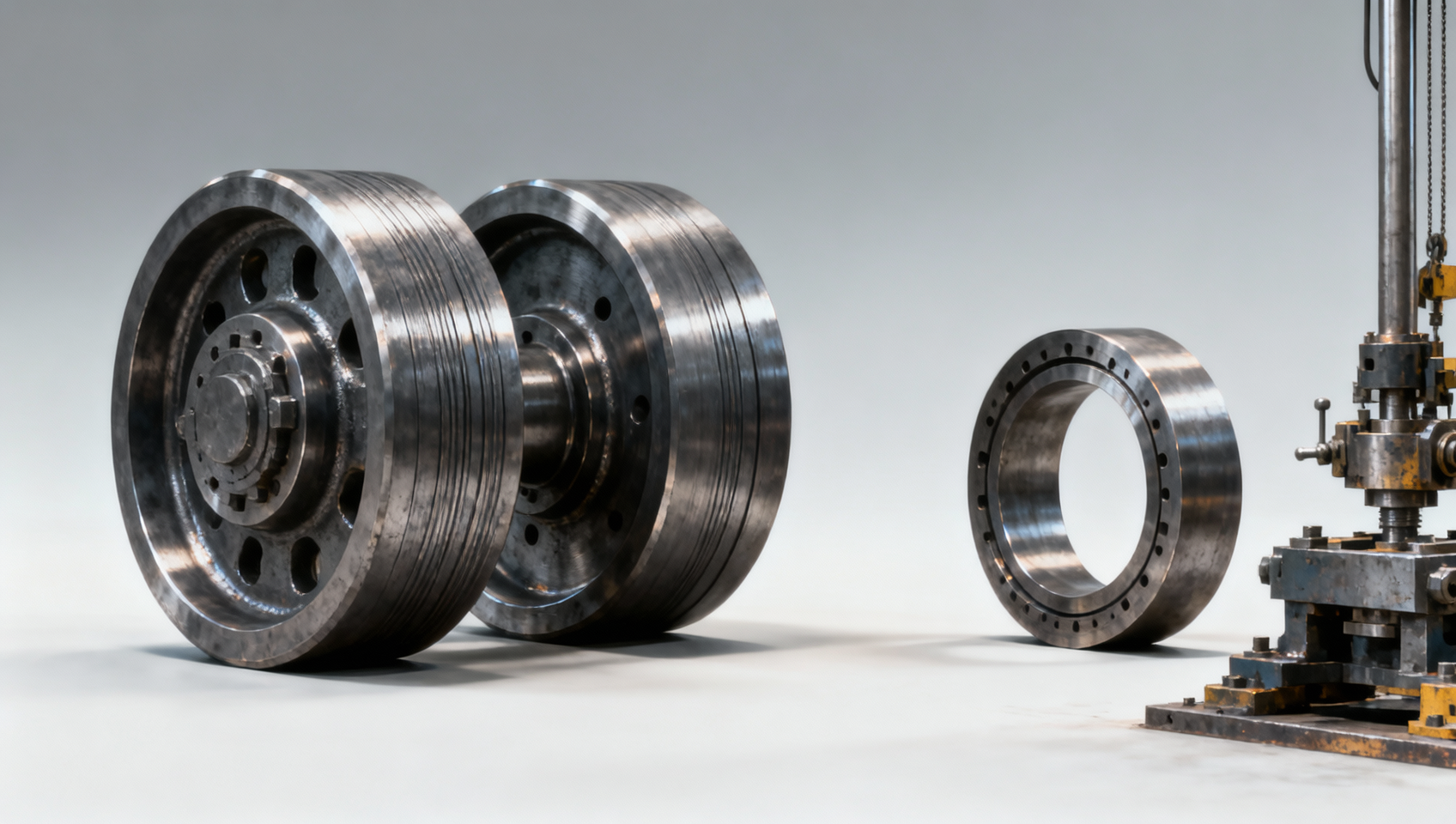
When sourcing forged crane wheels, procurement professionals rarely stop at “How much per ton?” — because that number alone tells you almost nothing about real cost, risk, or performance. You’re not buying steel weight. You’re buying load-bearing integrity, fatigue resistance under cyclic stress, and long-term safety in overhead lifting environments where failure isn’t an option. At Liaocheng Jiucheng Auto Parts Co., Ltd., we’ve supplied precision-forged components to wind turbine gearbox OEMs and heavy-duty vehicle manufacturers since 2015 — and we see the same question repeated across procurement desks: *Why does AISI 4140 cost more than 42CrMo4? Is the premium justified? Or is it just alloy branding?*
It’s Not Just Chemistry — It’s How You Forge It
Yes, both AISI 4140 and 42CrMo4 are medium-carbon chromium-molybdenum steels — chemically similar, often interchangeable on paper. But in practice, their behavior diverges sharply during forging, heat treatment, and final machining. AISI 4140 has tighter control over residual elements (especially sulfur and phosphorus), and its hardenability curve responds more predictably to quenching in large-section forgings like crane wheels — critical when you’re dealing with diameters over 800 mm and section thicknesses exceeding 120 mm.
42CrMo4, while widely accepted in EU and Chinese standards (GB/T 3077), tends to show greater batch-to-batch variation in hardenability — especially when sourced from mills without strict ladle metallurgy control. That variability forces conservative heat treatment parameters: longer soak times, slower cooling rates, or post-tempering stress relief cycles. Each adds time, energy, and inspection overhead — costs that don’t appear in the raw material quote but hit your landed cost hard.
Where Price Really Moves — Beyond the Alloy Grade
If you’re comparing quotes per ton, here’s what actually drives variance — and where many buyers misallocate attention:
- Dimensional tolerance stack-up: Crane wheels aren’t stock items. A ±0.5 mm OD tolerance may seem minor — until you realize it requires CNC turning after forging. That adds 12–18% to machining time and scrap risk. Precision forging — like what we run in our 6,000 m² mechanical processing workshop — reduces that need significantly.
- Ultrasonic testing scope: ASTM A578 Level 3 vs. Level 1 isn’t a checkbox — it’s hours of scanning time, calibration setup, and certified operator labor. Buyers who specify “UT required” without defining acceptance criteria often get quoted for worst-case coverage — inflating cost without added value.
- Surface finish & hardness uniformity: Hardness gradients across the rim or flange can trigger rework. We routinely see 42CrMo4 wheels fail hardness mapping at the hub-to-rim transition — not due to poor alloy, but inconsistent cooling geometry during quenching. Fixing that means custom jigs, controlled air-quench zones, or even local induction tempering — all baked into unit cost.
And yes — heat treatment complexity matters. AISI 4140’s narrower hardenability band lets us use faster, more energy-efficient oil quenching on large wheels. With 42CrMo4, we often default to polymer quench + double tempering to avoid cracking — adding 20–25% to thermal processing time and electricity consumption. Our automated production lines cut that gap, but the physics remain.
Precision Forging Isn’t a Buzzword — It’s Your Cost Lever
Here’s what changes when you shift from conventional open-die forging to near-net-shape precision forging: material utilization jumps ~50%, total production cost drops ~20%, and electricity use falls over 30%. That’s not theoretical — it’s measured across hundreds of gear blanks, shafts, and ring components we produce annually for SAIC, Dongfeng, and wind power gearbox suppliers.
A forged crane wheel starts as a Forged Ring Blank. Its geometry — hub height, rim width, bore chamfer — determines how much machining remains. If your design allows for 2–3 mm finishing allowance instead of 8–10 mm, you save not just turning time, but tool wear, coolant, and inspection passes. That’s why our engineers collaborate early — not to sell more services, but to identify where tolerance relaxation or feature simplification delivers real ROI without compromising safety margins.
We don’t push AISI 4140 by default. For cranes operating below 120°C ambient, with static or low-cycle loading, 42CrMo4 — properly forged and heat-treated — performs reliably. But for port cranes with salt exposure, frequent shock loading, or wheels supporting >50-ton hoists? The consistency of AISI 4140 becomes operational insurance — not luxury.
What to Ask Before Finalizing Your Quote
Before accepting any “per ton” figure, clarify these points — they’ll expose hidden cost drivers:
- Is the price based on delivered weight — or net forging weight before machining?
- Does the quote include full UT coverage, hardness mapping, and dimensional certification — or are those add-ons?
- What’s the heat treatment process window? (e.g., “quench & temper” is vague — ask for soak temperature/time, quench medium, and temper cycle details)
- Are test coupons forged with the lot — and tested per ASTM A370?
- Can the supplier demonstrate traceability to mill heats — especially for alloying elements affecting hardenability?
At Jiucheng, every forged crane wheel carries full chemical and mechanical test reports — not just for compliance, but because our quality engineers know that a 0.02% difference in molybdenum content can shift Jominy end-quench results by 3 HRC points across a 150-mm section. That’s not something you catch in final inspection. It’s managed upstream — in material selection, furnace control, and die design.
So when you see a $1,850/ton quote for AISI 4140 versus $1,620/ton for 42CrMo4 — look past the headline. Ask how much of that gap disappears when you factor in reduced rework, shorter lead time, fewer heat treat iterations, and lower scrap rate. Because in heavy machinery procurement, the cheapest ton isn’t always the lowest-cost wheel.
Please give us a message