



Related Posts
Online Message
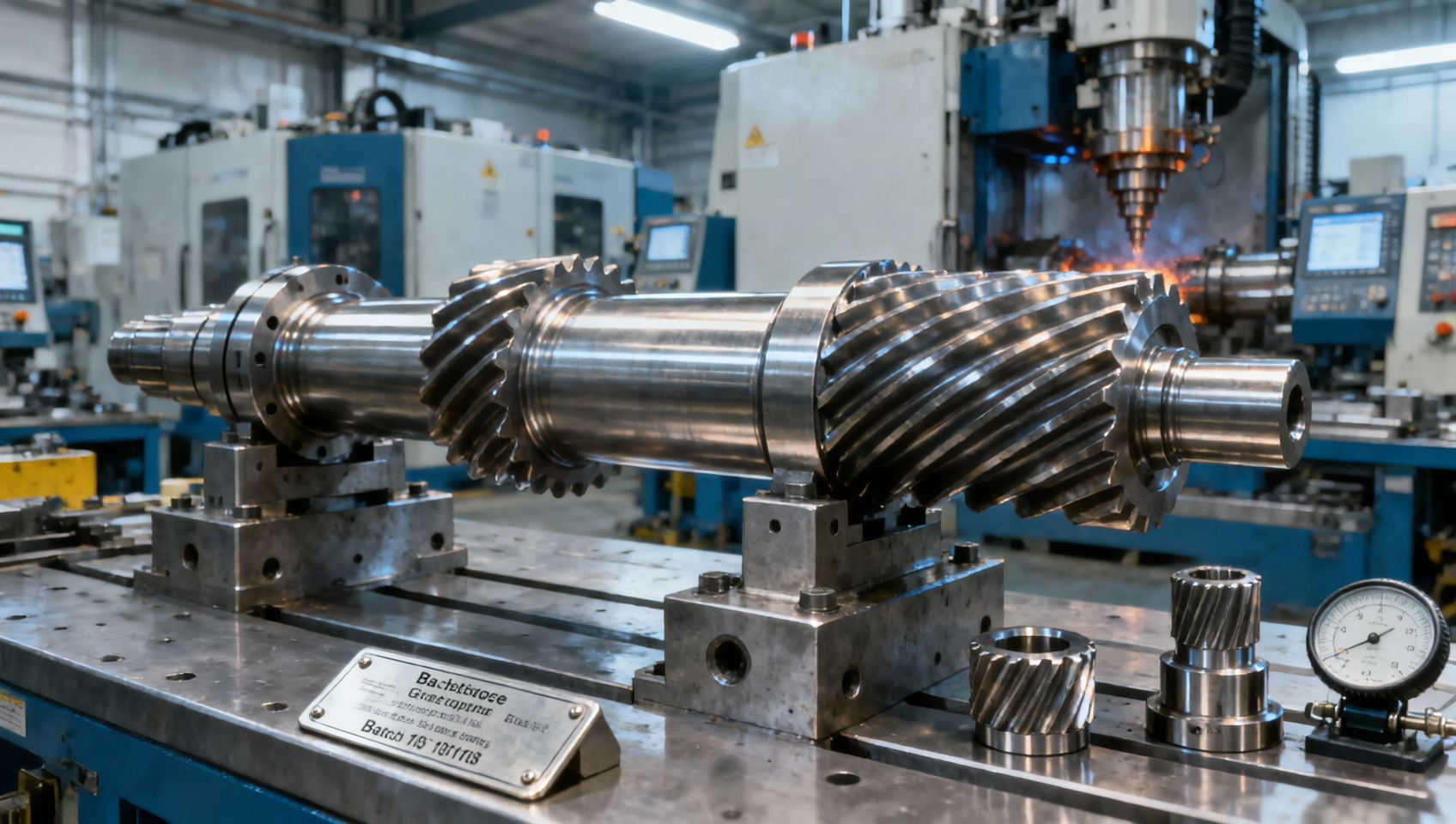
How to Qualify a Spline Shaft Supplier for Repeatable Production Quality
Choosing a spline shaft supplier is not only about comparing quoted unit prices. A shaft that fits during prototype assembly can still create expensive problems once production volumes rise: variable backlash, inconsistent hardening depth, premature tooth wear, assembly interference, or batches that cannot be traced back to their original material and heat-treatment records. For procurement teams buying automotive, wind power, marine, or industrial transmission parts, qualification should focus on the controls that keep the same part performing the same way over repeated runs.
The practical question is not simply whether a supplier can manufacture a spline shaft. Most capable machine shops can make a sample from a drawing. The better question is whether the supplier can control the entire manufacturing route—from steel selection and forging through machining, heat treatment, inspection, packaging, and shipment—without relying on luck, manual correction, or undocumented process changes.
A strong sourcing decision therefore combines technical review with cost discipline. The lowest piece price can be misleading if it excludes tooling development, inspection requirements, rejection handling, traceability documentation, or the cost of production interruptions at the buyer’s assembly plant. Repeatable quality is usually built into process planning before the first purchase order is released.
Start with the Function of the Spline, Not the Drawing Alone
A spline shaft transmits torque while allowing a controlled fit with a mating hub, gear, clutch, or sliding component. Yet two shafts with similar outside diameters may have very different production risks. Internal or external splines, involute or straight-sided profiles, fixed or sliding engagements, high-cycle loads, corrosion exposure, shock loading, and lubrication conditions all influence the appropriate material, surface treatment, machining route, and inspection method.
Before sending requests for quotation, procurement should work with engineering to define the characteristics that are genuinely critical to function. These commonly include spline standard or customer drawing revision, tooth profile, major and minor diameters, effective tooth thickness, lead and pitch variation, concentricity relative to journals or bearing seats, surface finish, hardness requirement, and acceptable runout. If a mating part is available, its actual inspection data can be as useful as its nominal drawing dimensions.
It is also worth identifying where the shaft will fail if variation occurs. A gearbox input shaft may be especially sensitive to tooth contact and heat-treatment consistency. A marine transmission shaft may require closer attention to corrosion protection and material documentation. In an automotive driveline, concentricity between spline and bearing journals can matter just as much as spline geometry. This functional context gives suppliers a realistic basis for proposing a stable process rather than quoting against incomplete assumptions.
Assess Whether the Manufacturing Route Matches the Part
The production route is often the clearest indicator of whether a quote is sustainable. Spline shafts may be made from bar stock, forged blanks, precision forgings, or near-net-shape forgings, followed by turning, milling, hobbing, broaching, rolling, grinding, heat treatment, and finishing operations as required. No single route is automatically superior. The right option depends on loading, geometry, tolerances, annual demand, material grade, and the buyer’s total cost target.
For high-load transmission components, a forged blank can offer a sensible starting point when the forging layout supports grain flow and reduces unnecessary stock removal. It can also reduce machining time and material waste compared with producing the full form from larger bar stock. However, the benefit depends on tool design, dimensional repeatability of the forging, and sufficient machining allowance in the areas that need final precision. A supplier should be able to explain where forging ends and precision machining begins.
Liaocheng Jiucheng Auto Parts Co., Ltd., established in 2015, combines a precision forging workshop with a mechanical processing workshop. Its work covers precision forgings, gears, transmission shafts, and spline shafts for applications including automotive, wind power, mechanical equipment, and marine gear parts. For a buyer, this type of integrated capability is relevant because responsibility for blank quality and downstream machining is less fragmented. It does not remove the need for qualification, but it can simplify process review and root-cause analysis when a dimensional or material issue is found.
Ask the supplier to map each operation in sequence. The map should show incoming material control, blank production, rough machining, spline forming, heat treatment where applicable, finishing, final inspection, preservation, and packing. Look for the points where datum surfaces are established and re-established. Poor datum strategy can turn an apparently acceptable spline profile into an assembly problem because its relationship to the rest of the shaft is unstable.
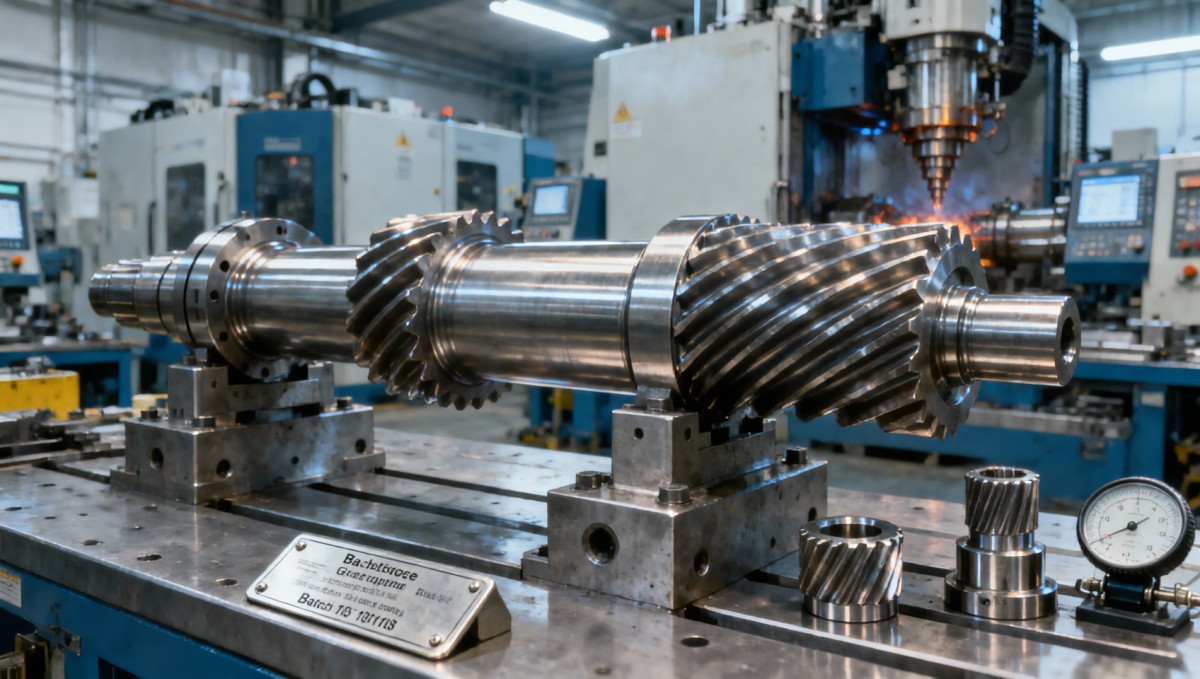
Material Traceability Must Survive the Production Floor
Material traceability is easy to promise and harder to maintain once batches are cut, forged, moved, heat treated, and mixed with work in progress. Procurement should ask how the supplier links incoming steel to the finished shaft lot. The answer should cover material certificates when specified, heat or batch identification, segregation of different materials, and the method used to retain identity after individual components are separated from the original stock.
A material grade name alone is not enough. The agreed technical package should clarify chemical composition requirements, mechanical-property expectations, delivery condition, and any required nondestructive testing or metallographic examination. If carburizing, induction hardening, nitriding, or another treatment is involved, define what evidence is needed for hardness, case depth, distortion control, and post-treatment inspection. These requirements should be confirmed before serial production, not negotiated after a rejected delivery.
For components that go into regulated or safety-sensitive assemblies, documentation retention periods and format may also matter. A supplier should be asked to provide only the records that are relevant to the project, but those records should be tied to a lot number that appears on the shipment and inspection documents. Traceability is valuable because it allows containment; it is not merely paperwork for a supplier audit.
Verify Spline Inspection Capability, Not Just General Measuring Equipment
A supplier may have calipers, micrometers, and coordinate measuring capability, yet still lack an effective method for controlling spline features in production. The qualification discussion needs to move beyond “Do you inspect parts?” to “Which spline characteristics do you inspect, how often, and with what gauges or programs?”
Depending on the design, control may involve go/no-go gauges, functional gauges, dedicated spline gauges, profile measurement, tooth-thickness checks, runout measurement, or CMM inspection. A functional gauge can be particularly useful because it tests the mating condition rather than an isolated dimension. Still, it does not always replace profile-level analysis when the drawing calls for it. The supplier’s inspection plan should distinguish between first-piece approval, in-process checks, final sampling, and periodic verification of the measuring system itself.
Ask to see an anonymized inspection format or a draft control plan for the proposed part. The document does not need to be elaborate. What matters is whether critical dimensions have clear acceptance criteria, measurement methods, frequencies, and reactions when results move toward a limit. “100% inspected” is not automatically reassuring if the method cannot reliably detect the actual failure mode.
This same discipline applies across rotational components. A supplier serving transmission systems may also process related parts such as Slewing bearing rings, where geometry, concentricity, material condition, and process traceability similarly need to be controlled across multiple operations. The product categories differ, but the procurement principle is the same: evaluate the process chain, not a single final measurement.
Look at Capacity Through the Lens of Process Stability
Capacity is more than factory floor area or the number of machines. A supplier may have unused equipment but no realistic ability to add a new product because skilled setup personnel, inspection resources, tooling, furnace availability, or subcontracted finishing capacity are constrained. Conversely, a smaller team with an established product family may run repeat work predictably because its routing and tooling are already standardized.
Jiucheng reports an 8,000-square-meter factory site, including 6,000 square meters of workshop space, with precision forging and machining operations. Its workforce includes engineering, quality, inspection, and electrical personnel, including eight quality inspectors. These facts are useful starting points for a capability conversation, particularly where forged and machined drivetrain components are involved. They should not replace a buyer’s own review of the specific production line, fixture strategy, bottleneck operations, and planned output for the requested shaft.
A practical capacity review asks for cycle-time assumptions, tooling lead time, changeover approach, contingency for equipment downtime, and the supplier’s plan for ramping from samples to repeat orders. It should also ask whether critical operations are performed in-house or outsourced. Outsourced heat treatment, coating, or grinding is not necessarily a concern; the key issue is whether the supplier owns the specification, verifies incoming results, and has a clear response if an external process drifts.
Compare Cost on a Like-for-Like Basis
When comparing quotations from a spline shaft supplier, build a cost sheet that separates the recurring unit price from one-time and risk-related costs. Tooling, gauges, first-article inspection, packaging, material price adjustment mechanisms, freight terms, and payment terms can materially change the commercial picture. So can a supplier’s quoted scrap allowance if the part is difficult to forge or heat treat.
The cost advantage of precision forging deserves a careful review rather than a blanket assumption. Jiucheng states that its precision-forged products are designed for no-turning or reduced-turning production, with reported material utilization 50% higher than traditional processes, comprehensive production cost reduced by 20%, and electricity savings above 30%. Those figures describe the company’s stated process direction, not a guaranteed saving for every spline shaft. For a particular project, procurement should request a part-specific comparison of blank weight, machining allowance, tooling cost, expected yield, and annual volume break-even point.
The more useful cost question is: what must be true for this price to hold for twelve months of repeat production? If the answer depends on loose tolerances, buyer-provided gauges, unstable material pricing, or unconfirmed heat-treatment capacity, the quote needs qualification before it becomes a sourcing benchmark.
Use Samples to Validate the Process, Not Merely the Part
Sample approval should test more than whether a few parts meet drawing dimensions. Ideally, the buyer reviews the first pieces alongside the proposed manufacturing route, inspection report, material records, and any heat-treatment evidence. If the application allows it, checking fit with the mating component can reveal issues that are invisible in a dimensional report.
It is wise to ask whether samples were made on production-intent tooling and equipment. Hand-finished prototype pieces can be useful for design confirmation, but they say little about repeatability. If production tooling is not ready, the supplier should state that openly and explain what will change between prototype and serial manufacture.
After approval, establish a controlled change process. Changes in steel source, forging die, machining fixture, heat-treatment provider, inspection method, or manufacturing location can affect performance even if the drawing does not change. A dependable supplier communicates such changes before shipment, allowing the buyer to determine whether requalification is necessary.
Make Qualification a Shared Production Plan
The best supplier relationship is not built on vague assurances of quality. It is built on a shared understanding of the shaft’s function, the critical characteristics, the chosen process route, the required records, and the cost assumptions behind the order. That clarity protects both sides when production volumes increase or engineering revisions arrive.
For buyers sourcing forged and machined drivetrain parts, a supplier with both technical engineering involvement and production experience across automotive, wind gearbox, mechanical, and marine applications can provide a useful foundation. The final decision should still rest on evidence: a review of the actual part, process capability, inspection plan, traceability method, production schedule, and commercial terms. A spline shaft that is economical to buy but inconsistent to assemble is never truly low cost.
Please give us a message