



Related Posts
Online Message
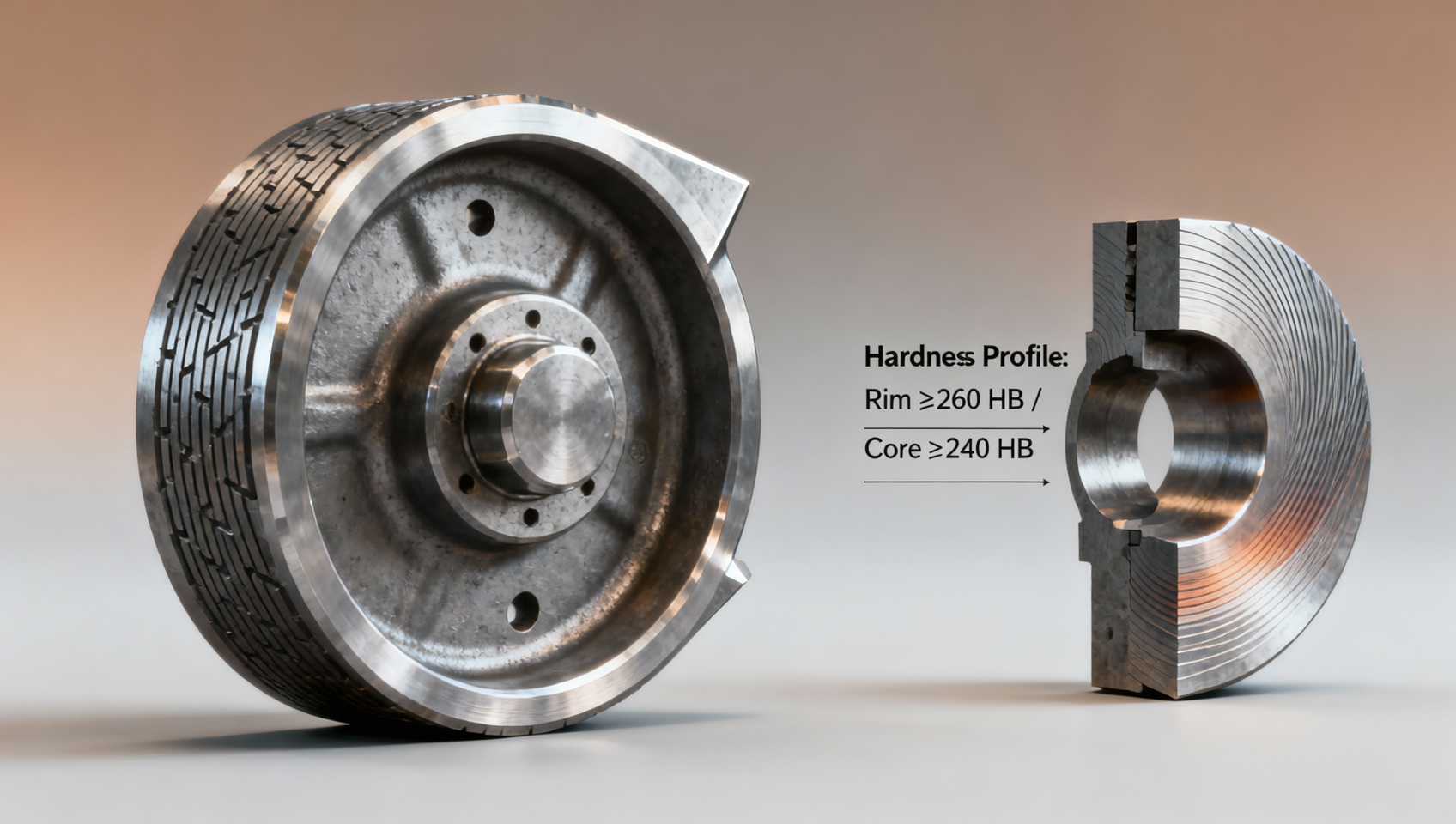
Specifying forged crane wheels for hot rolling mill cranes operating at 250°C ambient temperature is not a matter of selecting from standard catalogues. At this thermal threshold, conventional carbon steel wheels rapidly lose tensile strength, suffer accelerated wear, and risk dimensional instability under cyclic loading. Project managers overseeing crane upgrades or new installations in rolling mills must prioritize material behavior—not just mechanical ratings—when defining specifications. Failure to account for sustained high-temperature exposure leads to premature wheel cracking, increased maintenance frequency, unplanned downtime, and compromised safety margins during heavy slab handling.
The core requirement is clear: forged crane wheels must retain adequate hardness, fatigue resistance, and creep stability at 250°C without relying on external cooling or insulation. This eliminates most ASTM A108 Grade 1045 and AISI 4140 wheels unless specially heat-treated and alloy-modified. The solution lies in intentional metallurgical design—not post-facto adaptation. Liaocheng Jiucheng Auto Parts Co., Ltd. applies precision forging and controlled thermal processing to produce wheels where microstructure, grain flow, and phase balance are engineered for thermal endurance—not just room-temperature load capacity.
Material Selection Must Reflect Thermal Load History
Ambient temperature alone doesn’t define the thermal environment. Wheel rims absorb radiant heat from hot slabs (often >900°C), conduct heat from hot bearings, and experience thermal gradients across cross-sections. Standard forged wheels with Brinell hardness of 300–340 HB may drop below 220 HB at 250°C—reducing surface durability and increasing pitting risk. Alloy steels like 34CrNiMo6 (DIN 1.6580) or modified 42CrMo4 offer superior temper stability due to chromium-molybdenum-nickel synergy, maintaining ≥260 HB after exposure at 250°C for extended periods. Nickel content improves toughness retention; molybdenum suppresses temper embrittlement; chromium enhances oxidation resistance at the rim surface.
Carbon content must be balanced: too low (<0.35%) limits hardenability; too high (>0.45%) increases brittleness risk during thermal cycling. Forged wheels specified for this duty typically use 0.38–0.42% C, with strict control over residual elements (P < 0.025%, S < 0.020%) to prevent grain boundary weakening at elevated temperatures.
Forging & Heat Treatment Are Non-Negotiable Process Controls
Hot rolling mill cranes demand directional strength alignment. Rolling direction, grain flow, and defect distribution directly affect crack propagation resistance under thermal-mechanical fatigue. Only closed-die forging achieves uniform density and optimal grain orientation—casting or rolled plate blanks cannot replicate this. Each wheel undergoes full-section normalizing followed by quenching and double tempering: first at 620–650°C to relieve forging stresses, then at 580–600°C to stabilize carbides and maximize hot hardness retention. Tempering time is extended—not shortened—to ensure homogeneity through the rim-to-hub transition zone.
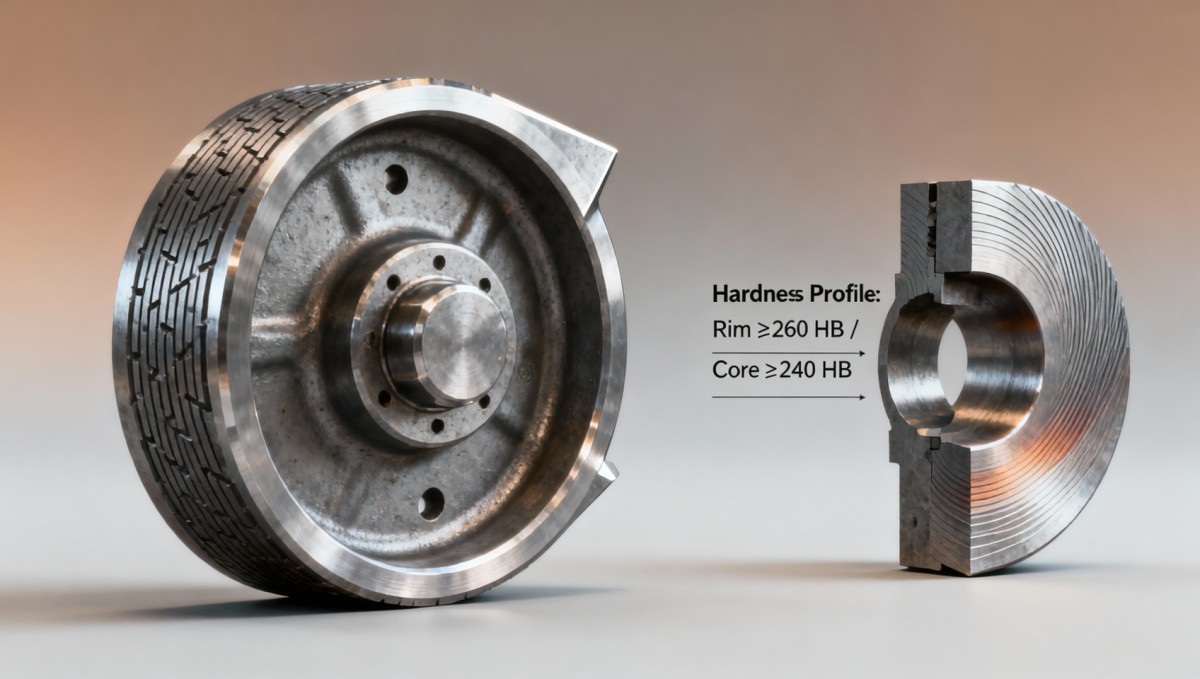
Surface hardness alone is insufficient. Core hardness must remain ≥240 HB to prevent subsurface plastic deformation under repeated impact loading. Hardness profiling across radius is mandatory—not optional—for verification. Wheels showing >40 HB drop from rim to core indicate inadequate tempering or uneven heating during heat treatment.
Dimensional Stability Under Thermal Cycling
Thermal expansion mismatch between wheel and axle, combined with repeated heating-cooling cycles, induces radial stress that accelerates fatigue cracking at hub fillets. Tolerances must reflect operational temperature—not room-temperature measurement. Specifying ISO 286-2 H7/h6 fit at 20°C ignores ~0.12 mm/m radial growth at 250°C for steel. Recommended practice: specify bore tolerance referenced to 250°C simulated condition, or apply thermal offset correction during machining. Hub thickness should be ≥22% of wheel diameter to limit thermal gradient-induced bending stress.
Flange geometry also matters. Standard flange angles (60°–70°) increase contact stress concentration when thermal expansion reduces running clearance. A 45° flange angle distributes lateral load more evenly across the tread width under thermal distortion—reducing edge wear and derailment risk during high-speed traverse.
Surface Integrity & Fatigue Life Validation
Surface finish impacts thermal fatigue initiation. Machined surfaces with Ra > 3.2 μm create micro-notches that act as crack nucleation sites under combined thermal and mechanical loading. All tread and flange surfaces require grinding to Ra ≤ 1.6 μm, followed by shot peening (Almen intensity N10–N12) to induce compressive residual stress ≥ -200 MPa at 0.1 mm depth. This delays crack initiation by up to 3× compared to non-peened counterparts under identical thermal cycling conditions.
Ultrasonic testing (UT) per EN 12680-2 is required—not just for internal voids, but for detecting subsurface microsegregation bands that become preferential paths for thermal fatigue cracks. UT must cover full rim section, including the critical 15 mm below tread surface where thermal gradients peak.
Integration With Supporting Components
Wheel performance depends on interface integrity. Axle material must match thermal expansion coefficient closely—42CrMo4 axles paired with 34CrNiMo6 wheels reduce differential expansion stress by ~35% versus standard 45# steel axles. Bearing selection must account for reduced grease life above 150°C; sealed spherical roller bearings with high-temperature lithium complex grease (NLGI #2, dropping point >220°C) are minimum requirement.
For applications requiring synchronized motion or torque transmission, a Spur gear integrated into the wheel assembly must use the same base alloy and heat treatment schedule to avoid galvanic or thermal mismatch issues at the interface.
Verification Protocol Before Installation
Do not rely solely on mill certificates. Require batch-specific test reports for: (1) hardness profile across radius, (2) tensile strength at 250°C (not room temperature), (3) Charpy V-notch impact energy at 250°C, and (4) thermal expansion coefficient measured from 20°C to 250°C. Third-party validation is recommended for first-time suppliers or new alloy grades.
Pre-installation thermal soak testing—holding wheels at 250°C for 48 hours, then measuring runout and dimensional change—is advisable for critical lifts. Runout exceeding 0.15 mm after thermal stabilization indicates residual stress imbalance or improper heat treatment.
Forged crane wheels for hot rolling mill cranes operating at 250°C ambient temperature demand specification rigor beyond standard lifting equipment criteria. Material grade, forging method, heat treatment sequence, dimensional referencing, surface conditioning, and interface compatibility must all be defined with thermal behavior as the governing parameter—not as an afterthought. When these parameters are aligned, forged wheels deliver predictable service life, reduced inspection frequency, and uninterrupted production continuity—even under extreme thermal stress.
Please give us a message