



Related Posts
Online Message
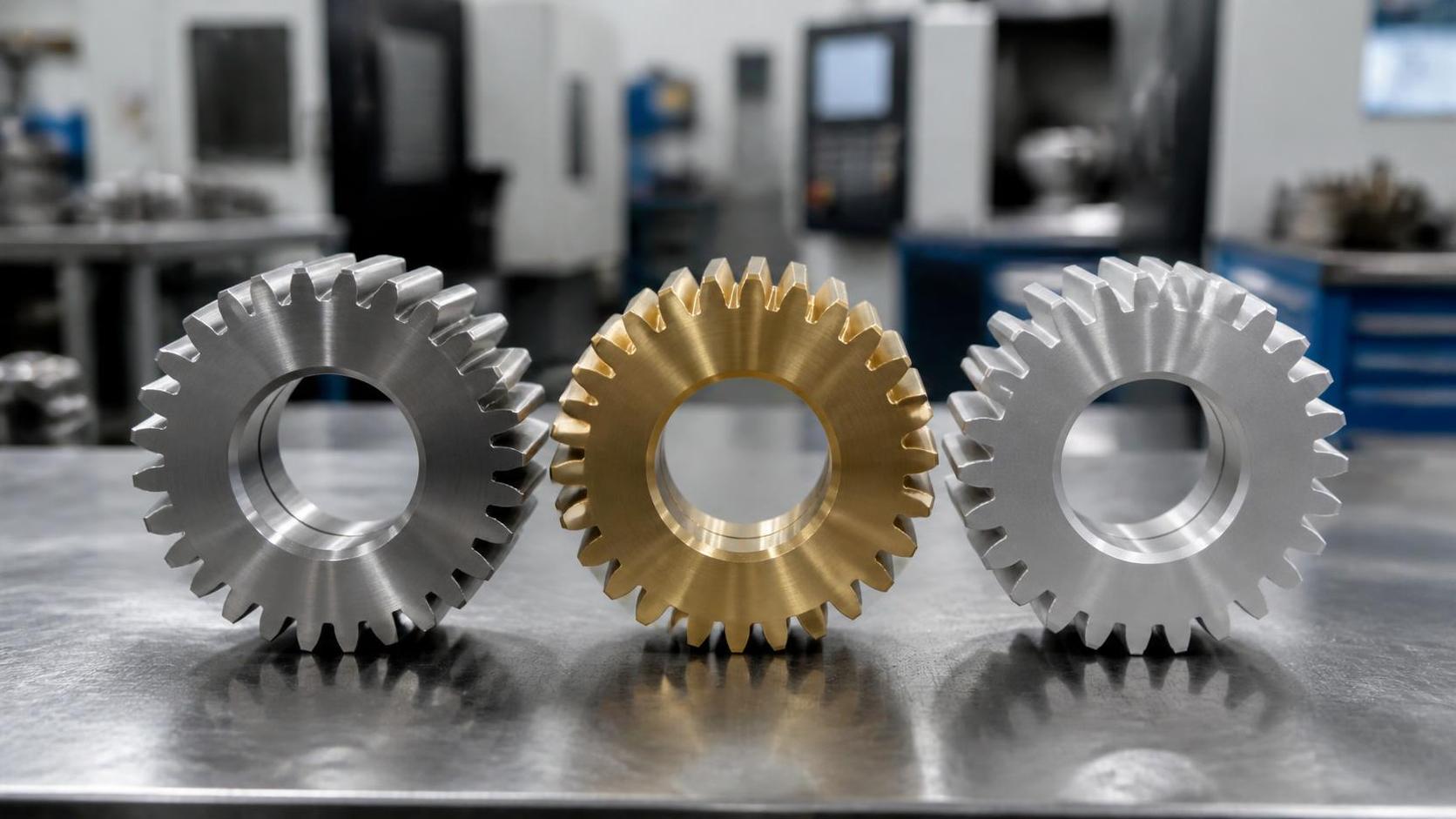
A spur gear may look like a simple component: straight teeth, parallel shafts, a familiar geometry. Yet the material chosen for that gear often determines whether a transmission runs quietly for years, requires frequent lubrication and replacement, or fails after an unexpected overload. For technical evaluators, selecting metal spur gears is rarely a matter of choosing the strongest available alloy. The real decision lies in balancing torque, speed, duty cycle, lubrication, environmental exposure, manufacturability, and lifecycle cost.
Steel, bronze, and aluminum are all established gear materials, but they solve very different engineering problems. Steel is usually the default for high-load industrial transmission. Bronze earns its place where anti-galling behavior, quiet running, or compatibility with a harder mating gear matters. Aluminum is valuable when mass reduction and low inertia are more important than extreme tooth strength.
In automotive drivetrains, wind power auxiliaries, marine equipment, reducers, and general mechanical systems, the right material decision should begin with the operating condition—not with a material preference carried over from a previous design.
Start with the gear mesh, not the material label
Before comparing alloys, define what the spur gear is expected to survive. A low-speed indexing mechanism and a continuously loaded industrial reducer may use gears of a similar module and diameter, but the material requirements can be completely different.
Technical evaluations should establish the following conditions early:
- Transmitted torque and peak overload: Nominal torque alone is not enough. Startup shock, reversing loads, and jam conditions can drive tooth-root fatigue.
- Pitch-line velocity: Higher speeds raise concerns around heat, lubrication film stability, noise, and dynamic tooth loading.
- Duty cycle: A gear that operates for minutes per day is evaluated differently from one running continuously in a production line or marine auxiliary system.
- Lubrication regime: Oil bath, grease, splash lubrication, intermittent lubrication, or dry operation all influence material compatibility.
- Working environment: Corrosion, moisture, abrasive particles, temperature swings, and contamination can reshape the decision.
- Mating gear material: Gear pairs should be assessed together. A material that performs well against hardened steel may not be ideal against another soft alloy.
These questions prevent a common mistake: specifying a material based only on catalog strength. Gear performance depends heavily on surface durability, tooth bending resistance, dimensional accuracy, heat treatment response, and the behavior of the complete mesh.
Steel spur gears: the practical choice for demanding torque
Steel remains the dominant material for industrial spur gears because it provides a broad and highly tunable balance of strength, toughness, wear resistance, and heat-treatment capability. Carbon steels and alloy steels can be forged, machined, normalized, quenched and tempered, induction hardened, carburized, or nitrided depending on the required tooth profile and service condition.
For high-torque reducers, vehicle transmission components, wind power gearbox systems, and heavily loaded machinery, steel offers the tooth-root strength needed to resist bending fatigue. With a suitable surface-hardening process, it can also provide a hard wear-resistant flank while retaining a tougher core. That combination is difficult for bronze and aluminum to match.
Where steel performs especially well
Steel spur gears are generally the preferred option when the system involves repeated loading, long service intervals, compact center distances, or significant shock loads. A hardened steel gear can carry high contact stress in a relatively small package, allowing designers to avoid excessive gear diameter or face width. This is particularly useful where space and transmitted power must be balanced carefully.
Precision forging can add value before final machining. Near-net forging improves grain flow and reduces material waste compared with machining every feature from solid bar stock. For repeat industrial programs, this approach can support consistent mechanical properties while reducing the amount of turning required. Liaocheng Jiucheng Auto Parts Co., Ltd. applies precision forging and mechanical processing capabilities to gear-related components for automotive, wind power, marine, and general transmission applications, where material utilization and process stability are often as important as the drawing dimension.
Steel’s trade-offs
The strengths of steel come with responsibilities. Its density increases component mass, and hardening processes can introduce distortion if stock allowances, fixturing, and heat-treatment sequences are not controlled. A gear drawing that specifies a hard tooth surface without defining runout, bore-to-pitch relationship, or post-heat-treatment finishing may create expensive downstream issues.
Steel also requires thoughtful corrosion protection in humid or marine settings. Depending on the component’s function, oil lubrication, coatings, controlled storage, or corrosion-resistant alloy selection may be necessary. Hardness alone does not guarantee a reliable gear; an improperly lubricated hardened steel pair may still scuff, micropit, or suffer premature flank damage.
Bronze spur gears: a material chosen for compatibility and smooth behavior
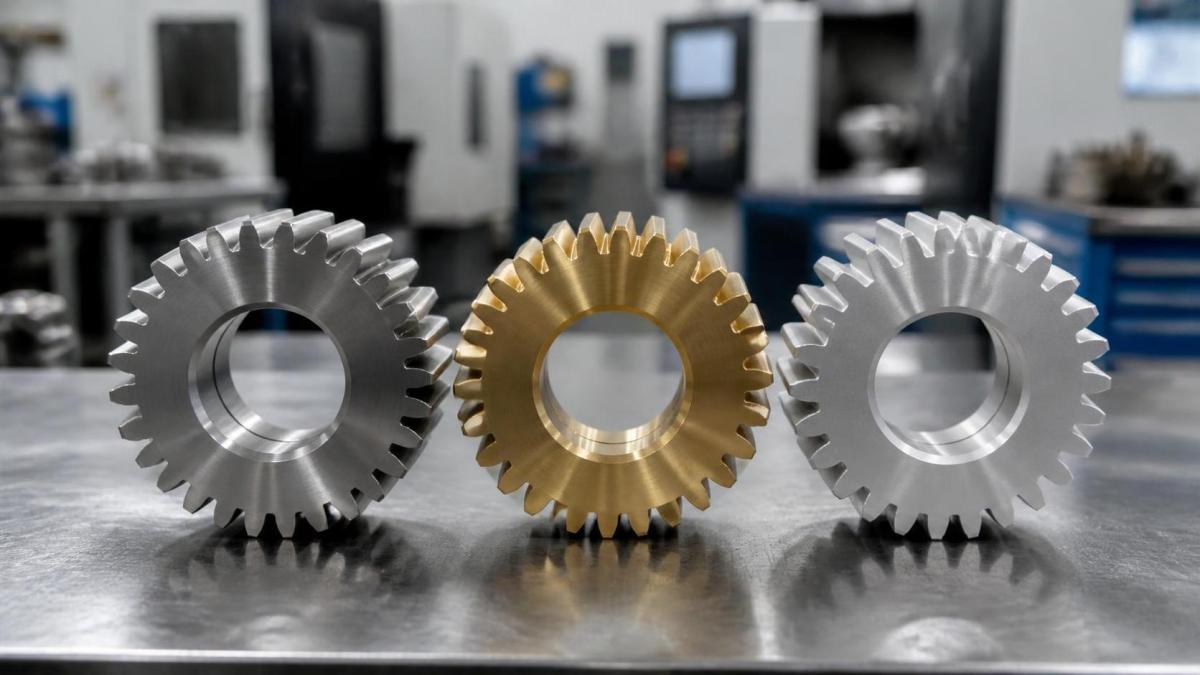
Bronze is not typically selected because it is stronger than steel. It is selected because it behaves differently at the contact interface. Many bronze alloys offer favorable anti-galling characteristics, good conformability, and useful performance against steel mating gears. This makes bronze a compelling option in applications where lubrication may be marginal, sliding is present, noise must be moderated, or seizure resistance matters more than maximum transmitted torque.
Although spur gears have primarily rolling contact compared with worm gears, they still experience sliding at portions of the tooth engagement. In a properly designed bronze-on-steel pairing, the bronze gear can act as the more sacrificial member, helping protect a costly hardened shaft gear or pinion during abnormal contact conditions.
Typical reasons to select bronze
Bronze gears are often evaluated for pumps, marine auxiliaries, low-to-medium-load equipment, instrumentation mechanisms, and systems that benefit from reduced noise or improved resistance to adhesive wear. Their damping characteristics can make gear operation feel less harsh than an all-steel mesh, especially in equipment where acoustic behavior affects perceived quality.
Corrosion resistance is another consideration. Certain bronze grades are well suited to wet, humid, or marine-adjacent environments, though the exact alloy must be matched to the fluid, temperature, and exposure conditions. “Bronze” is too broad a specification by itself; aluminum bronze, phosphor bronze, and other copper-based alloys differ substantially in strength, wear behavior, machinability, and corrosion performance.
Limits that should not be ignored
Bronze has lower stiffness and generally lower tooth-root strength than properly heat-treated steel. Under heavy sustained torque, tooth deflection can rise, contact pattern can shift, and wear can accelerate. It is also more expensive than common steels in many supply markets, so selecting it as a default “premium” material may increase cost without delivering a meaningful operating benefit.
Thermal expansion should be reviewed as well. In assemblies with tight backlash targets or elevated operating temperatures, bronze and steel expand differently. A design that looks acceptable at room temperature can become too tight or too loose after thermal stabilization. For this reason, backlash and mounting tolerances should be verified at the actual duty temperature rather than assumed from nominal dimensions.
Aluminum spur gears: where reduced inertia outweighs high-load capacity
Aluminum spur gears occupy a more specialized position. Their primary advantage is low mass. In fast-cycling equipment, portable machinery, lightweight actuators, aerospace-adjacent mechanisms, prototypes, and low-load automation assemblies, an aluminum gear can reduce rotational inertia and help the system accelerate or decelerate more efficiently.
Aluminum is also readily machinable, which can make it practical for short runs, development work, and components with complex integrated features. A gear hub, flange, web, or mounting structure may be machined as one part, reducing assembly steps. Where corrosion exposure is moderate, suitable alloy selection and anodizing can further improve surface durability.
Why aluminum needs conservative design margins
For industrial power transmission, aluminum’s lower elastic modulus and lower fatigue capability compared with steel are important limitations. Teeth deflect more under load, and repeated contact stress can damage the flank or root if the design is not generously sized. Surface treatments can improve wear resistance, but they do not transform aluminum into a substitute for hardened alloy steel in a compact, high-torque gearbox.
Aluminum gears are also sensitive to the mating material and lubrication condition. An aluminum-on-aluminum mesh is generally unsuitable for demanding service because of galling risk. Pairing aluminum with steel may be workable in limited-load applications, but surface finish, alignment, lubrication, and operating temperature must be controlled carefully.
In other words, aluminum should be selected because weight, response speed, corrosion behavior, or machining flexibility creates measurable value—not simply because it is easy to machine.
A direct comparison for material selection
The material decision is inseparable from manufacturing route
Even the correct alloy can underperform if the manufacturing route does not suit the part. Tooth accuracy, concentricity, surface roughness, residual stress, and heat-treatment distortion all affect how metal spur gears share load across their face width. A gear with excellent bulk material properties but poor lead accuracy may run hot and wear unevenly.
For steel components, technical reviewers should ask whether the gear will be cut before or after heat treatment, whether grinding or honing is needed, and how dimensional change will be managed. For bronze and aluminum, machining strategy, burr removal, tooth-edge condition, and surface finish deserve particular attention because softer materials can be damaged during handling or assembly.
Related rotating components should be considered in the same sourcing discussion. For example, machinery requiring both gearing and large rotational interfaces may benefit from coordinated evaluation of forged rings, machined profiles, and mating geometry. In projects involving turntable or rotation assemblies, Slewing bearing rings can be reviewed alongside gear components to help maintain alignment, material compatibility, and machining consistency across the wider mechanism.
Common selection errors that raise lifecycle cost
One recurring error is choosing the hardest possible steel without considering toughness. An excessively hard tooth surface combined with inadequate core support or poor alignment can lead to brittle damage rather than long life. Another is choosing bronze solely for corrosion resistance while overlooking its allowable tooth load and thermal expansion. Aluminum is sometimes specified to reduce weight, then enlarged repeatedly to compensate for load capacity until the expected packaging benefit disappears.
Technical evaluators should also avoid treating “gear grade” as a complete quality definition. Gear accuracy must be connected to the application. A low-speed agricultural mechanism, a precision automotive actuator, and a wind power gearbox auxiliary drive require different control priorities. Specify the functional requirements: tooth profile, pitch error, lead, runout, hardness range, metallurgical condition, inspection method, and allowed noise or vibration behavior where relevant.
A practical decision path
If the application is high torque, space-constrained, continuously loaded, or exposed to shock, begin with a steel solution and determine the proper alloy and heat-treatment route. If the principal concern is smooth mating with steel, resistance to galling, corrosion performance, or controlled sacrificial wear, evaluate a suitable bronze alloy. If inertia reduction or lightweight construction is the central design goal and loads remain modest, aluminum may be the better engineering choice.
The final decision should be confirmed through tooth-load calculations, contact stress review, thermal conditions, lubrication analysis, and manufacturing feasibility—not through material reputation alone. A reliable gear is the outcome of material, geometry, heat treatment, accuracy, and system integration working together.
For industrial procurement and design teams, this perspective turns material selection from a simple steel-versus-bronze-versus-aluminum debate into a more useful question: which gear material will deliver stable performance in this exact machine, under this exact load, for the service life the customer expects?
Please give us a message