



Related Posts
Online Message
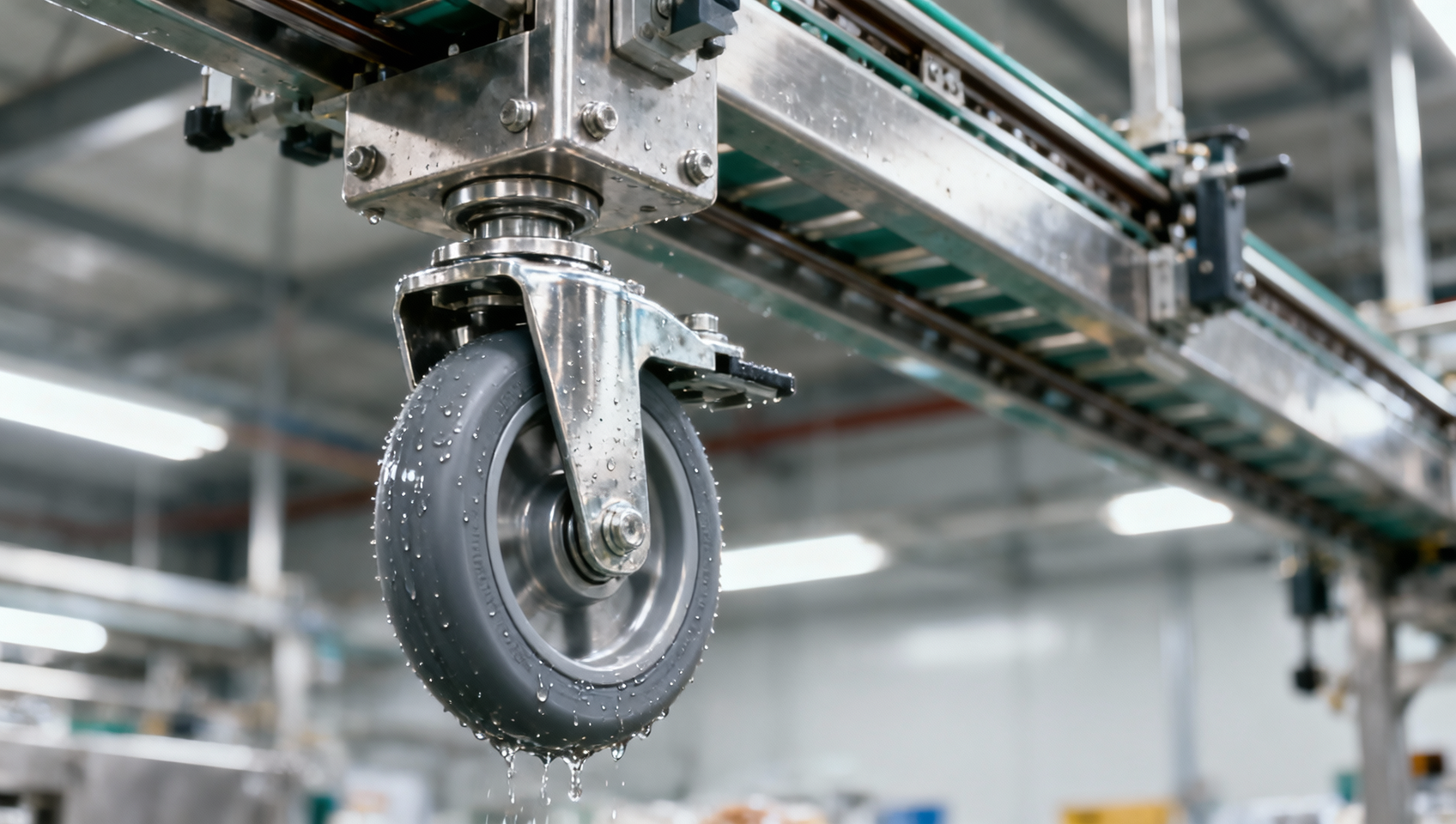
IP67-rated trolley wheels: a hygiene safeguard—or a spec that overshoots reality?
If you’ve just inherited a brownfield upgrade for a meat-packing line or a new dairy filler conveyor system, you’ve likely seen IP67 stamped on half a dozen trolley wheel datasheets. It sounds definitive—“dust-tight, protected against immersion up to 1 m for 30 minutes.” But in practice? That rating doesn’t automatically translate to “right for your washdown zone.” Not all washdowns are equal. Not all overhead conveyors face the same exposure. And not all IP67 wheels deliver what their label promises—especially when mounted on aging carrier tracks or subjected to thermal cycling from steam + cold water alternation.
What’s really happening in your washdown zone?
Start with cleaning frequency and method—not just regulatory box-ticking. A USDA-inspected ready-to-eat poultry facility may run full CIP cycles three times per shift, using 85°C alkaline solution at 4–6 bar pressure, followed by acidic rinse and chlorine-based sanitizer. That’s fundamentally different from a dry-bakery ingredient transfer line where operators use handheld low-pressure sprayers once per day. In the first case, IP67 isn’t overkill—it’s baseline resilience. In the second? You’re paying for protection you won’t stress.
Also consider mechanical exposure. Overhead conveyor trolley wheels don’t just sit in water—they roll. They absorb shock from product loading, track misalignment, and thermal expansion of support structures. A sealed IP67 housing means no grease ports. If the bearing isn’t pre-lubricated for life (and many aren’t), or if the seal lip degrades under repeated thermal shock, contamination enters *from the inside out*. We’ve seen cases where IP67 units failed faster than IP54 equivalents—not because of ingress, but because trapped moisture accelerated internal corrosion once the seal micro-fractured.
The gap between rating and real-world mounting
Here’s what datasheets rarely show: IP67 is tested on standalone components, under lab conditions—no vibration, no side-load torque, no track debris, no 12-hour temperature swings from 5°C ambient to 90°C steam bursts. Mounting matters more than the rating itself. A poorly aligned hanger bracket can compress or shear the seal lip. A corroded track flange introduces grit that abrades the housing seam. And if the wheel assembly isn’t fully isolated from the trolley frame—say, via conductive elastomers—the ground path for stray current (common in high-humidity zones with variable-frequency drives) can accelerate electrochemical degradation of aluminum housings.
That’s why some Tier-1 food equipment integrators now specify *IP67-rated assemblies*, not just wheels. The difference? Sealed axle interfaces, integrated drain paths, and validated mounting hardware—none of which appear in a component-level IP test.
When IP67 makes sense—and when it doesn’t
Three practical thresholds help narrow the decision:
- High-frequency, high-pressure zones: Where >2 full wash cycles occur daily, with hot caustic + high-pressure rinse, IP67 is justified—even expected by auditors like BRCGS or SQF. But verify the entire assembly—not just the wheel—is rated.
- Mixed-material lines: Facilities handling both raw protein and dry ingredients often use shared overhead conveyors. Here, IP67 prevents cross-contamination risk during changeovers—but only if the wheel design avoids crevices where organic residue can accumulate beneath seals.
- Legacy track compatibility: If retrofitting onto existing monorail or I-beam systems, confirm whether IP67 wheels increase rolling resistance or require track modifications. Some sealed designs add 15–20% rotational inertia. On long, high-speed lines, that impacts motor sizing and energy use—something our team sees regularly when optimizing automated production lines for clients like wind power gearbox manufacturers.
Conversely, avoid IP67 if your process uses only ambient-temperature potable water rinses, or if maintenance access is severely limited. Replacing a failed sealed unit often requires full trolley disassembly—not just wheel swap. That downtime cost can outweigh any longevity benefit.
Material choice matters as much as sealing
Stainless steel housings? Yes—but grade matters. 304 resists mild cleaners; 316 handles chlorinated sanitizers. And don’t overlook the wheel body itself. Polyurethane treads with hydrolysis-resistant binders last significantly longer in humid, chemically aggressive environments than standard thermoplastic elastomers—even if both carry IP67. We’ve observed PU wheels retaining dimensional stability after 18 months in continuous dairy washdown, while TPE variants showed visible swelling and edge delamination by month 10.
This ties directly to forging integrity. Precision-forged components—like the Forged cylindrical parts we produce for demanding gear applications—offer tighter grain structure and better fatigue resistance than cast or machined alternatives. That’s critical when the wheel hub must withstand repeated torsional loads without micro-crack propagation near sealing interfaces.
A note on verification—not just certification
Don’t assume “IP67-certified” means field-proven. Ask for third-party test reports—not just manufacturer declarations—and check whether testing included thermal cycling (e.g., -20°C to +80°C, 500 cycles) and abrasion simulation. Also request evidence of lubricant compatibility with common food-grade greases (e.g., ISO 12946 Class H1). We’ve seen wheels pass IP67 in air, then leak within weeks when lubricated with calcium-sulfonate thickeners that swell certain nitrile seals.
Finally, talk to operators—not just spec sheets. Do they need quick-release features? Can they visually inspect seal integrity without tools? Is there documented history of wheel-related line stops in your facility? Real-world failure modes rarely match lab test parameters. They match how people actually clean, maintain, and adapt equipment on the floor.
Bottom line: match the spec to the stress, not the standard
IP67-rated overhead conveyor trolley wheels solve a real problem—but only where the problem exists. They’re not universally necessary, nor are they universally sufficient. The smarter move is to map your actual washdown profile: pressure, temperature, chemistry, frequency, and mechanical load. Then evaluate wheel design holistically—sealing, material, lubrication, mounting, and serviceability—not just the IP code on the label.
If your project sits at the intersection of high hygiene demand and high mechanical reliability—like upgrading a ready-to-eat seafood line or integrating a new robotic palletizer into an existing dairy plant—then yes: IP67 is worth the investment. Just make sure it’s part of a coherent system solution, not a standalone checkbox.
Please give us a message