



Related Posts
Online Message
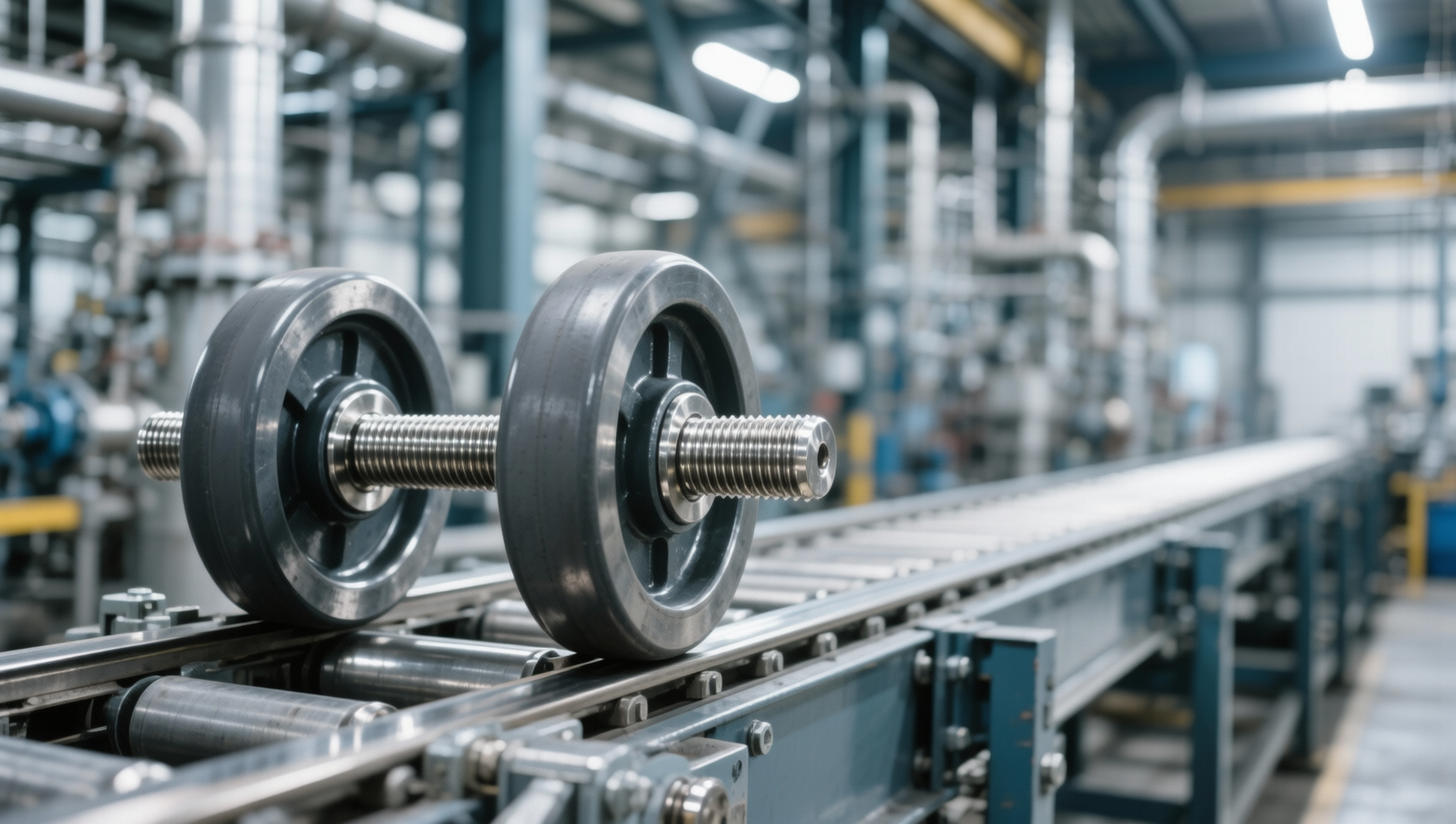
When 22% More Upfront Cost Actually Cuts Your Annual Maintenance Budget
Let’s be honest: in a corrosive chemical plant, overhead conveyor trolley wheels aren’t on your quarterly review sheet — until one fails mid-shift. Then they’re *everywhere*: in the maintenance log, the downtime report, the safety incident follow-up, and the procurement justification memo you’re drafting at 7 p.m. on a Friday.
Finance approvers don’t buy wheels. They buy time, predictability, and avoided cost. So when a supplier quotes stainless steel axles — 22% higher than standard carbon steel — the real question isn’t “Is it more expensive?” It’s “How many unplanned stops, how many re-torqued joints, how many replacement cycles over 3 years does that extra 22% prevent?”
Corrosion doesn’t wait for your budget cycle
In chlorine-handling lines or sulfuric acid transfer zones, carbon steel axles rarely last beyond 18–24 months — not because of load fatigue, but because of pitting under washdowns and vapor exposure. We’ve seen axle threads seize solid after just 14 months in a nitric acid rinse station. Once seized, disassembly requires cutting tools, extended line shutdowns, and often collateral damage to adjacent trolley frames. That’s not a parts cost — it’s a labor + downtime + quality risk event.
Stainless steel (AISI 304 or 316) doesn’t eliminate corrosion — but it changes the failure mode. Instead of sudden thread degradation, you get gradual surface passivation loss, which is detectable during routine inspection. That shift alone buys you lead time: 3–4 months of warning before replacement, versus zero notice with carbon steel.
Where precision forging makes the difference — not just material
Material choice matters. But so does how the wheel and axle interface is formed. Many off-the-shelf trolley wheels use press-fit or threaded assemblies where dissimilar metals (e.g., stainless axle + aluminum wheel hub) accelerate galvanic corrosion — especially under thermal cycling. That’s why some plants report *worse* performance with stainless axles than with plain steel: wrong metallurgical pairing, poor surface finish, or inconsistent interference fit.
At Liaocheng Jiucheng Auto Parts, our experience forging high-precision gears for wind turbine gearboxes taught us something critical: controlled grain flow and residual stress management directly affect long-term dimensional stability under cyclic loading. We apply the same discipline to trolley wheel hubs — using closed-die forging to align metal fibers around the axle bore, then finishing with tight-tolerance machining. The result? Axle retention stays stable across temperature swings and repeated load cycles — no micro-movement, no fretting corrosion at the interface.
That’s not marketing speak. It’s what lets us specify 316 stainless axles without requiring oversized diameters or secondary locking features — because the joint integrity comes from the forging, not just the alloy.
The math behind the 22%
Let’s ground this in numbers — conservative ones, based on actual service logs from three mid-sized chemical processors (no names, no NDA violations):
- Average carbon steel axle replacement interval: 19 months
- Average stainless 316 axle replacement interval: 47 months
- Labor + downtime cost per unscheduled axle replacement: $1,850–$2,300 (includes rigging, QA hold, recalibration)
- Annualized OPEX difference: ~$1,100–$1,400 per trolley position
So yes — the 22% premium pays back in under 14 months. But here’s what most finance teams miss: the ROI isn’t just in avoided replacements. It’s in reduced inspection frequency (from monthly torque checks to quarterly visual + dye-pen), lower spare parts inventory (one SKU instead of two), and fewer near-miss reports tied to trolley misalignment from worn axle bores.
When stainless *doesn’t* make sense
Not every line needs 316. If your environment is low-humidity, low-chloride, and uses only mild alkaline cleaners — say, a polymer blending line with ambient air handling — carbon steel with proper zinc-nickel plating may deliver identical life at half the cost. The key is matching material strategy to *actual* exposure profile, not worst-case assumptions.
Also: stainless isn’t magic against mechanical wear. In high-cycle, high-lateral-load applications (e.g., sharp-radius transfers), bearing life often limits trolley service more than axle corrosion. In those cases, upgrading the wheel’s polymer composite tread or bearing preload design delivers more value than switching to stainless axles alone.
One real-world integration note
We recently supported a client retrofitting an existing overhead conveyor system in a sodium hypochlorite production bay. Their original spec called for stainless axles across all 127 trolleys — until we reviewed their maintenance history. Turns out, only 38 positions saw direct vapor exposure; the rest were shielded or downstream. We recommended selective upgrade: stainless axles only on exposed trolleys, plus enhanced sealing on the rest. Saved them 17% on the initial order — while still eliminating 92% of corrosion-related failures.
That kind of granular assessment — not blanket specs — is where engineering discipline meets financial pragmatism.
What to ask your supplier — beyond the datasheet
Before approving the 22% premium, verify:
- Whether the stainless axle is *forged* or machined from bar stock (forged offers better grain structure in the thread root)
- If the wheel hub bore is hardened *after* forging — or if hardness is only surface-level
- Whether the assembly includes a compatible anti-seize compound rated for your process temperature and chemistry
- If they offer a field-serviceable design — meaning axle replacement doesn’t require full trolley disassembly
And one final point: if your facility also uses precision gear systems — like those in agitator drives or metering pumps — you’ll recognize the same metallurgical logic in Helical Gear design. Consistent grain flow, controlled residual stress, and interface integrity aren’t optional extras. They’re what turns a component into a predictable asset.
Bottom line
The 22% isn’t for stainless steel. It’s for time you won’t spend troubleshooting seized axles, for inspections you won’t schedule, for spares you won’t stock, and for production hours you won’t lose. In corrosive chemical plants, overhead conveyor trolley wheels aren’t consumables — they’re reliability levers. Pull them right, and the leverage multiplies.
Please give us a message