



Related Posts
Online Message
What Material Specifications Matter Most When Sourcing Heavy Duty Pipe Track Wheels for Offshore Use?
Time : Sep 25, 2026
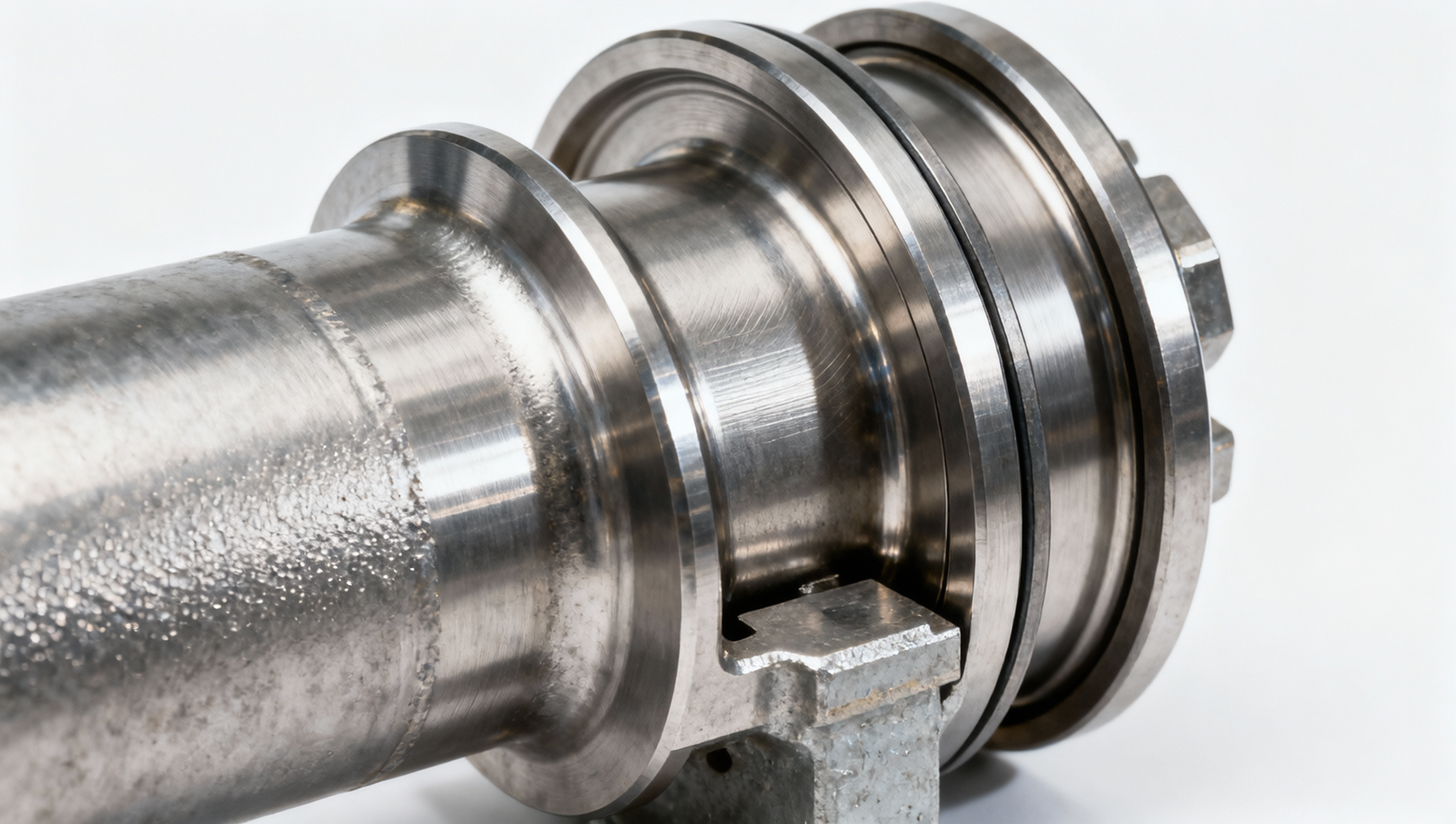
When sourcing heavy duty pipe track wheels for offshore use, procurement teams face a deceptively narrow technical question with outsized operational consequences: *Which material specifications actually drive lifecycle cost—and which ones are just paperwork?* The answer isn’t found in datasheets alone. It’s determined by how material properties interact with three immutable offshore realities: cyclic mechanical loading under salt-laden corrosion stress, limited access for inspection or replacement, and zero tolerance for sudden failure during critical operations.
Material selection isn’t about maximizing tensile strength or hardness on paper. It’s about matching metallurgical behavior to functional failure modes—specifically fatigue cracking, pitting corrosion, and stress corrosion cracking (SCC). These dominate wheel failure in offshore environments far more than static overload. A wheel rated for 50 tons in air may fracture after 12,000 cycles in seawater spray—not because it was underspecified for load, but because its microstructure and surface condition were mismatched to the electrochemical environment.
**Yield strength matters—but only if it’s sustained after welding and heat treatment.** Many suppliers quote high-yield alloys like ASTM A514 or quenched-and-tempered 4140, yet fail to disclose whether the final forged wheel retains that strength post-machining and stress-relieving. Offshore applications demand yield retention across the entire cross-section—not just in the as-received billet. Precision forging, as practiced by manufacturers with ISO-certified thermal process control, minimizes grain distortion and residual stress, preserving mechanical integrity where it counts: at the root of the wheel flange and along the contact arc with the pipe track. This directly reduces risk of subsurface crack initiation—a leading cause of unanticipated wheel drop in crane gantries and subsea handling systems.
**Corrosion resistance isn’t about chromium content alone—it’s about passive film stability under dynamic loading.** Stainless steels like 316L are common, but their performance collapses when crevice corrosion initiates in bolt holes or between wheel and axle interface. For offshore pipe track wheels, duplex stainless steels (e.g., UNS S32205/S32206) deliver superior resistance—not because they’re “more stainless,” but because their balanced ferrite-austenite microstructure inhibits chloride-induced pitting at stressed interfaces. Crucially, this benefit is only realized when the material is solution-annealed and pickled *after* final machining, not before. Suppliers who perform final heat treatment pre-machining introduce microstructural inconsistencies that accelerate localized attack. Procurement teams must verify post-finish certification—not just mill test reports.
**Fatigue endurance is non-negotiable—and it’s dictated by surface integrity, not bulk composition.** Surface finish, residual stress profile, and inclusion content govern fatigue life more than ultimate tensile strength. Wheels subjected to repeated pipe impact and lateral tracking loads fail most often at surface discontinuities: machining marks, grinding burns, or embedded abrasive particles from shot blasting. ISO 1127 specifies maximum surface roughness (Ra ≤ 0.8 µm) for critical rotating components—but compliance requires traceable metrology, not just a shop-floor claim. Suppliers using precision CNC turning followed by superfinishing—not just polishing—deliver repeatable surface integrity. More importantly, they control inclusion morphology through vacuum-remelted or electro-slag refined (ESR) billets. Standard ASTM A276 bars won’t suffice; offshore-grade wheels require ASTM A959-compliant compositional control and ASTM E45 inclusion rating ≤ 1.0 (fine series).
**Certification isn’t documentation—it’s evidence of process discipline.** DNV-OS-F101 and API RP 2A-WSD don’t certify materials; they certify *how* those materials were processed, inspected, and verified. A DNV-certified wheel must demonstrate full traceability from ingot heat number through forging, heat treatment, NDT, and final dimensional check—with all records retained for 20 years. Procurement teams should audit supplier quality manuals for clause-by-clause alignment with DNV SE-0001, not just accept a “DNV-approved” label. Where welds exist (e.g., in multi-piece hub assemblies), ASME IX weld procedure specifications must be validated for the exact base/filler metal combination used—not generic approvals.
**Cost misalignment starts early—and compounds over time.** A wheel priced 18% lower than a certified alternative may appear economical—until you factor in offshore downtime. Replacing a failed wheel on a jack-up rig costs $12,000–$25,000 per hour in lost operation time, plus mobilization fees for specialized lifting gear. One premature failure can erase five years of procurement savings. Lifecycle cost analysis must include:
- Inspection frequency (NDT every 6 months vs. 24 months);
- Predicted replacement interval (8 vs. 15 years);
- Spare inventory holding cost (single-source vs. multi-vendor compatibility);
- Warranty enforceability (on-site failure investigation rights vs. “as-is” clauses).
Precision-forged solutions—like those engineered for marine gear applications—reduce lifecycle cost not by cutting corners, but by eliminating process variability. Forged microstructures eliminate centerline porosity common in cast equivalents, raising fatigue threshold by 30–40%. Higher material utilization (50% better than traditional machining) lowers raw material waste—but more critically, it ensures consistent grain flow alignment with principal stress vectors. That consistency translates directly into predictable service life, not statistical averages.
 The decision isn’t between “standard” and “premium” steel—it’s between *predictable performance* and *managed risk*. Offshore operators don’t pay for material grade; they pay for confidence that a wheel will survive 20,000 load cycles without inspection-triggered removal. That confidence comes from verifiable process control—not brochure claims. When evaluating suppliers, prioritize auditable evidence over certifications: ask for batch-specific Charpy impact test results at –40°C (not room temperature), inclusion maps from SEM-EDS analysis, and ultrasonic C-scan records showing volumetric soundness across the full wheel section.
One final point often overlooked: material specification interacts directly with geometry. A wheel designed for high radial load but thin flange section demands higher fracture toughness than one with deep, load-distributing geometry. The same alloy behaves differently depending on section thickness and fillet radii. Procurement teams should insist on FEA-supported material selection—not just catalog matching. A Spur gear used in marine winch drives faces similar metallurgical constraints; its material validation process reveals how tightly coupled design, processing, and specification truly are.
Ultimately, the most critical material specification isn’t listed in any standard: it’s the supplier’s ability to prove, for each delivered unit, that every variable—from furnace atmosphere during tempering to coolant pH during grinding—was controlled, measured, and recorded. In offshore procurement, that traceability isn’t overhead. It’s the only thing standing between acceptable cost and unacceptable consequence.
Previous page:Already the first
Next page:Already the last
Please give us a message
Liaocheng Jiucheng Auto Parts Co., Ltd.
Phone : +86 18596356103
WhatsApp : +86 18596356103
WeChat : +86 18596356103