



Related Posts
Online Message
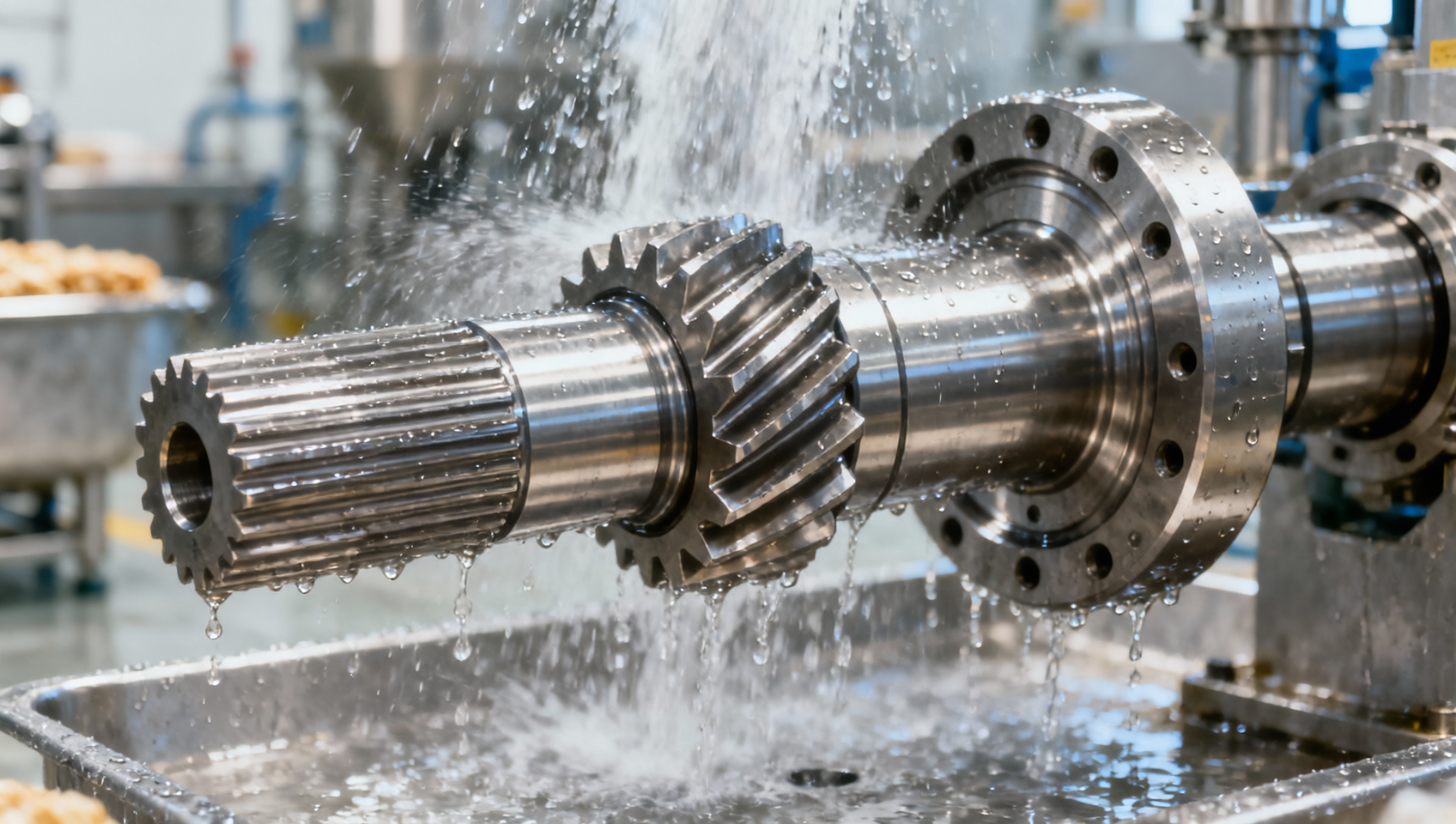
A stainless steel spline shaft is needed when water or process fluids can reach the spline teeth, shaft shoulders, seal land, or mating hub often enough to create corrosion before the drivetrain's planned service interval. This includes direct washdown, splash zones, standing water, condensation inside enclosed equipment, salt-laden air, coolant leakage, and intermittent immersion. The decision becomes stronger when the shaft must still transmit torque accurately after repeated wet-dry cycles, rather than merely survive occasional exposure.
A coated carbon-steel shaft can be acceptable in a dry enclosure with only brief accidental moisture. It becomes a poor fit when coating damage, trapped moisture, or fretting at the tooth flanks exposes bare steel. Splines are particularly sensitive because the contact surfaces are narrow, loaded, and difficult to protect after assembly. Corrosion products consume clearance, disturb sliding motion, and can turn an intended clearance fit into a binding connection. Once the joint begins to fret, oxide debris accelerates wear at both the shaft and hub.
Conditions that justify stainless steel
Stainless steel is justified when the wet environment is persistent or when maintenance access makes surface renewal impractical. A shaft inside a washdown conveyor drive, marine auxiliary mechanism, food-processing attachment, outdoor actuator, pump coupling, or equipment exposed to road spray faces a different duty from a shaft in a climate-controlled gearbox. The relevant question is not whether water is present somewhere nearby. It is whether moisture can remain at the spline interface long enough to disrupt lubrication, initiate pitting, or corrode an unloaded portion that later enters the hub during axial movement.
Salt exposure deserves separate treatment. Chloride-bearing water attacks many stainless alloys more aggressively than clean fresh water, especially where deposits dry on the surface and concentrate salts. A standard corrosion-resistant material selected only for indoor humidity may stain, pit, or develop crevice corrosion in marine spray or de-icing salt conditions. The spline root, the transition between shaft and shoulder, and the contact area beneath a retaining component are common locations for this type of damage because moisture is retained there.
Frequent cleaning changes the requirement as well. High-pressure washing can force liquid past seals and into interfaces that appear protected during normal operation. Detergents, alkaline cleaning agents, acidic residues, and elevated wash temperatures may alter the corrosion mechanism. A material decision should therefore be based on the actual fluid, its concentration, temperature, contact duration, and rinse cycle, rather than on the broad description of a “wet environment.”
Corrosion resistance alone does not select the shaft
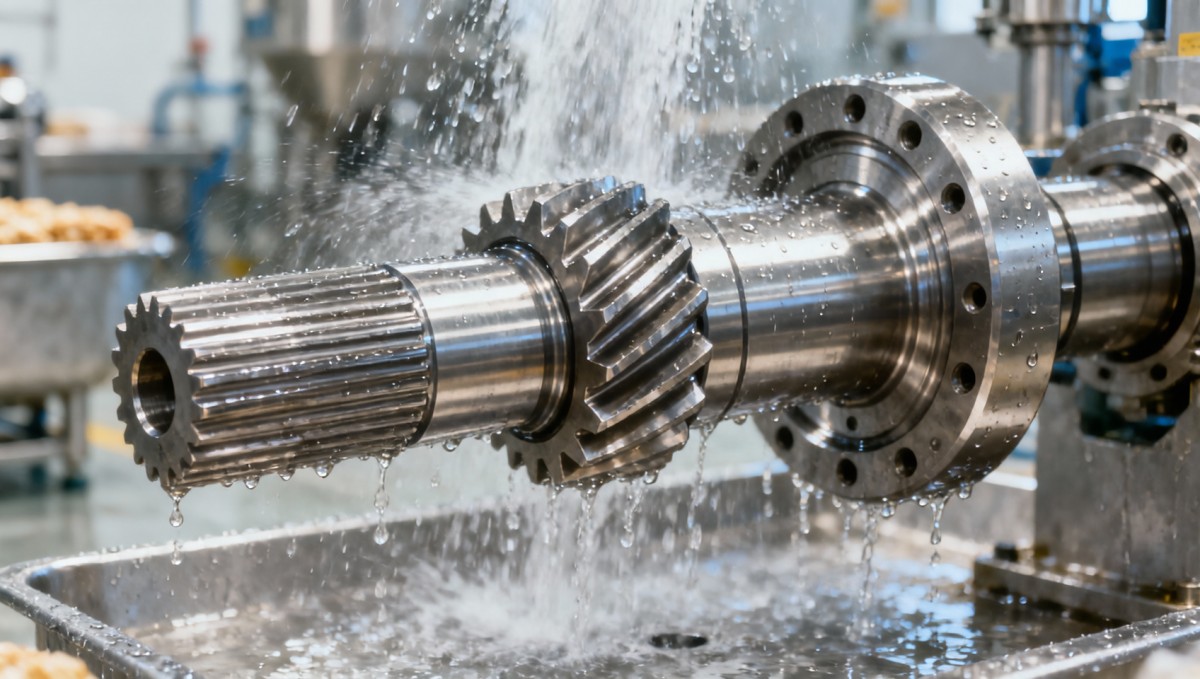
A stainless steel spline shaft still has to meet torsional strength, tooth-contact stress, fatigue resistance, and dimensional stability requirements. Some corrosion-resistant grades machine well but do not provide sufficient surface hardness for heavily loaded splines. Others can be strengthened by heat treatment yet require careful control of distortion, especially when the spline pitch diameter and flank geometry have tight limits. Selecting the most corrosion-resistant alloy without considering the torque path can produce a shaft that resists staining but wears prematurely.
For moderate load and fresh-water exposure, an austenitic stainless material is often considered because of its general corrosion resistance. Its limitation is relatively low hardness unless a separate surface treatment or work-hardening effect is available. Martensitic or precipitation-hardening stainless grades are more suitable where spline teeth need higher strength and wear resistance, provided the selected grade has adequate corrosion behavior for the actual fluid. In chloride-rich service, material selection must account for pitting and crevice-corrosion resistance as well as attainable mechanical properties.
The mating component matters equally. A stainless shaft paired with a carbon-steel hub may shift the problem into the hub bore or create corrosion products that contaminate the spline contact. Pairing dissimilar metals in the presence of an electrolyte also raises galvanic-corrosion concerns. Electrical isolation, compatible material selection, drainage, and an appropriate protective lubricant may be required. Specifying only the shaft material leaves the assembly-level failure mechanism unresolved.
Separate surface rust from spline-joint failure
Visible discoloration on an exposed shaft extension does not automatically mean that the spline connection needs stainless steel. Surface staining outside the hub can be cosmetic if it does not reach a seal, bearing seat, or loaded interface. Conversely, a spline may look acceptable externally while corrosion proceeds inside the hub, where condensed water remains trapped. Inspection should focus on tooth flanks, roots, ends of engagement, and the interface near seals or covers.
Several symptoms are often confused:
- Red or brown residue at the spline entrance can indicate external corrosion washing inward, but it can also be fretting debris produced by micro-movement under torque reversal.
- Difficulty sliding the hub during service may result from corrosion growth, damaged tooth flanks, burrs from assembly, or misalignment that loads one side of the spline.
- Polished local areas on otherwise dull teeth often point to uneven contact or insufficient lubrication rather than a material-grade problem.
- Pits near shoulders and under retaining hardware suggest a moisture-retention issue. Changing the shaft alloy without improving drainage can leave the geometry-driven cause in place.
This distinction matters because stainless steel is not a substitute for correct fit. A loose spline can fret in stainless material. A spline that is too tight can gall during assembly, especially where similar stainless alloys slide against each other without suitable lubrication. The specification needs to control both corrosion behavior and the intended contact condition.
Fit, torque, and axial movement
Spline type affects how water exposure should be evaluated. A fixed spline connection that is assembled once and protected inside a sealed housing faces different risks from a sliding spline that moves repeatedly under load. Sliding splines require a surface condition that supports motion without adhesive wear, while their lubricant must remain effective in the presence of water. Water-displacing grease may protect a lightly loaded interface, but it can be displaced by pressure washing or diluted by certain process fluids. The shaft design should provide a realistic path for relubrication or use sealing features where service access is limited.
Torque capacity should be calculated from the effective tooth engagement, tooth geometry, load distribution, allowable contact pressure, and torsional stress in the shaft core. Wet service can reduce usable capacity indirectly. Corrosion pits create stress raisers at the spline root, lubrication loss raises flank friction, and debris prevents uniform engagement. A shaft that is adequate in a clean dry test may have reduced fatigue margin after repeated corrosion and vibration cycles.
Axial movement creates an additional concern. If the hub travels over an exposed shaft section, every stroke can carry moisture and abrasive contamination into the spline. In that case, the exposed travel zone needs the same attention as the engaged teeth. A protective boot, scraper, shield, or revised drainage path can reduce contamination substantially. Stainless steel is appropriate when those controls cannot reliably prevent wet contact, but it should be specified as part of the whole motion system.
Surface finish and manufacturing details
Machining quality affects corrosion performance because rough tooth flanks and torn material retain contaminants and make protective films less stable. Burrs at the spline edges can damage seals, scrape lubricant from the mating hub, and create local corrosion initiation points. After milling, broaching, rolling, grinding, or other spline-forming operations, tooth geometry and surface condition should be assessed together. A dimensionally correct spline with sharp raised edges is not ready for wet service.
Passivation or another suitable post-machining cleaning process is often considered for stainless components after machining and handling. The purpose is to remove surface contamination that could compromise corrosion resistance. It does not repair deep tool marks, incorrect alloy selection, embedded abrasive particles, or heat-tint conditions left by uncontrolled thermal operations. Any finishing process must preserve the specified spline dimensions and avoid rounding the tooth profile beyond its functional tolerance.
Where wear is severe, a hardened surface may be required. The process must be compatible with the selected stainless grade and should be evaluated for distortion, brittle layers, altered fatigue behavior, and the resulting flank finish. Hardness alone is not a complete answer: a very hard surface with poor toughness or a poor mating fit can crack or spall under cyclic load. For finely controlled drivetrain assemblies, tooth profile inspection after final heat treatment or surface treatment is more meaningful than relying on pre-treatment measurements.
Details that should appear on the drawing
A useful specification describes the environment and function instead of stating only “stainless steel.” The material grade or approved grade family should be identified alongside required mechanical condition. The drawing should define spline standard or tooth form, major and minor diameters, fit class, effective engagement length, runout limits relative to bearing or seal journals, and allowable surface defects in fatigue-sensitive areas.
Wet-service information belongs in the same technical package: fluid type, salt exposure, operating temperature range, washdown method, expected immersion or splash location, lubricant type, sealing arrangement, and whether axial sliding occurs. These details influence the alloy, surface treatment, finish, and inspection method. A corrosion requirement without the fluid description leaves too much room for an unsuitable material choice.
For a shaft integrated with forged drivetrain components, datum strategy should be established before final machining. Forging allowance, grain-flow orientation where applicable, and machining stock around splines and bearing seats influence concentricity and fatigue performance. Related components such as Wheel-type forgings may share load paths or mounting references, so mating geometry should be reviewed before defining shaft runout in isolation.
Assembly controls often decide field performance
Cleanliness during assembly is especially important for close-fitting stainless splines. Chips, dried machining coolant, steel particles from nearby work, and abrasive dust can become trapped in the tooth contact. Such contamination can score the flanks during first movement and hold moisture against the metal. Before assembly, the spline and hub should be cleaned with a process compatible with the intended lubricant and seal materials, then inspected for burrs, dents, and coating fragments.
Use the lubricant specified for the joint rather than applying a general-purpose compound without review. The chosen product needs to address contact pressure, temperature, water resistance, compatibility with elastomers, and the possibility of food, chemical, or marine exposure where relevant. Anti-seize compounds may assist assembly but are not automatically suitable as the operating lubricant for a sliding, torque-transmitting spline.
Installation force is also diagnostic. A hub that requires excessive force can be misaligned, contaminated, dimensionally incorrect, or thermally distorted. Forcing it onto the shaft risks galling and masks the root cause until the joint later seizes. Conversely, a hub that assembles too freely may have insufficient flank contact, encouraging impact and fretting under reversal loads.
When stainless is unnecessary
Stainless steel is not automatically needed for every damp location. A conventional alloy-steel spline shaft with a proven coating or surface treatment can remain suitable when the connection stays inside a well-sealed gearbox, water ingress is controlled, service temperature suits the coating, and the shaft has sufficient maintenance access. This approach may also be preferable when high core strength and deep hardening are the primary requirements and the environment is only mildly humid.
The decision changes when seal failure is expected to be occasional rather than impossible. If leakage or washdown reaches the spline before it can be detected and serviced, corrosion tolerance becomes a functional requirement. In that situation, stainless material, compatible mating materials, controlled finish, and effective drainage provide a more durable basis than relying on an undamaged coating throughout the part's life.
A well-specified stainless steel spline shaft is therefore needed when moisture reaches the actual load-bearing interface and the resulting corrosion, wear, or seizure would compromise torque transfer or serviceability. The strongest specification connects the fluid exposure to the material condition, spline fit, surface treatment, mating hub, sealing arrangement, and maintenance method. Treating those elements as one joint prevents corrosion resistance from becoming an isolated and incomplete requirement.
Please give us a message