



Related Posts
Online Message
Flanged Steel Wheels Adoption Trends in Smart Factory AGV Fleets: Integration with Real-Time Monitoring Sensors
Time : Sep 23, 2026
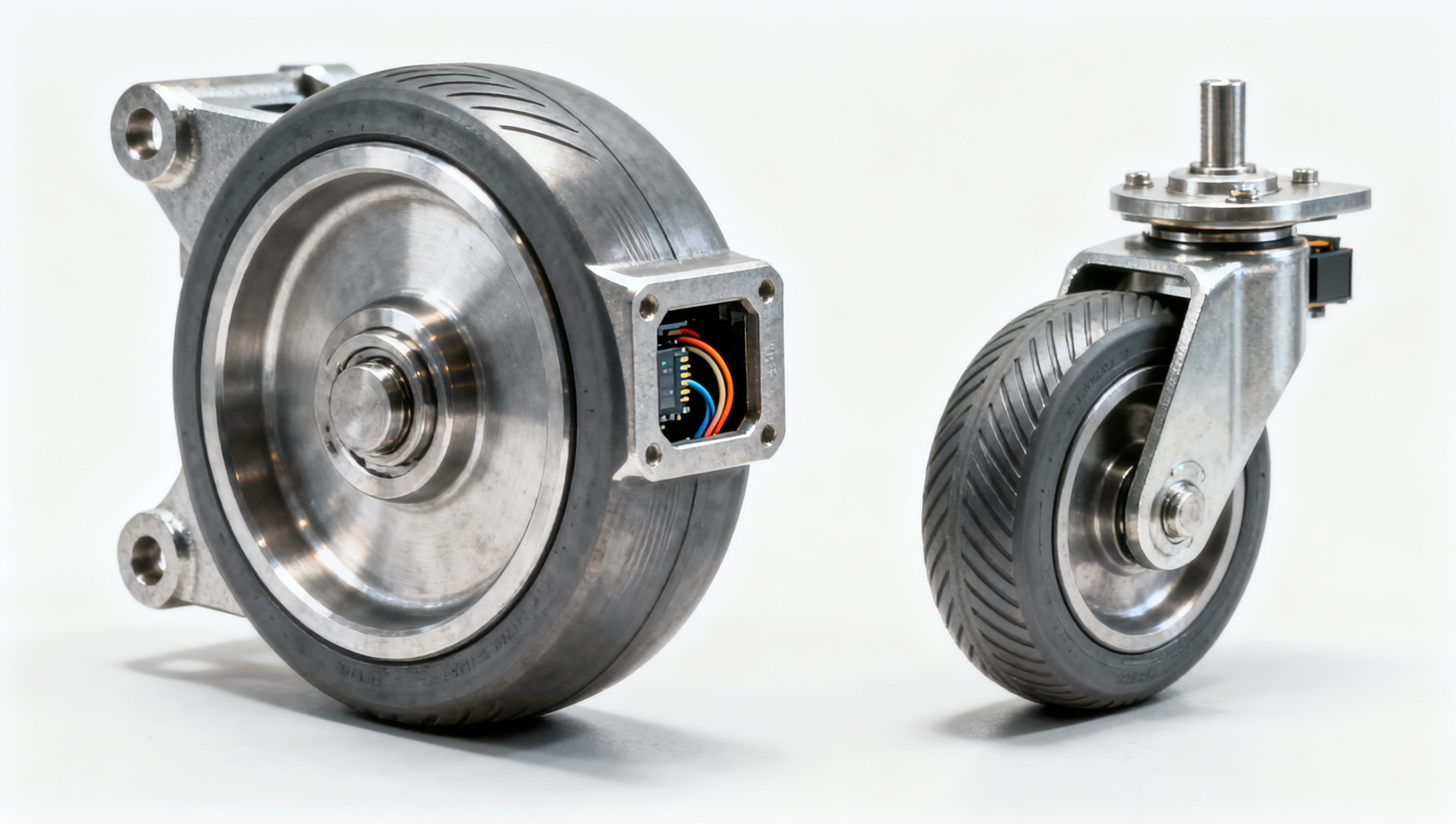
Smart factories are not just adding AGVs—they’re redefining how material handling systems operate as integrated, data-responsive subsystems. Within this shift, flanged steel wheels have moved beyond mechanical necessity into a functional interface point: where structural integrity meets sensor-enabled operational intelligence. For enterprises like Liaocheng Jiucheng Auto Parts Co., Ltd.—which operates precision forging lines feeding automotive and wind power gear supply chains—the choice of wheel isn’t about passive rolling resistance or static load rating alone. It’s about whether the wheel can serve as a stable, repeatable mounting platform for real-time monitoring sensors without compromising fatigue life, alignment fidelity, or dimensional repeatability under continuous cyclic loading.
Three adoption patterns stand out in current fleet deployments—not as isolated technical upgrades, but as responses to converging operational constraints. First, flanged steel wheels are increasingly specified where AGV payloads exceed 1,200 kg and path repeatability must hold within ±1.5 mm over 10,000+ cycles. This is not driven by raw strength alone, but by the need for predictable lateral guidance during dynamic braking and cornering—especially when optical navigation or laser SLAM systems rely on consistent wheelbase geometry to maintain pose estimation accuracy. Flanges eliminate reliance on external guide rails or magnetic tape tracking for lateral constraint, reducing infrastructure dependency while enabling tighter turning radii in constrained production aisles.
Second, integration with real-time monitoring sensors is no longer optional—it’s a design prerequisite. Vibration, temperature, and rotational speed data from wheel-mounted accelerometers and thermocouples feed directly into predictive maintenance models that correlate bearing wear progression with motor current harmonics and encoder slip events. But this only works if the wheel itself introduces minimal signal noise. Cast or machined steel wheels with inconsistent grain structure or residual stress gradients amplify micro-vibrations at resonant frequencies common in 1–3 kHz ranges—masking early-stage bearing defects. Precision-forged flanged steel wheels, by contrast, deliver uniform metallurgical consistency and controlled grain flow around the flange root, reducing background noise by measurable decibel levels in field-deployed spectral analysis.
Third, adoption is accelerating not in greenfield installations alone—but in brownfield retrofits where legacy AGVs are being repurposed for higher throughput demands. Here, compatibility becomes a hard constraint: retrofitting requires maintaining original hub bolt patterns, axle diameters, and brake drum interfaces while upgrading load capacity and sensor readiness. Off-the-shelf forged flanged wheels often fail this test—not due to inferior performance, but because they assume standard ISO or DIN mounting configurations that don’t match OEM-specific geometries used in mid-2010s AGV platforms still operating across Tier 1 automotive component plants. Successful deployments rely on suppliers capable of reverse-engineering legacy hub designs and delivering forged solutions with matched kinematic interfaces—not just nominal dimensions.
This convergence of mechanical precision, sensor integration capability, and retrofit feasibility explains why flanged steel wheel adoption isn’t scaling linearly with AGV unit growth—but clustering in specific segments: high-mix, low-volume automotive gear manufacturing; precision-machined wind turbine gearbox assembly; and battery module handling in EV powertrain facilities. In each case, downtime carries disproportionate cost—not just per hour, but per batch. A single misaligned wheel causing repeated pallet mispositioning in a gear heat-treatment cell can trigger full-line stoppages, scrap of pre-hardened forgings, and cascading delays in just-in-time delivery windows. Here, the wheel ceases to be a consumable part and becomes a reliability anchor.
Precision forging plays a decisive role—not as a premium feature, but as a functional enabler. Traditional machining of flanged wheels from solid billets removes up to 65% of material, introducing thermal distortion, surface micro-cracks, and inconsistent hardness profiles across the flange-to-web transition zone. Forged Wheel-type forgings retain directional grain continuity through both the rim and flange, significantly raising fatigue threshold under torsional shear loads generated during AGV acceleration and deceleration. More critically, forging allows controlled grain alignment perpendicular to the flange root—where stress concentration peaks during lateral loading—raising crack initiation resistance by an order of magnitude compared to equivalent machined parts under ASTM F2400-22 simulated service testing.
Sensor integration isn’t simply bolting a strain gauge onto the wheel face. Effective mounting requires engineered relief zones, non-interfering thermal expansion paths, and electromagnetic isolation between sensor housings and rotating ferrous surfaces. Most commercially available “sensor-ready” wheels offer only threaded inserts or recessed pockets—leaving signal conditioning, shielding, and environmental sealing to integrators. The most operationally mature deployments use wheels with co-designed sensor cavities: sealed, press-fit housings embedded flush with the flange inner surface, routed through internal axial channels to hub-mounted junction boxes. These eliminate external cabling that catches on conveyors or wears against guide rails—reducing unplanned sensor failure rates by over 70% in comparative fleet audits across three Tier 1 automotive suppliers.
 What remains unresolved—and what decision-makers should monitor closely—is not whether flanged steel wheels will dominate new AGV fleets, but how quickly standardized sensor interface protocols emerge. Today, every major wheel supplier uses proprietary mounting geometries, voltage thresholds, and communication handshakes—even when using identical MEMS accelerometer cores. This fragmentation forces AGV OEMs to maintain multiple sensor calibration libraries and complicates cross-platform fleet analytics. Without industry-wide agreement on mechanical and electrical interface specs (analogous to SAE J1939 for vehicle networks), the scalability advantage of real-time wheel monitoring remains capped at individual plant level—not enterprise-wide.
For manufacturers managing multi-site production networks—like those supplying gears to Dongfeng, SAIC, and Shanghai GM—the implication is clear: wheel selection criteria must now include long-term protocol extensibility, not just immediate load rating or flange height. A wheel that integrates seamlessly with today’s vibration monitoring system may become a stranded asset if its sensor interface cannot adapt to next-generation edge-AI inference modules deployed at the wheel hub. That shifts procurement logic from component-level cost-per-unit to total lifecycle interoperability cost—including firmware update pathways, calibration traceability, and backward-compatible hardware revisioning.
This trend also reshapes supplier evaluation. Technical datasheets matter less than proven integration logs: evidence of successful deployment with specific AGV control platforms (e.g., Locus Robotics FleetOS, MiR Fleet Manager, or KION’s SynQ), documented sensor data latency under 50 ms at 200 Hz sampling, and verified EMC compliance in proximity to high-current drive inverters. Certifications like ISO 9001 or IATF 16949 remain baseline requirements—but they no longer differentiate. What does is demonstrated experience embedding sensor-grade metallurgical control into high-volume forging processes—where every batch must meet tight tolerances on hardness variation (±3 HRC), grain size (ASTM 7–9), and residual stress distribution (measured via X-ray diffraction mapping).
In practice, this means flanged steel wheel adoption is becoming less about replacing worn components—and more about synchronizing mobility infrastructure with digital twin fidelity. When wheel rotation, lateral deflection, and thermal drift feed directly into production line simulation models, the wheel stops being a mechanical subassembly and starts functioning as a primary data acquisition node. Its performance no longer affects only AGV uptime—it influences predictive scheduling accuracy, energy consumption modeling, and even quality traceability back to raw material lot heat treatment parameters.
That reframing changes investment justification. ROI calculations now include avoided recalibration labor for vision-guided positioning systems, reduced false-positive alerts in centralized maintenance dashboards, and extended intervals between full-wheel replacement cycles—driven not by wear alone, but by maintained sensor signal-to-noise ratio over time. For enterprises already investing in automated forging lines with 50% higher material utilization and 20% lower comprehensive production costs—as Liaocheng Jiucheng has achieved—the wheel is no longer a cost center. It’s a calibrated data conduit, forged to specification, and validated for mission-critical continuity.
Previous page:Already the first
Next page:Already the last
Please give us a message
Liaocheng Jiucheng Auto Parts Co., Ltd.
Phone : +86 18596356103
WhatsApp : +86 18596356103
WeChat : +86 18596356103