



Related Posts
Online Message
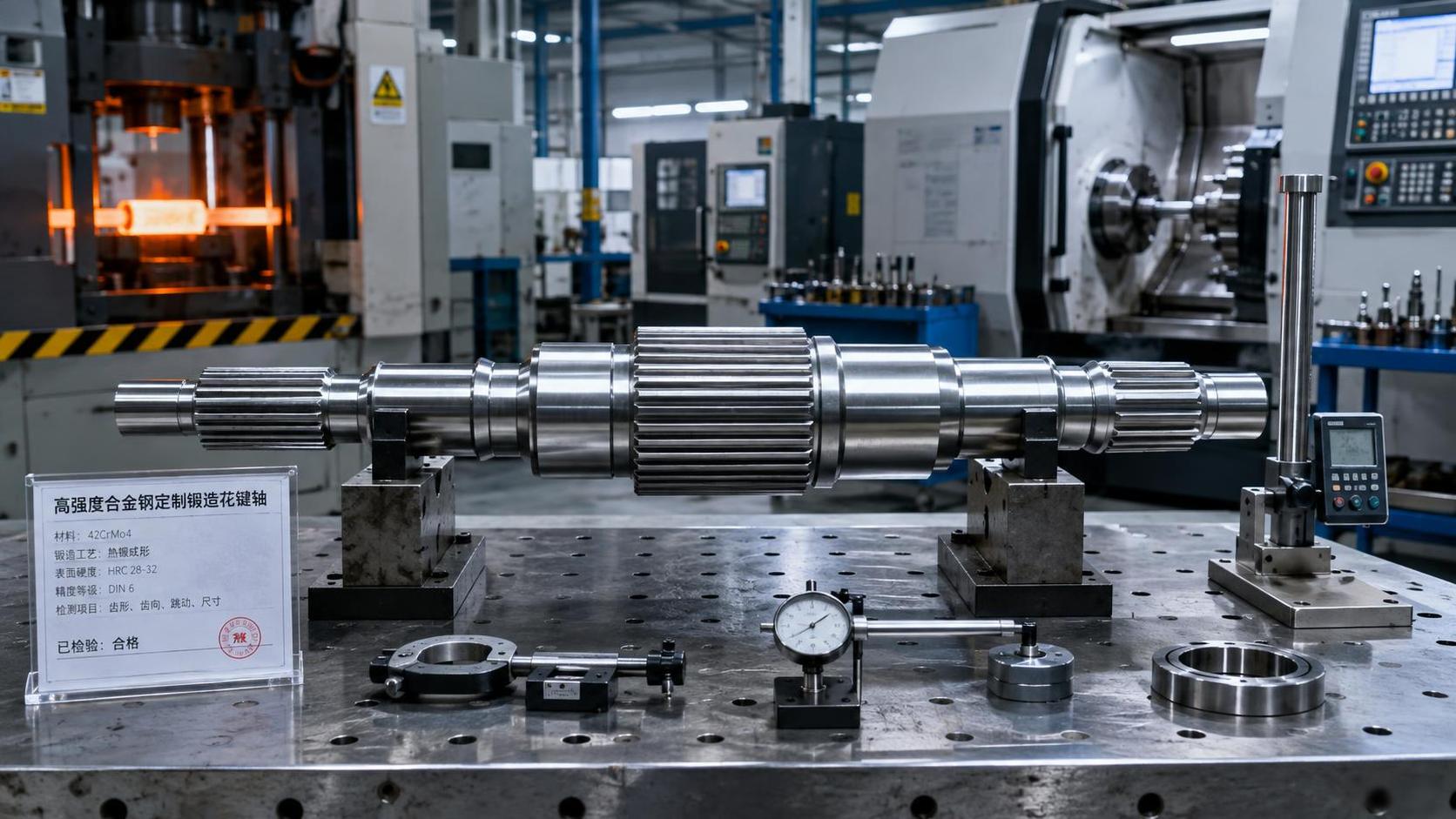
A new drive design can look ready on paper yet lose weeks before the first functional assembly is built. The delay often begins when the spline shaft drawing reaches sourcing: the chosen steel grade is not available in the required section, forging die design has not accounted for machining stock, spline geometry is still moving, or inspection expectations are unclear. By the time these gaps surface, prototype dates, gearbox testing, and purchasing plans may all be under pressure.
The practical answer is not simply to find a shop that can make shafts quickly. A capable custom forged spline shafts supplier shortens lead time by reducing handoffs between material preparation, forging, machining, heat-treatment coordination, and dimensional verification. For new automotive, wind-power, marine, and industrial drive designs, the most useful supplier is one that identifies manufacturability risks early and turns an evolving drawing into a controlled production route rather than treating each operation as a separate transaction.
Lead time is usually lost before production starts
Decision-makers sometimes compare suppliers only by quoted manufacturing days. That figure matters, but it does not reveal where a program is likely to stall. A spline shaft typically passes through several linked decisions: material selection, billet size, forging method, die configuration, machining allowance, datum strategy, spline generation method, heat treatment, and inspection. A weakness in any one of these decisions can create rework or waiting time later.
Consider a shaft designed for a compact transmission. The design team may specify a high torque capacity and tight spline fit, while procurement is focused on receiving parts quickly enough for test builds. If the shaft is initially designed from bar stock but production volumes point toward forging, the supplier may need to revisit the root diameter, flange transitions, and stock distribution. If that review happens only after a purchase order is placed, the apparent fast quote becomes less useful.
Current sourcing behavior is moving toward earlier technical engagement because new drive systems often leave less tolerance for late correction. Higher torque density, tighter package space, changing interfaces, and greater attention to material use all increase the cost of discovering a basic process mismatch after tooling is released. Lead-time reduction therefore starts with making the production route visible at the drawing-review stage.
Why custom forging can remove time from the development path
Forging does not automatically suit every spline shaft. Low-volume development parts, unusually complex geometries, or designs still undergoing major changes may be better served by machining from bar or by a hybrid route. Yet where the part shape, expected volume, and mechanical requirements support forging, near-net shaping can simplify later operations and create a more stable basis for repeat production.
A forged blank can place material closer to the required shaft profile than a fully machined solid bar. This may reduce rough-turning time, lower material removal, and provide more consistent stock for subsequent spline cutting or rolling. The value is not only cycle time. Less variation in available machining allowance helps the machining team hold concentricity between bearing journals, reference faces, and spline features with fewer corrective passes.
Precision forging is especially relevant when a shaft includes stepped diameters, shoulders, gear-adjacent features, or transitions that would otherwise require extensive removal from a larger bar diameter. The forging route must still preserve adequate material for finish machining and any geometry affected by heat treatment. The objective is not to forge every feature to final size; it is to create a blank that makes the final critical features easier to control.
For a new drive program, this creates a useful development sequence: confirm functional requirements, establish the forging envelope, define machining stock and datums, then release tooling with clear limits on what can change without a major revision. This sequence is faster than making a die first and discovering later that a critical interface needs additional stock or a different reference scheme.
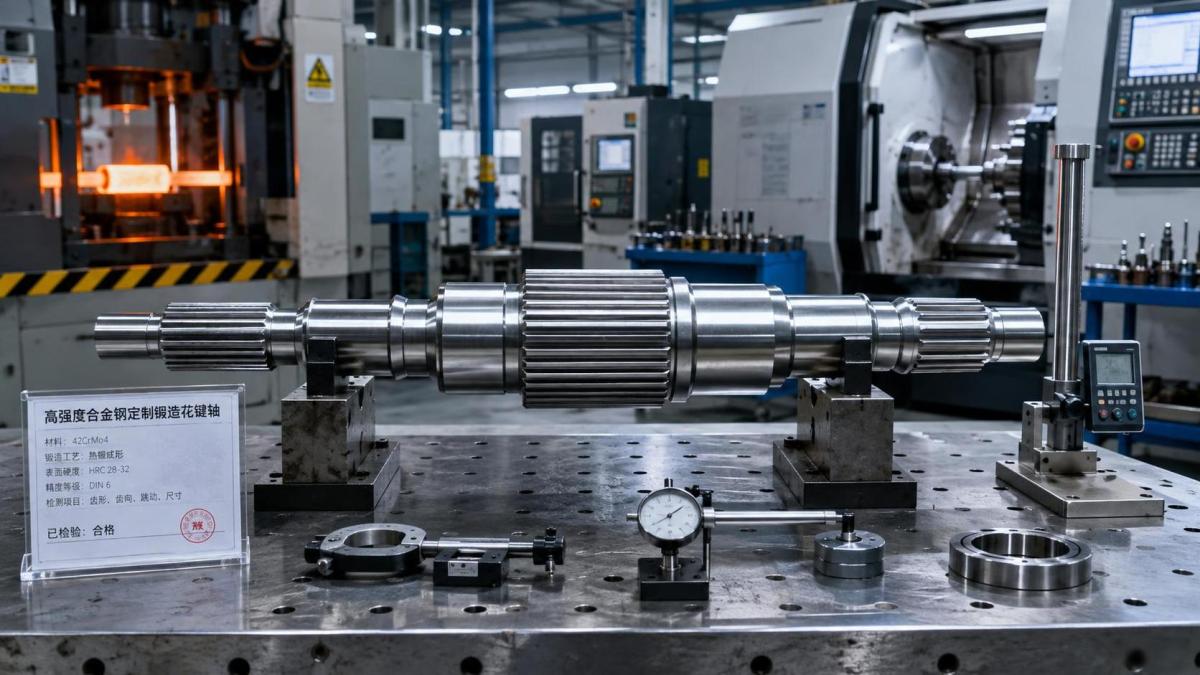
The supplier’s response speed depends on technical information quality
Urgent schedules often lead buyers to send only a drawing and request a price and delivery date. That may produce an initial response, but it rarely produces a dependable plan. The earlier a supplier receives the information below, the sooner it can separate a routine job from a development-risk job.
- Functional spline definition: spline type, number of teeth, module or pitch, pressure angle, fit class, effective length, and the surfaces used to establish measurement.
- Interface priorities: which journals, shoulders, flange faces, or gear locations govern concentricity, axial position, torque transfer, and assembly behavior.
- Material and mechanical requirements: specified grade, permitted equivalents, heat-treatment condition, hardness range, and any requirements for core or surface properties.
- Demand pattern: prototype quantity, expected pre-production demand, annual volume assumptions, and likely changes between development and serial production.
- Inspection expectations: critical dimensions, runout limits, spline inspection method, traceability needs, and whether initial sample approval is required before a larger release.
These inputs allow the supplier to make choices that affect both speed and cost. For example, a nominally simple shaft may need a different blank strategy when the spline runout is measured relative to a bearing journal rather than an outside diameter. A drawing that lists tolerance values without identifying the functional datum relationship can trigger repeated clarification cycles. Those cycles are often described as supplier delay, although they are really unresolved design-to-process questions.
Early manufacturability review prevents the most expensive revisions
The most productive supplier conversations do not begin with “Can this be made?” They begin with “Which elements control performance, and which elements can be adjusted to make production more reliable?” That distinction preserves what the drive system needs while opening room to improve the route.
Geometry at transitions deserves more attention than nominal shaft size
Spline shafts commonly fail to move smoothly through development because of local features: abrupt changes from spline root to shaft body, narrow undercuts, small corner radii, short relief zones, or closely spaced shoulders. These features can complicate die filling, increase machining-tool access issues, and make heat-treatment movement harder to manage. A manufacturability review should examine whether radii, relief dimensions, and stock allowance are realistic for the planned route.
Where a design change is not acceptable, the supplier should explain the process consequence plainly. It may require an additional machining operation, a revised die approach, or a different order of operations. A credible answer distinguishes between a feature that adds cost and a feature that introduces schedule uncertainty.
Material decisions should match both performance and availability
Material selection is often frozen for valid engineering reasons, but development lead times can be affected by the availability of the exact grade, billet diameter, and mill condition. A supplier with forging experience can evaluate whether the specified stock form supports the planned blank size and deformation. It can also flag when a permitted equivalent, subject to engineering approval, may offer a more stable supply route.
No substitution should be assumed. The important point is that material sourcing and process planning must be discussed together. Choosing an available bar size that produces poor material yield or insufficient forging stock can simply move the delay downstream.
Tooling should be staged around design maturity
New drive designs rarely remain unchanged from the first sample through production release. The appropriate tooling plan depends on how stable the geometry is. For early validation, a buyer may prefer a route that limits dedicated tooling exposure. Once shaft interfaces, spline dimensions, and predicted volume are firmer, dedicated forging tooling can support shorter cycle times and improved material use.
The key is to agree in advance which design changes affect the die, which only affect machining, and which require a new process review. This protects the schedule from a common problem: a small drawing revision that appears harmless but changes the forging fill pattern or removes essential finishing stock.
Integration matters more than claiming a short factory cycle
A supplier that coordinates forging and machining internally or through an established, controlled route can make better decisions about the entire shaft. The forging team needs to understand finish-machining datums. The machining team needs to know where forging variation is most likely. Quality personnel need a practical inspection plan that reflects the functional relationship between spline, journals, and faces.
Without that coordination, each party may optimize its own operation while increasing risk for the next one. A forging source may aim for the lowest blank cost, a machine shop may receive inconsistent stock, and the final inspector may discover runout issues after substantial value has already been added. This is particularly damaging when parts are needed for a build date rather than general inventory.
Quality planning should run in parallel with tooling and machining
Waiting until completed parts are available to decide how to inspect them is an avoidable source of delay. Spline shafts can meet individual size limits yet still create assembly problems if tooth form, indexing, runout, or datum relationships are not evaluated correctly. Inspection planning needs to be part of the launch discussion, particularly where the shaft mates with a transmission component, reducer, gearbox, or coupling that has limited tolerance for misalignment.
A sensible plan identifies the controlling reference surfaces first. It then defines how spline dimensions will be checked, how runout will be measured, and which characteristics require first-piece confirmation. Depending on the drawing, this can involve conventional gauges, dedicated spline gauges, measurement equipment for profile or lead, and dimensional checks of journals and shoulders. The method should be proportionate to the functional requirement; unnecessary inspection complexity can slow release just as surely as inadequate inspection can create rework.
For forged parts, the plan should also account for where dimensional movement may occur after heat treatment and how final machining compensates for it. A supplier that raises this question before production is not adding bureaucracy. It is protecting the delivery date from a late-stage discovery that the sequence cannot consistently achieve the specified relationship.
How procurement teams can compare suppliers beyond quoted delivery
When a new drive design has an aggressive schedule, the lowest unit quote and the shortest stated lead time may point to different suppliers. The better decision is usually made by examining the assumptions underneath each offer. Ask whether the quoted time starts after drawing approval, after material arrival, after tool approval, or after receipt of an order. Those are materially different commitments.
It is also useful to ask how the supplier handles open technical items. A responsive supplier should identify missing dimensions, tolerance conflicts, material questions, or inspection ambiguities before promising a firm route. Silence can appear efficient at the quotation stage but become costly once manufacturing begins.
- Can the supplier explain the proposed blank route and why it fits the shaft geometry?
- Has machining allowance been defined for critical journals, spline areas, and faces?
- Which design changes would affect tooling, and what information is needed to assess them?
- How will the first pieces be verified before repeat production proceeds?
- Is there a clear handoff between forging, machining, and final inspection?
- Can the supplier distinguish a prototype route from a volume-production route without overstating either one?
These questions reveal whether a supplier is managing a controlled process or merely offering capacity. Capacity is valuable, but it does not solve the engineering coordination that typically determines whether new shafts arrive usable on the required date.
Where the market is moving
Drive-component sourcing is increasingly shaped by shorter development windows and stronger pressure to reduce unnecessary material removal. That favors suppliers able to combine near-net forging knowledge with precision machining discipline. The shift is not about replacing engineering judgment with a standard process. It is about moving manufacturability, material efficiency, and inspection planning closer to the point where design decisions are still inexpensive to change.
For organizations developing new driveline, gearbox, or transmission systems, the supplier relationship is becoming less transactional during the launch phase. The useful supplier is expected to translate a functional design into practical blank geometry, machining references, tooling decisions, and quality controls without losing sight of the required delivery sequence. When those activities are coordinated early, lead time is shortened not by rushing individual operations, but by preventing the pauses, rework, and re-approval loops that consume the schedule.
A custom forged spline shafts supplier should therefore be evaluated as part of the new-drive development process. The strongest choice is the one that can identify the few features that truly govern function, build a realistic route around them, and keep production decisions aligned as the design moves from first parts toward stable supply.
Please give us a message