



Related Posts
Online Message
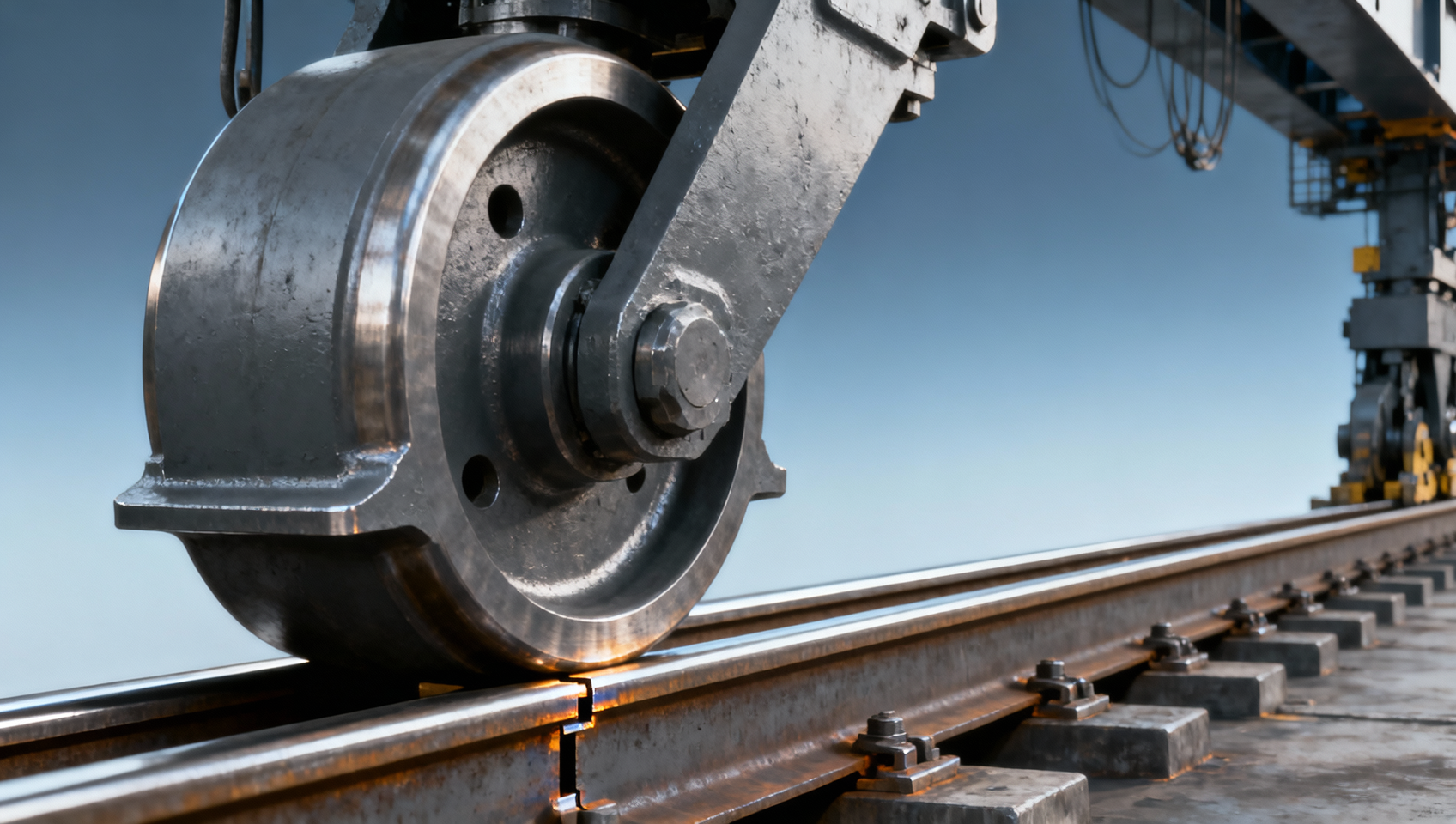
Out on the wharves—where salt spray stings the skin, wind howls off the open sea, and cranes lift 40-ton containers with mechanical calm—the track wheels beneath those massive booms aren’t just rotating parts. They’re silent guardians of operational continuity. A single failure isn’t just downtime—it’s a safety incident waiting to happen, a port schedule derailed, a multimillion-dollar asset immobilized in corrosive air.
That’s why heavy duty track wheels for outdoor port cranes demand more than dimensional accuracy or surface finish. They require a triad of non-negotiable performance attributes: corrosion resistance that withstands decades of marine exposure; impact toughness capable of absorbing shock loads from uneven rail joints or sudden lateral forces during high-wind operations; and full traceability to ASTM A668—the industry’s definitive standard for steel forgings used in critical structural applications.
ASTM A668 isn’t a checklist. It’s a philosophy written in metallurgy. It defines heat treatment requirements, tensile strength thresholds, Charpy V-notch impact energy minimums at sub-zero temperatures, and strict non-destructive testing protocols—including ultrasonic inspection for internal integrity and magnetic particle testing for surface discontinuities. Compliance isn’t certified by paperwork alone. It’s validated through batch-specific test reports, microstructure analysis, and documented process controls—from raw material certification through forging temperature logs, quenching rates, and tempering hold times.
At Liaocheng Jiucheng Auto Parts Co., Ltd., this level of rigor isn’t added as an afterthought—it’s engineered into the forging sequence from day one. Founded in 2015 and rooted in precision hot forging, the company treats each wheel not as a commodity, but as a load-bearing node in a larger safety chain. Their 6,000-square-meter mechanical processing workshop doesn’t just machine parts—it refines intent. When a wheel is forged from AISI 4140 or ASTM A668 Class D steel, the grain flow is deliberately aligned along the load path. The heat treatment cycle isn’t generic—it’s calibrated per lot, verified with furnace thermocouples and post-treatment hardness mapping across radial sections.
Corrosion resistance here isn’t achieved solely by zinc plating or paint. It starts with material purity—low sulfur and phosphorus residuals, controlled inclusion morphology, and uniform carbide distribution. Then comes surface integrity: no decarburization beyond 0.1 mm, no grinding burns, no residual tensile stress at the tread interface. Real-world validation happens where it matters most—not in climate chambers alone, but on active port infrastructure in Qingdao, Ningbo, and Guangzhou, where wheels log over 15 years of service under tidal humidity, chloride-laden fog, and daily thermal cycling.
Impact toughness, meanwhile, is tested not just at room temperature—but at –20°C and –40°C. Why? Because crane operators don’t pause for seasonal calibration. A winter storm in Dalian can drop rail temperatures below freezing while lifting containers stacked four high. At those conditions, brittle fracture risk spikes—and ASTM A668 Class D mandates ≥27 J Charpy energy at –40°C. Jiucheng’s in-house impact lab runs comparative tests against legacy cast wheels and lower-grade forgings, documenting ductile-to-brittle transition curves—not just pass/fail results.
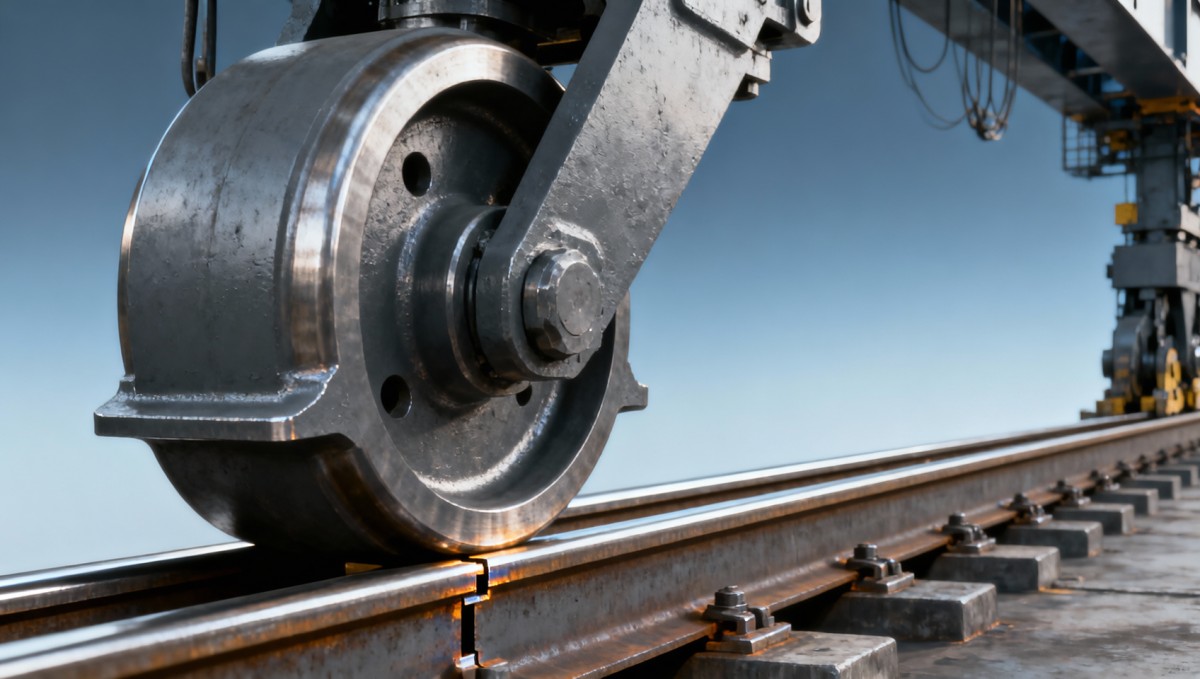
What separates these wheels from off-the-shelf alternatives isn’t just compliance—it’s contextual intelligence. For example: rail alignment tolerances vary across port types. Container terminals often use welded continuous rails with tight flatness specs; bulk cargo facilities may rely on bolted section rails with greater joint gaps. Jiucheng engineers factor that into wheel geometry—tread radius, flange height, and contact angle are adjusted not to a universal template, but to the crane OEM’s dynamic model and the end-user’s rail condition survey data. That’s why their Special-shaped forgings include variants with reinforced flanges for high-sidewind zones and crowned treads for older rail systems prone to lateral creep.
For QA and safety managers, traceability isn’t administrative overhead—it’s forensic readiness. Every wheel carries a laser-etched ID linked to its master heat number, forging die history, NDT report ID, and final dimensional CMM scan. If a wheel shows unexpected wear at mile 37,822 of its service life, the full metallurgical and process lineage is retrievable within minutes—not days. No batch mixing. No undocumented rework. No “as-built” ambiguity.
This discipline extends beyond the wheel itself. It informs how supporting components are sourced and integrated. Gear teeth meshing with drive pinions? Forged in the same heat, tested to the same fatigue curve. Axle housings? Matched thermal expansion coefficients, verified via differential scanning calorimetry. Even lubrication specifications are co-developed with bearing suppliers—because grease compatibility affects surface fatigue life far more than many realize.
It’s worth noting that not all “ASTM A668-compliant” wheels deliver equal assurance. Some manufacturers meet only the nominal tensile strength requirement—while falling short on impact consistency or grain size control. Others outsource heat treatment, losing control over cooling rates and residual stress profiles. Jiucheng’s vertically integrated process—forging, heat treating, machining, and inspection under one roof—eliminates those handoff risks. Their 20-million-RMB fixed assets include two fully automated quenching lines with programmable oil flow and temperature ramping, plus a dedicated metallurgical lab equipped for SEM/EDS analysis and tensile specimen fractography.
For safety managers reviewing procurement specs, here’s what to look for beyond the ASTM stamp: • Batch-level Charpy impact data—not just averages, but min/max ranges across three specimens per lot • Ultrasonic inspection reports showing flaw sizing methodology (e.g., DAC vs. TCG) and acceptance criteria per ASTM E127 • Hardness gradients across cross-sections—not just surface readings • Evidence of pre-NDT stress relief annealing for large-section forgings • Documentation of die maintenance history—because worn tooling induces subsurface folding defects invisible to surface NDT
And for those weighing long-term value: consider lifecycle cost—not just unit price. A wheel that costs 12% more upfront but lasts 2.3× longer, requires zero unplanned rail realignment due to flange wear, and avoids two crane shutdowns per year saves over $180,000 annually in port throughput loss alone. That math becomes sharper when factoring in reduced crane frame fatigue, lower maintenance labor hours, and fewer near-miss investigations tied to wheel slippage or derailment precursors.
Jiucheng’s approach reflects a quiet conviction: that reliability isn’t engineered in isolation. It emerges from how deeply material science intersects with field observation, how tightly process control aligns with real-world loading profiles, and how thoroughly documentation serves as both audit trail and predictive tool. Their wheels don’t just roll—they anchor confidence.
Because in ports, where seconds count and consequences scale fast, the most unassuming component—the one buried in dust and grease, rotating unseen beneath tons of steel and cargo—often holds the line between routine operation and systemic vulnerability. Choosing heavy duty track wheels isn’t about specifying a part. It’s about affirming a standard—one forged not just in fire and pressure, but in responsibility.
For QA teams validating supplier capability, or safety managers auditing crane maintenance protocols, that distinction isn’t theoretical. It’s the difference between reading a spec sheet—and standing on the wharf, watching a crane lift its 10,000th container, knowing the wheels beneath it have never missed a rotation.
Please give us a message