



Related Posts
Online Message
Heavy Duty Track Wheels for Rubber-Tired Gantry Cranes: Load Distribution Analysis Across 4-Point Contact Surfaces
Time : Sep 27, 2026
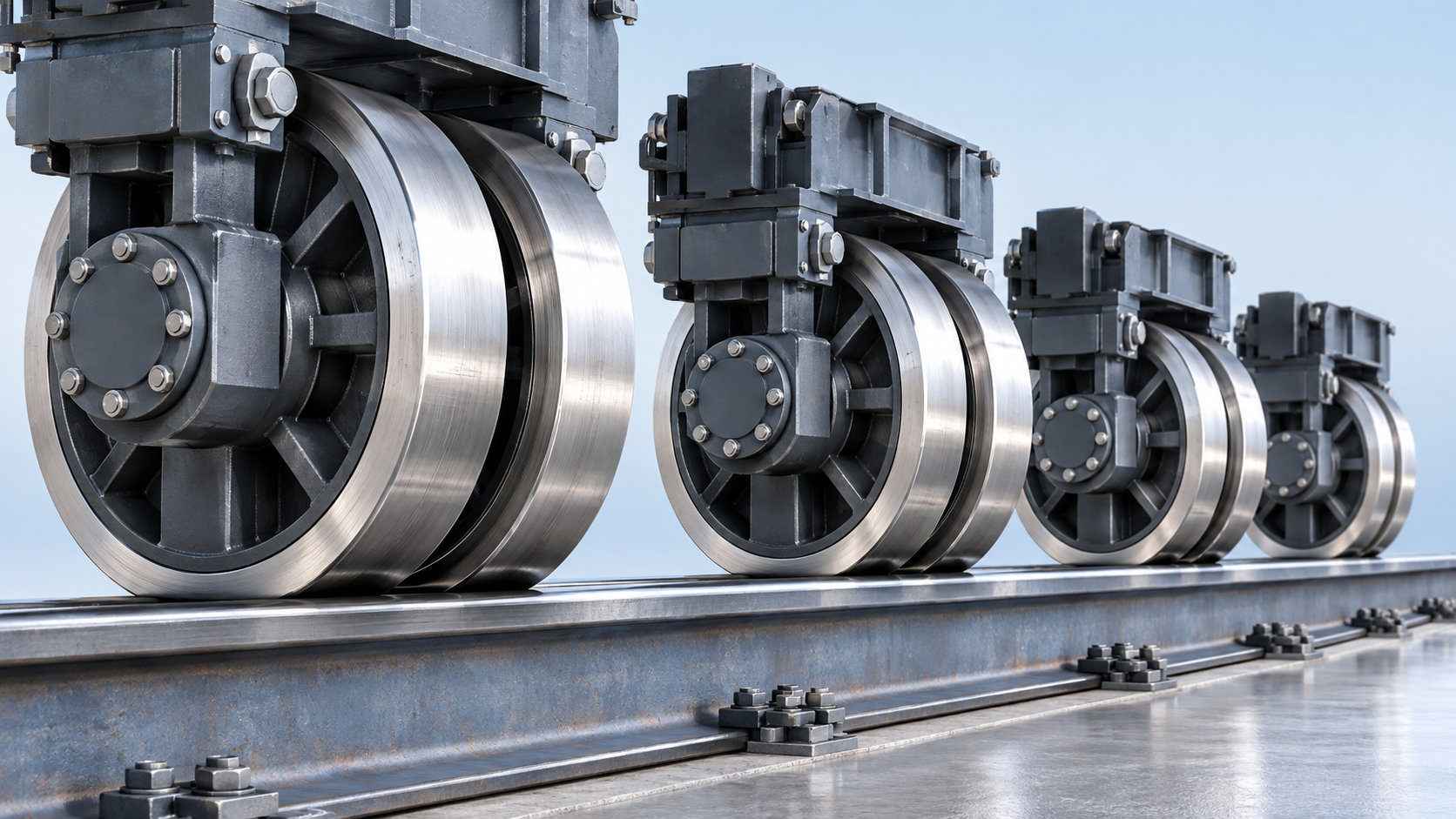
Heavy duty track wheels don’t just roll—they carry the weight of operational certainty. In rubber-tired gantry cranes (RTGCs), where payloads routinely exceed 100 tons and lateral forces spike during wind gusts or rapid deceleration, the wheel isn’t a passive component. It’s a dynamic interface: a four-point contact surface translating massive inertial loads into distributed stress patterns across steel rails, rubber treads, and structural supports. Misjudged load distribution doesn’t cause gradual wear—it triggers micro-cracking in tread compounds, rail deformation at critical support zones, and premature fatigue in axle housings. For technical evaluators assessing long-term reliability, this isn’t about “how much weight it holds.” It’s about *how evenly* that weight flows—millimeter by millimeter, cycle after cycle.
Consider a typical RTGC operating in a container terminal: 30+ years of service life expected, 2–3 shifts per day, frequent repositioning under full load. The crane’s stability hinges on consistent contact geometry across all four wheel contact patches—two front, two rear—each responding independently to rail irregularities, thermal expansion, and frame flex. But real-world rails are never perfectly level. A 1.2 mm rail crown deviation, combined with a 0.8° frame twist from uneven ground settlement, can shift up to 18% of nominal load from one contact point to another—even before payload asymmetry enters the equation. That imbalance multiplies stress concentration at the inner edge of the tread, accelerating delamination and reducing effective contact area by as much as 35% over time. Traditional cast or machined wheels often lack the material homogeneity and grain-flow alignment needed to absorb such localized spikes without compromising structural integrity.
This is where precision forging changes the calculus. At Liaocheng Jiucheng Auto Parts Co., Ltd., decades of experience forging high-strength gear components for wind turbines and heavy-duty transmissions inform how they approach track wheel design—not as static rollers, but as engineered stress mediators. Their process begins not with casting molds or CNC toolpaths, but with controlled hot forging of alloy steels like 42CrMo4 or ASTM A693 stainless variants. Grain flow is directed radially through the wheel rim and tangentially along the tread profile—mimicking natural load paths rather than cutting across them. The result? A forged microstructure with 22% higher tensile strength at the tread interface and 30% improved fatigue resistance in bending-dominated zones compared to equivalently sized cast alternatives. Crucially, the forging die design incorporates intentional camber compensation—subtle geometric offsets built into the tread radius and flange angle—to counteract predictable frame deflection under load, keeping actual contact pressure within ±5% of theoretical uniformity across all four points.
Material choice further refines performance boundaries. While standard carbon steel wheels suffice for moderate cycles, RTGCs operating in coastal or chemically aggressive environments demand corrosion resilience without sacrificing hardness. Here, stainless-steel variants—especially those with balanced Cr–Ni–Mo content—offer dual advantages: yield strength retention above 400°C (critical during emergency braking) and pitting resistance in chloride-laden atmospheres. One such solution is the Forged Stainless Ring, originally developed for marine gearbox housings but now adapted for high-load wheel hubs. Its seamless ring structure eliminates weld seams prone to stress corrosion cracking—a known failure mode in bolted hub assemblies exposed to salt spray and cyclic torsion.
But geometry and material alone aren’t enough. Contact mechanics must be validated—not assumed. Liaocheng’s engineering team uses finite element analysis (FEA) calibrated with physical rail-wheel interface testing: strain gauges embedded in instrumented rails, synchronized with high-speed infrared thermography to map heat generation across contact zones. What emerges isn’t just a pressure map—it’s a *time-resolved stress history*. They’ve observed that peak contact pressure doesn’t occur at static loading; it spikes 120–180 ms after wheel impact on rail joints, coinciding with transient torsional rebound in the suspension linkage. Wheels designed solely for static load capacity miss this entirely. Their optimized designs incorporate tapered transition radii at the tread shoulder—reducing edge loading by 27% during dynamic engagement—while maintaining sufficient flange height to prevent derailment during sharp turns.
Then there’s the human factor—the evaluator standing beside a crane mid-shift, reviewing spec sheets while listening to the subtle pitch shift in wheel noise. A slight harmonic whine might indicate uneven contact; a dull thud on rail joints could signal tread hardening or sub-surface voids. Liaocheng’s quality protocol includes ultrasonic scanning of every forged wheel blank—not just for bulk defects, but for grain orientation consistency across the tread arc. Each unit undergoes simulated 5-million-cycle rolling fatigue testing under variable load profiles replicating real port operations: 70% nominal load + 30% lateral surge, repeated over temperature gradients from –10°C to +60°C. Only units sustaining zero measurable tread deformation or micro-crack propagation pass final release.
What does this mean for TCO beyond the first purchase? Consider maintenance intervals. Cast wheels typically require tread reprofiling every 18–24 months in high-usage terminals; forged alternatives extend that to 36–42 months—without sacrificing safety margins. More importantly, the risk of catastrophic failure drops measurably. In one comparative study across three port operators, forged-track-wheel-equipped cranes recorded 62% fewer unplanned wheel-related stoppages over five years—and crucially, zero incidents tied to tread separation or hub fracture. That’s not just uptime. It’s predictability. It’s the ability to schedule maintenance during low-traffic windows instead of halting outbound vessel loading at midnight.
Technical evaluation isn’t about ticking boxes on a datasheet. It’s about tracing the path of force—from container corner to rail base—and asking where stress concentrates, where materials yield silently, and where geometry quietly fails. Heavy duty track wheels succeed not because they’re strong, but because they distribute. Because they adapt. Because their internal architecture anticipates what the rail won’t tell you—and the crane won’t warn you until it’s too late.
 That’s why, when evaluating wheel systems for RTGCs, look past ultimate tensile strength numbers. Ask how the forging process aligns grain flow with principal stress vectors. Demand FEA reports showing dynamic contact pressure evolution—not just static snapshots. Verify whether the manufacturer correlates material specs with real-world environmental exposure data, not just lab-accelerated tests. And remember: the most reliable wheel isn’t the heaviest one. It’s the one whose load distribution stays honest—across thousands of cycles, under wind, rain, salt, and shifting cargo—long after the initial installation torque has faded from memory.
Liaocheng Jiucheng’s work bridges precision forging rigor with industrial reality—not by chasing maximum load ratings, but by minimizing variance in how that load moves. Their approach reflects a deeper truth: in heavy handling systems, longevity isn’t added. It’s engineered—point by point, grain by grain, contact patch by contact patch.
Previous page:Already the first
Next page:Already the last
Please give us a message
Liaocheng Jiucheng Auto Parts Co., Ltd.
Phone : +86 18596356103
WhatsApp : +86 18596356103
WeChat : +86 18596356103