



Related Posts
Online Message
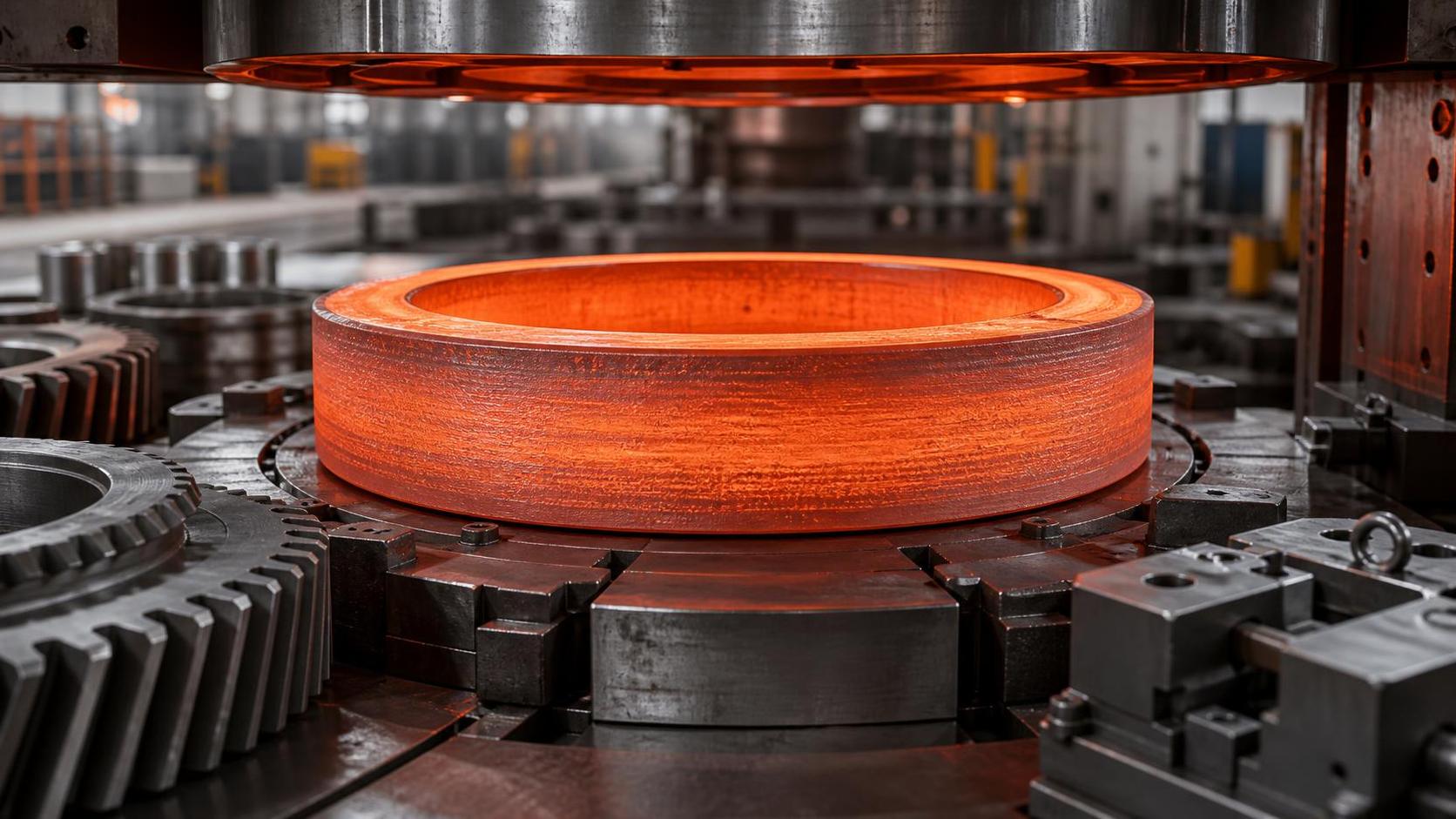
How Open Die Forged Rings Improve Material Flow in Heavy-Duty Parts
For heavy-duty gears, gearbox components, marine drive assemblies, and large rotating equipment, material integrity is decided long before the final machining operation. A finished part may have accurate teeth, clean surfaces, and acceptable dimensions, yet still carry internal weaknesses created during poor stock preparation or uncontrolled deformation. That is why the forging route deserves attention when engineers evaluate parts that will see repeated torque, shock loading, bending, or long service intervals.
Open Die Forged Rings are often selected when a component needs a robust forged starting form without the cost or geometric restrictions of a highly dedicated closed-die tool. Their value is not simply that they are “stronger.” The practical benefit is more specific: controlled deformation can redistribute material, work down as-cast structure, and guide grain flow around the shape that will eventually become a ring gear, flange, bearing seat, hub, or transmission element.
This distinction matters in automotive drivetrains, wind power gearboxes, industrial reducers, and marine machinery. In each of these applications, the buyer is usually not looking for a ring blank in isolation. They are trying to reduce risk in the finished component: uneven machining allowance, weak sections near a bore, inconsistent heat-treatment response, excessive material removal, or premature fatigue damage under service load.
Material flow is more than metal moving into shape
In forging, “material flow” describes how metal deforms under pressure and how its internal grain structure follows that deformation. When a heated billet is upset, pierced, expanded, and worked into a ring form, the operation can consolidate the material and orient the grain structure in a way that better follows the component’s circular geometry. For a part that transmits torque around its circumference, that orientation is generally more useful than a structure cut from a large plate or produced from a poorly worked stock section.
The word “generally” is important. Grain flow is not a substitute for proper steel selection, controlled heating, heat treatment, or non-destructive examination. A forged ring can still be unsuitable if the reduction is inadequate, the billet contains unacceptable defects, the temperature falls outside the workable range, or the process creates folds and laps. Forging improves the starting condition only when the whole route is managed as a system.
Open-die work gives the forge team room to adjust that system. Rather than forcing metal immediately into a final cavity, operators can use progressive upsetting and drawing steps to establish the required section. For larger diameters or lower-volume parts, this flexibility is often valuable. It allows the preform to be developed around the actual machining envelope rather than around an overly generic bar or plate size.
A common mistake is to assume that any circular blank has the same metallurgical advantage. It does not. A cut ring from tube, a rolled ring, an open-die forged ring, and a machined plate ring begin with different deformation histories. Their suitability depends on the load path, material grade, finished geometry, inspection requirements, and the amount of machining planned after forging.
Why heavy-duty components benefit from a forged starting shape
The most direct advantage is a more rational distribution of metal. Consider a large gear blank with a thick rim, a central bore, and transition areas that will later be machined into webs or mounting features. Starting from solid bar can mean removing a considerable amount of material from the center and outer diameter. Starting from plate may create a workable blank, but it does not necessarily provide the same directional grain pattern around the ring.
With open-die forging, the aim is to move metal toward the sections that need it before expensive machining begins. The forge blank should leave enough stock for stable finishing, but not so much that turning time, tool wear, and scrap become excessive. This is where experience matters. Too little allowance can expose decarburized surface material, distortion, or local dimensional shortage after heat treatment. Too much allowance wastes the benefit of near-net-shape preparation.
For gear and transmission parts, the load is rarely uniform. Tooth-root stress, torsional loading through the bore, keyway or spline transitions, and contact fatigue all place different demands on the material. The forging plan should therefore reflect the final part drawing rather than only the nominal outside diameter and thickness. A ring that looks efficient on a forging sketch may become inefficient once gear teeth, oil passages, shoulder locations, and inspection reference surfaces are added.
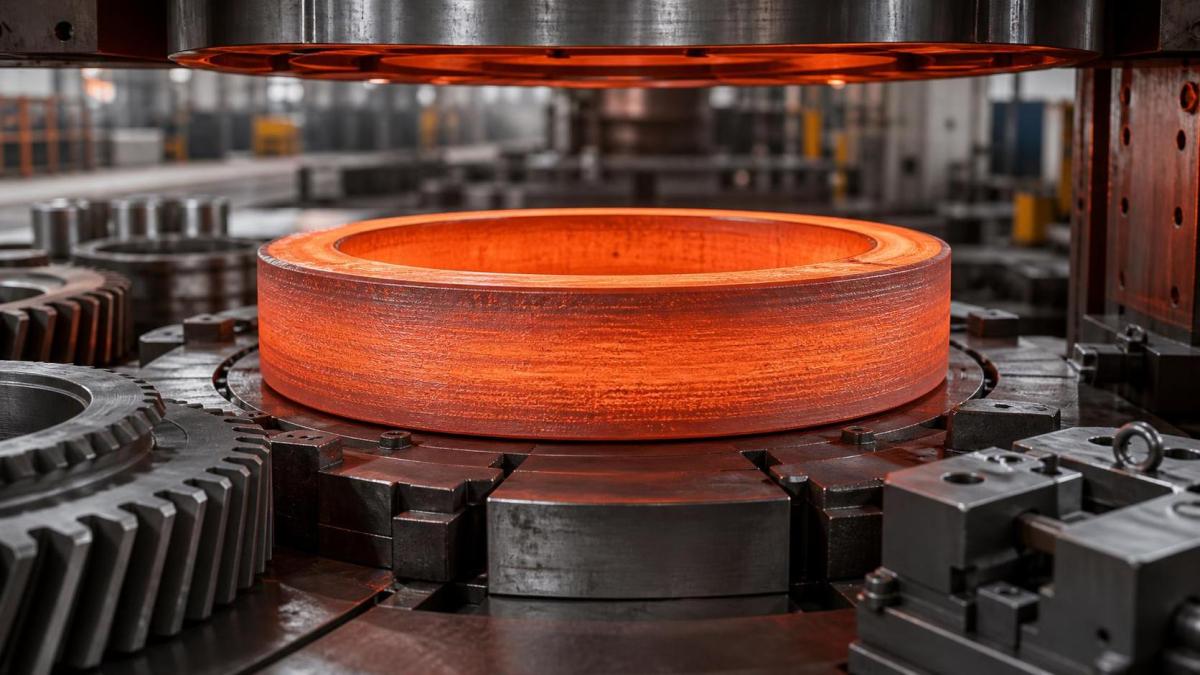
The same principle applies to shafts and splined transmission components. A properly designed forged preform can reduce the amount of stock removed around high-stress transitions and leave a more appropriate flow pattern in critical areas. Where a project calls for a forged transmission element, a Spline Shaft should be reviewed as a complete route—billet quality, forge reduction, machining datum strategy, heat treatment, and spline finishing—not as a standalone catalogue item.
Open-die forging versus ring rolling: choose the route for the job
Open-die forged rings and rolled rings are related, but they should not be treated as interchangeable terms. Ring rolling is especially effective when the ring geometry, production volume, and equipment capability support a continuous expansion process. It can produce efficient circumferential grain flow and good material utilization for many ring-shaped components. Open-die forging is often preferable when dimensions vary, the section is unusually heavy, the order quantity is limited, or the preform needs additional flexibility before final machining.
There is also a hybrid reality in many workshops: open-die operations may prepare a billet or pierced preform before later forming steps. What matters to the customer is not the label attached to the process. It is whether the forging reduction, shape control, heat cycle, and inspection plan are appropriate for the component.
The process details that decide whether material flow is actually improved
The billet is the first control point. Forging cannot reliably erase all problems inherited from incoming material. Chemistry, internal soundness, segregation level, and traceability need to match the component specification. For critical drivetrain work, it is sensible to agree early on whether the purchaser requires mill documentation, ultrasonic examination, mechanical test coupons, or additional controls. The exact requirements should come from the drawing, contract, and applicable technical standard—not from assumptions based on the part name.
Heating is equally practical and frequently underestimated. Inadequate soak can leave temperature gradients across a heavy section, making deformation uneven. Overheating may cause excessive grain growth or surface deterioration. During open-die operations, repeated reheating may be necessary for larger sections; this should be controlled rather than treated as an incidental delay. Surface condition matters because defects created early can survive long enough to appear during rough machining.
Then comes deformation sequence. Upsetting before piercing, bore expansion, and drawing of the section should be planned to avoid concentrating strain in one area while leaving another area insufficiently worked. A good forging team watches shape continuously: wall thickness, ovality, face flatness, bore condition, and the transitions where metal has changed direction. If a ring begins to develop folding or local buckling, pressing ahead to hit a cycle-time target is usually the expensive choice.
After forging, cooling and heat treatment must be tied to the alloy and final requirement. A rough-forged blank is not automatically ready for gear cutting. Depending on the route, it may need normalization, annealing, quenching and tempering, or a later carburizing and hard-finishing sequence. Distortion allowance should be discussed before forging dimensions are frozen, particularly for thin-ring sections and components with uneven mass distribution.
Where material savings are real—and where claims need caution
Near-net forging can materially reduce chips compared with machining a finished component from oversized stock. It can also shorten rough-turning time and reduce the amount of energy spent converting valuable alloy steel into scrap. Liaocheng Jiucheng Auto Parts Co., Ltd., established in 2015, works across precision forging and mechanical processing for automotive gears, wind-power gearbox parts, mechanical equipment, and marine gear components. Its 8,000-square-meter factory includes dedicated precision forging and machining workshops, which is useful from a process perspective: forging dimensions and downstream machining requirements can be reviewed together rather than handed off as separate problems.
The company states that its precision-forging approach is intended to reduce turning, save material and energy, and support automated production. Those goals are credible process targets, but actual savings will vary with part geometry, steel grade, batch size, equipment utilization, and tolerance requirements. A thick, simple ring may show a very different material-utilization profile from a complex gear blank with deep machining features. Buyers should ask for the proposed forging envelope and estimated machining allowance rather than relying on a general percentage claim.
This is also why the cheapest raw blank is not always the lowest-cost option. A blank with generous oversize may be easy to quote, but it can shift cost into turning, handling, heat treatment, and inspection. Conversely, an aggressively tight forging may look efficient until machining reveals insufficient cleanup allowance. The best commercial decision is typically a stable middle ground: enough stock to protect quality, with no unnecessary metal where the final geometry does not need it.
Questions worth asking before approving an open-die forged ring
A technical review should start with the finished part drawing, not a generic request for a ring. Clarify the finished dimensions, datum surfaces, alloy, delivery condition, heat-treatment route, target mechanical properties, and all agreed inspection requirements. If the ring will become a gear, identify whether tooth cutting occurs before or after a major heat-treatment step and whether the rim needs special stock allowance. If it will become a marine or wind-power component, define the expected service environment and the documentation required by the project.
It is also worth asking how the supplier will control bore and outside-diameter variation after forging. Those tolerances affect not only machining cost but also the amount of deformation imposed on the material. A supplier with both forging and machining capability can often give more useful feedback here, because the team sees where a theoretical forging shape creates a real fixturing or tool-access problem later.
For heavy-duty parts, Open Die Forged Rings are best understood as an engineered starting point. They can improve material distribution, support favorable grain orientation, and reduce avoidable machining waste, but only when process design follows the actual load path and final manufacturing route. The right question is not “Is forging better?” It is whether the proposed forged blank leaves the right material, in the right places, for the component that must perform after machining, heat treatment, and years of service.
Please give us a message