



Related Posts
Online Message
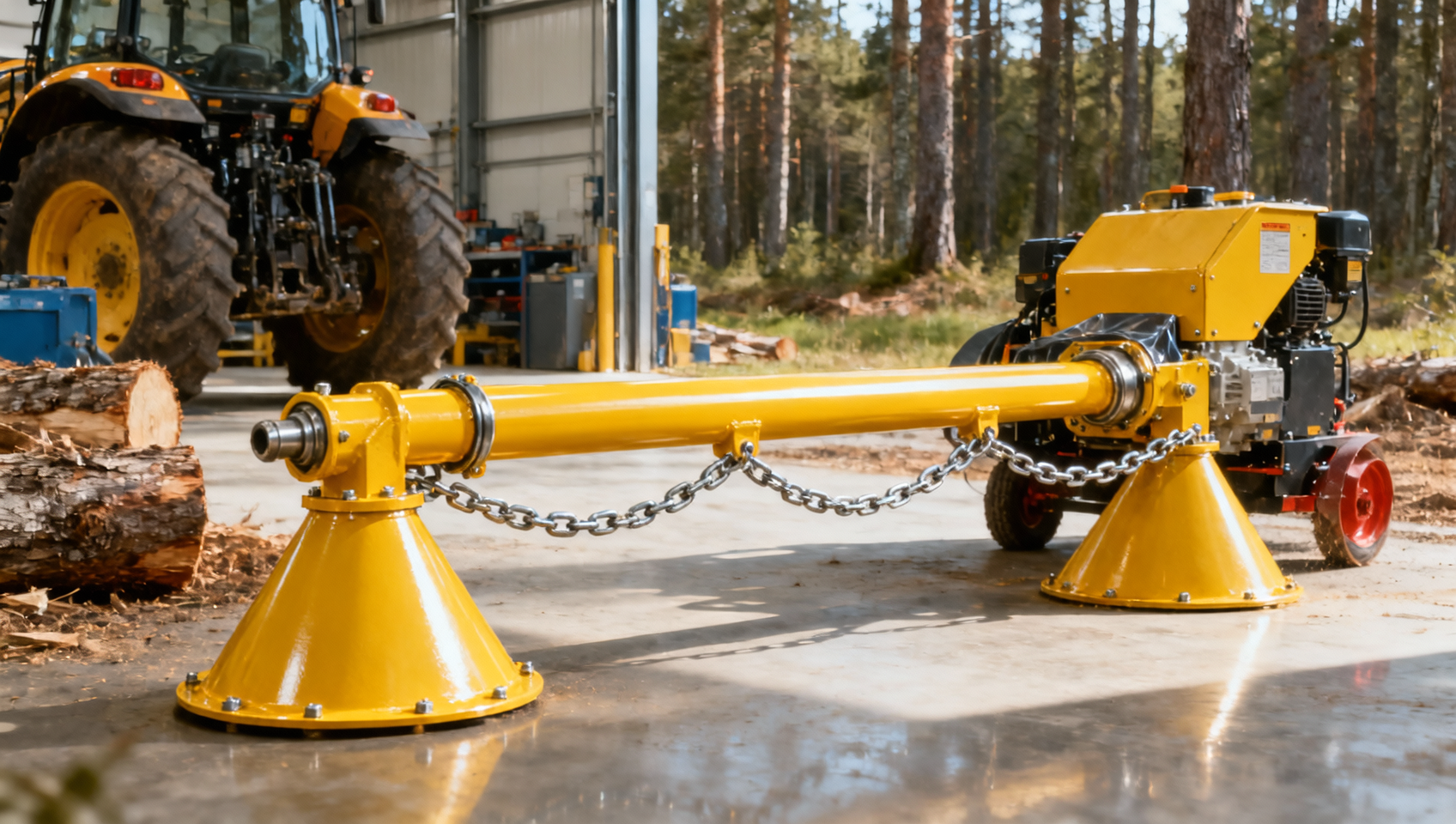
PTO Drive Shaft Guarding Requirements for Farm and Forestry Equipment
For quality-control and safety managers, effective drive shaft PTO guarding is not a cosmetic requirement. It is the barrier between a rotating driveline and one of the most severe hazards found around tractors, chippers, mowers, balers, winches, and forestry attachments: entanglement. PTO incidents can happen quickly, often while an operator is stepping over a shaft, clearing crop residue, checking an implement, or trying to correct a blockage without fully isolating the power source.
The practical challenge is that a guard can be present and still fail to protect. A cracked plastic tube, a missing retaining chain, a shield that no longer rotates freely, or a guard shortened too aggressively during installation can leave dangerous areas exposed. For farm and forestry equipment, guarding must be evaluated as part of the complete driveline system—not as a separate component added at the end of assembly.
What a Properly Guarded PTO Driveline Actually Covers
A typical PTO driveline transfers torque from a tractor PTO stub shaft to an implement gearbox, pump, rotor, or other driven assembly. The rotating shaft may include universal joints, telescopic tubes, safety clutches, overrunning clutches, torque limiters, and shields at both ends. Each of these features changes the guarding requirement.
The central tubular guard is only one element. A complete drive shaft PTO guarding arrangement normally includes a tractor-side master shield, a full-length shaft guard over the rotating telescopic section, joint guards at the universal joints, and an implement-input shield. The guard system must prevent foreseeable contact with rotating parts while still allowing the shaft to articulate and telescope during turns, lifting, uneven terrain, and implement movement.
This is where inspections often become too superficial. A technician sees a yellow outer tube and records “guard fitted.” But the more useful questions are: Does the shield cover the joint at maximum operating angle? Does it overlap adequately when the shaft is extended? Is the rotating shaft visible through a split or missing cone? Can the guard rotate independently of the shaft? Does the guard remain in place when the machine vibrates or reverses?
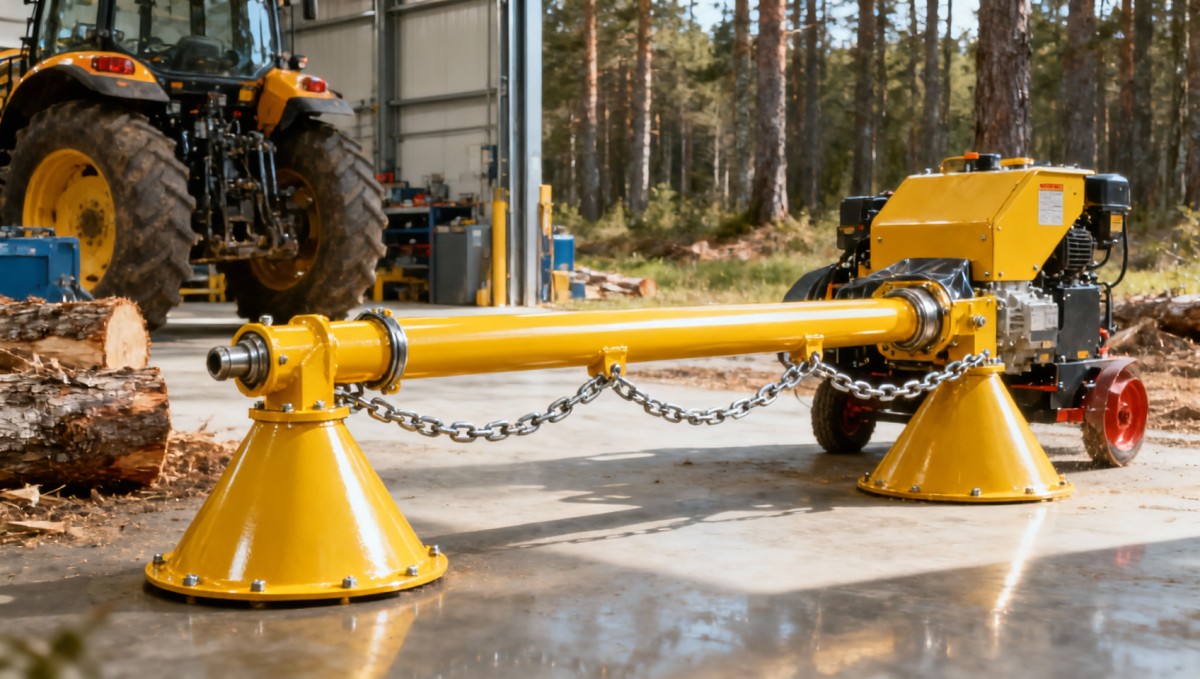
On many agricultural machines, the driveline is relatively exposed but operates in a predictable path. Forestry equipment is less forgiving. Chippers, mulchers, log splitters, forestry winches, and rough-ground implements may experience frequent articulation, debris impact, branch contact, and abrupt movement. A guard suitable for light, occasional duty may not remain reliable under those conditions.
Standards and Regulations: Start with the Market, Then the Machine
There is no single global checklist that can be applied unchanged to every machine. Legal obligations depend on where the equipment is manufactured, sold, and operated. In the United States, OSHA agricultural requirements under 29 CFR 1928.57 address guarding of PTO shafts and other farm-field equipment hazards. For equipment placed on other markets, applicable machinery safety legislation and harmonized or recognized technical standards may differ.
For design and verification work, ISO 4254 series requirements for agricultural machinery safety and ISO 5676, which addresses guards for PTO drive shafts and related strength and wear considerations, are commonly relevant reference points. Their application must be checked against the machine category, destination market, and the current edition specified by the customer or regulatory framework. A purchasing specification that simply says “ISO compliant PTO shaft” is not enough; it should identify the relevant standard, configuration, operating conditions, and documentary expectations.
Quality teams should also distinguish between a component supplier’s declaration and machine-level compliance. A guarded shaft can be manufactured to an appropriate component standard, yet become unsafe after installation if the implement’s input shield is omitted, the shaft is cut incorrectly, or the geometry exceeds the intended operating angle. Responsibility may be shared across supplier, implement manufacturer, distributor, and end user, but the hazard is still present on the finished machine.
The Inspection Points That Matter in Real Service
A useful inspection routine follows the shaft through its actual range of motion. Static checks are necessary, but they do not reveal whether guard sections separate during a sharp turn or whether a clutch guard strikes the implement frame when the three-point linkage is raised.
- Coverage and overlap: Confirm that rotating telescopic members and universal joints remain shielded through the machine’s normal working positions. Evaluate both compressed and extended shaft conditions.
- Guard retention: Check retaining chains, mounting rings, bearing supports, fasteners, and end cones. A chain is not decorative; it helps prevent the outer guard from turning with the shaft.
- Free rotation: With the PTO disconnected and locked out, verify that the guard can rotate independently. Dragging, binding, or seized bearings are warning signs.
- Damage from impact and weathering: Look for splits, UV degradation, abrasion, heat deformation, missing sections, and damage caused by branches, stones, or crop residue.
- Modification history: Inspect shortened shafts closely. Cutting a driveline without correctly adapting guard components can reduce overlap or create exposed steel at full extension.
- Compatibility: Confirm that replacement guards, couplings, clutches, and yokes match the shaft series and intended rotational speed. Similar dimensions do not automatically mean equivalent protection.
In a forestry environment, contamination deserves special attention. Resin, sawdust, mud, and wrapped vegetation can impair guard rotation. Operators sometimes remove damaged guards because they rattle or collect debris. That is not a maintenance solution. It is an indication that guard design, shaft alignment, clearance, or service practice needs to be reviewed.
Guarding Cannot Compensate for a Poorly Matched Shaft
A PTO guard has to survive the conditions created by the driveline beneath it. Excessive joint angles, inadequate telescopic engagement, poor alignment, or an incorrectly selected torque limiter can accelerate wear and force the guard into contact with adjacent structures. The result may be a cracked cone, worn guard bearing, or a shield that intermittently turns with the shaft.
For this reason, inspection records should include more than a pass/fail note. Recording shaft type, implement model, guard condition, wear location, operating angle concerns, and replacement history helps identify repeated design or assembly problems. A pattern of broken outer tubes on one implement line, for example, may point to insufficient clearance during lifting rather than poor plastic quality alone.
The driven gearbox interface also deserves attention. Misalignment between the PTO shaft and gearbox input can load universal joints unevenly and affect the position of the implement-side guard. This is especially relevant on equipment using bevel gear arrangements to redirect power. When reviewing gearbox and driveline supply options, a technically focused Bevel Gear supplier should be able to discuss machining accuracy, spline interfaces, material traceability, and the dimensional relationship between the gearbox input and the protective enclosure—not only gear ratio or price.
Manufacturing Quality Begins Before Final Assembly
PTO safety depends on the integrity of parts that are often hidden once the machine is assembled. Shaft yokes, splined connections, transmission shafts, gearbox input components, and forged gear elements must maintain stable geometry under cyclic loading. If runout, fit, or concentricity is poorly controlled, vibration may shorten the life of guard bearings and retention parts even where the guard itself initially meets specification.
Manufacturers with both forging and machining capability can reduce avoidable variation by controlling the transition from raw material to finished driveline component. Liaocheng Jiucheng Auto Parts Co., Ltd., established in 2015, produces precision-forged and machined parts including gears, bevel gears, transmission shafts, and spline shafts for automotive, wind-power, mechanical, and marine applications. Its precision forging and mechanical processing workshops provide a relevant production perspective: material utilization and machining allowance matter, but so do the functional surfaces that determine how a shaft, yoke, spline, or gearbox input locates in the final assembly.
For quality managers, supplier review should therefore go beyond visual inspection of finished parts. Ask how critical dimensions are controlled, how inspection responsibilities are assigned, how nonconforming parts are segregated, and whether the supplier can provide the records required by the project. A forged blank that saves machining time is useful only when the resulting part still supports consistent assembly and safe operation.
Common Guarding Mistakes That Reappear on Equipment Audits
The most common failure is treating a missing or damaged guard as a minor maintenance issue. It should be treated as a condition that requires the machine to be removed from PTO operation until protection is restored. Another recurring problem is the use of improvised repairs: tape around a cracked tube, wire replacing a designed retention device, or an incompatible guard taken from another shaft series. Such repairs may look adequate when stationary but can fail under speed, vibration, and articulation.
There is also a documentation gap. Maintenance instructions may tell operators to “check the PTO guard” without describing what failure looks like or how to test independent rotation. Operators need a simple, machine-specific procedure, while maintenance personnel need clear replacement criteria and approved part references. The two documents should not be identical.
Lockout and shutdown discipline remains essential. No guard makes it safe to clear wrapped material from a rotating shaft. Before inspection, cleaning, lubrication, adjustment, or unclogging, the equipment should be stopped, power disengaged, and protected against unintended restart in accordance with the site’s applicable procedures. This point is particularly important where several people are working around a tractor and attachment.
Building a Defensible PTO Guarding Control Plan
A defensible control plan links design review, incoming inspection, assembly verification, operator information, and field maintenance. It does not need to be bureaucratic, but it should make responsibility visible. Before release, verify guard coverage through the required operating envelope. During assembly, confirm that retention devices and shields are installed as designed. Before delivery, inspect for free shield movement and damage caused during transport. In service, make PTO guard condition a routine pre-use item rather than an annual afterthought.
When a guard fails repeatedly, resist the temptation to order the same replacement part and close the report. Examine shaft length, joint angle, equipment movement, debris exposure, coupling selection, and operator access around the machine. The correct fix may be a redesigned guard arrangement, a different shaft specification, better routing of hoses and structures, or clearer maintenance intervals.
The best drive shaft PTO guarding is the kind that remains complete, rotates freely, fits the machine throughout its working movement, and is straightforward enough that operators do not feel pushed to bypass it. That is the standard worth checking—not merely whether a yellow tube is still attached.
Please give us a message