



Related Posts
Online Message
What Makes Seamless Rolled Ring Forgings Reliable for Heavy-Duty Loads?
For technical evaluators specifying components for extreme loads, seamless rolled ring forgings offer a proven balance of strength, fatigue resistance, and dimensional integrity. Their continuous grain flow and refined material structure help reduce weak points often associated with fabricated or cast alternatives. In automotive drivetrains, wind turbine gearboxes, marine transmissions, reducers, and heavy mechanical equipment, that difference can shape the service life of the entire assembly.
The question is not simply whether a ring has sufficient static strength on a drawing. Heavy-duty parts must endure repeated torque reversals, contact stress, vibration, thermal variation, and occasional overload events. A ring that appears acceptable in a basic calculation may still become the starting point for fatigue cracking, gear misalignment, bearing damage, or expensive unplanned maintenance if its internal quality and manufacturing route are not properly controlled.
Reliability begins long before final machining. It is built into the way the metal is formed, inspected, heat treated, and matched to the duty cycle of the application.
Why the Seamless Structure Matters Under Repeated Load
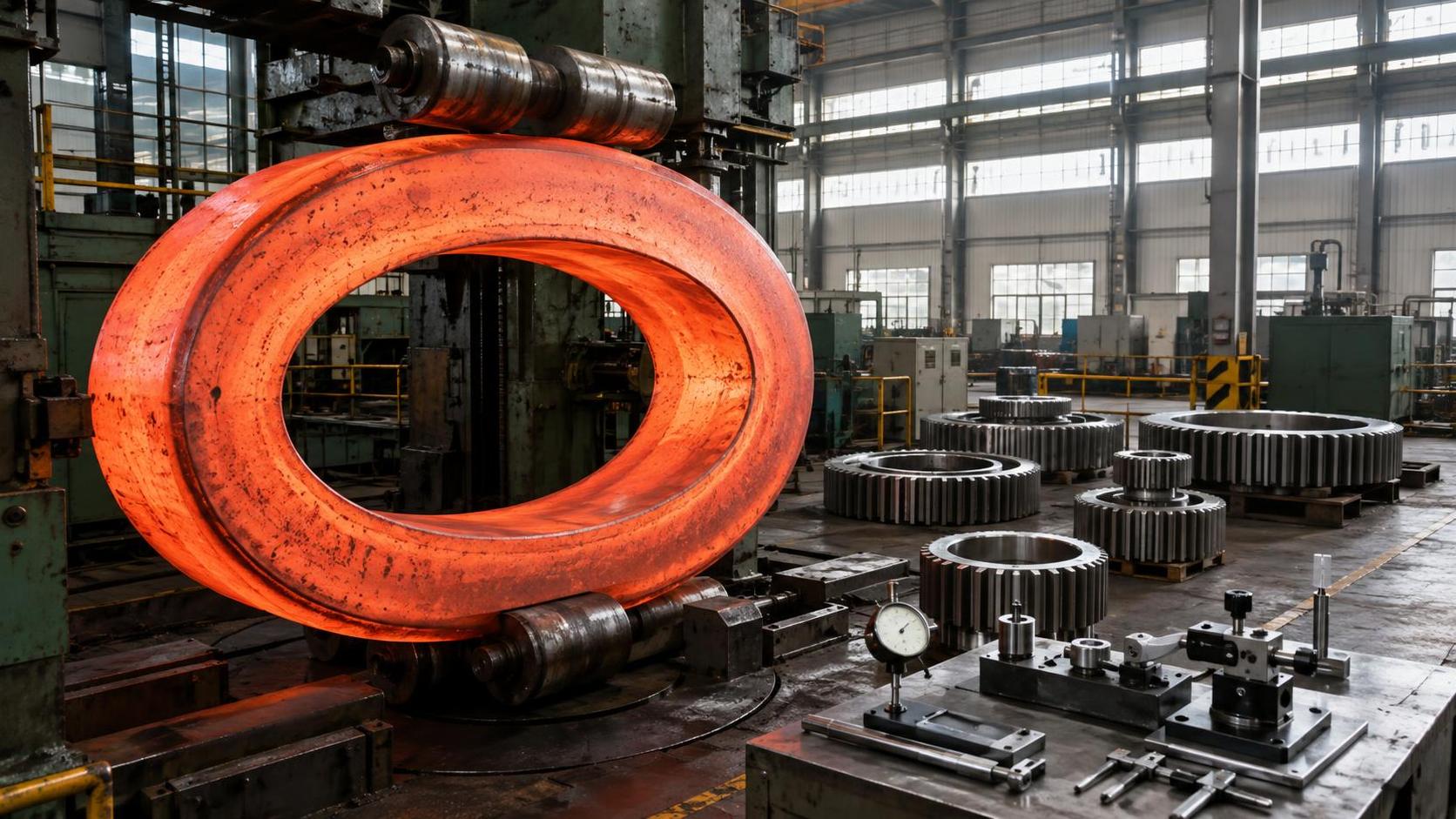
A seamless rolled ring starts from a solid forged blank that is pierced and then expanded between rolling tools. As the ring diameter grows and the cross-section is shaped, the material’s grain flow follows the circular geometry of the component. Instead of relying on a welded joint or a connection between separately produced sections, the ring retains a continuous metallic path around its circumference.
This characteristic is especially valuable where the component transmits rotational force. Torque does not act at one point only; it circulates through the ring, hub, gear rim, bearing seat, or flange. Continuous grain flow supports this load path and reduces the structural discontinuities that may concentrate stress. In practical terms, this can improve resistance to crack initiation when a part is exposed to millions of load cycles.
Castings can be suitable for selected shapes and loading conditions, but they require close control of shrinkage, porosity, inclusions, and local microstructure. Fabricated rings may provide flexibility for some large structures, yet weld zones introduce a separate area for qualification and inspection. Seamless rolled ring forgings avoid the inherent weld seam question and generally provide a more uniform forged structure for rotationally loaded components.
That does not mean every forged ring is automatically reliable. Grain flow is a benefit only when billet quality, deformation amount, forming temperature, reduction ratio, and subsequent heat treatment are managed correctly. Evaluators should therefore look beyond the phrase “forged” and ask how the ring was actually produced.
Reliability Is a Combination of Material, Geometry, and Process Control
Heavy-duty reliability is rarely determined by one material property. Yield strength may be important, but toughness, cleanliness, hardenability, residual stress, surface condition, and dimensional stability can be equally decisive. The appropriate balance changes with the application.
For example, a wind power gearbox component may prioritize long-term fatigue life under fluctuating torque and low-speed, high-load operation. A marine transmission part may need to maintain performance in a corrosive environment with shock loads and intermittent duty. An automotive driveline component may face high-volume consistency requirements, rapid torque changes, and demanding noise or runout limits.
For this reason, an effective forging review should connect the material specification to the real service condition. Questions worth asking include:
- What are the maximum torque, cyclic torque, and overload conditions?
- Is the ring subjected mainly to radial load, axial load, torsion, contact stress, or a combination?
- Will the final part receive carburizing, nitriding, induction hardening, or through-hardening?
- Which areas are machined into critical bearing seats, gear teeth, splines, or sealing surfaces?
- Does the drawing define straightness, ovality, concentricity, runout, or wall-thickness limits that affect downstream machining?
- What inspection evidence is required before the component enters the machining route?
A supplier that understands these links can recommend a sensible preform size, machining allowance, heat-treatment route, and inspection plan. This is particularly relevant when a ring forging will later become a gear blank. Removing too much material during turning can consume the beneficial outer forged layer or create avoidable waste; leaving too little allowance can make it difficult to correct distortion or maintain finished geometry.
The Manufacturing Route Behind a Stable Ring
The process usually begins with material selection and billet preparation. Chemistry control matters because alloying elements influence hardenability, toughness, and heat-treatment response. Steel cleanliness also deserves attention in fatigue-sensitive parts: non-metallic inclusions can act as local stress raisers, particularly near highly loaded surfaces.
After heating, the billet is upset and pierced to create the initial hollow shape. The ring rolling stage then expands the ring while reducing and distributing its cross-section. Proper temperature control is essential throughout this stage. If the metal is rolled too cold, deformation resistance increases and cracking risk may rise. If it is overheated or held improperly, grain coarsening and surface degradation may undermine the properties the forging process is meant to create.
Modern ring rolling is not merely a matter of making a ring reach a target diameter. The process must account for wall thickness, height, local section transitions, ovality, and expected cooling behavior. A ring used as a gearbox gear blank, for instance, may require stable stock distribution around the circumference so the later tooth-cutting and heat-treatment stages are not compromised by uneven material removal.
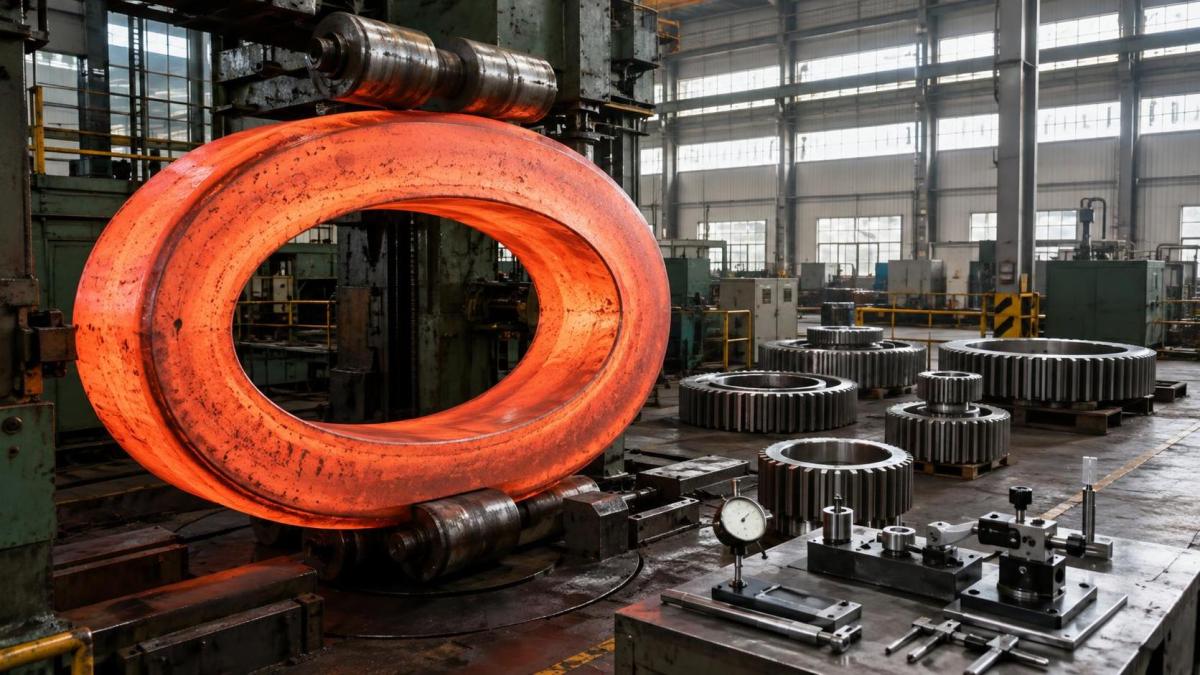
Cooling and heat treatment are the next critical chapter. Controlled cooling may be used to limit excessive residual stress or to prepare the forging for later thermal treatment. Depending on the steel grade and final performance requirements, a ring may be normalized, quenched and tempered, annealed for machinability, or supplied in another agreed condition. The evaluator should confirm not only the named heat-treatment condition, but also the required hardness range, microstructure, mechanical-property testing method, and sampling location.
Where Seamless Rolled Ring Forgings Deliver the Most Value
The value of this forging route becomes clearer when the component must carry force around a circular path. Common examples include bearing races, flanges, gear rims, slewing-related components, reducer rings, transmission hubs, and large-diameter gear blanks. In many assemblies, the ring itself is not visually dramatic; it may sit inside a gearbox or behind a cover. Yet its accuracy and fatigue behavior can influence the load distribution of the components around it.
Consider a bevel gear application. The forging blank must provide sufficient material continuity and stability before machining produces the final tooth geometry. If the blank has excessive ovality, uneven hardness, hidden discontinuities, or poorly managed residual stress, later machining may not fully correct the problem. Tooth contact patterns can be affected, bearing alignment may become more sensitive, and heat-treatment distortion may be harder to control.
When evaluating the complete supply chain for such parts, it is useful to coordinate the forging stage with the gear-manufacturing stage rather than treating them as isolated purchases. Companies sourcing forged blanks and precision gear components may also consult a Bevel Gear supplier to align blank geometry, machining allowances, and final transmission requirements.
What Technical Evaluators Should Verify Before Approval
A reliable specification should make acceptance criteria visible, not assumed. The exact requirements depend on the drawing and service condition, but several verification areas are widely relevant.
Material traceability
Each heat of steel should be traceable to its material documentation. Review chemical composition, heat number, incoming material condition, and any agreed restrictions on cleanliness or residual elements. Traceability becomes particularly important when several ring sizes or heat-treatment batches are processed in parallel.
Dimensional inspection before machining
Outside diameter, inside diameter, height, wall thickness, ovality, and local stock distribution should be measured against the agreed forging drawing. For near-net or precision forging routes, dimensional control has direct economic importance because it affects machining time and material utilization.
Non-destructive examination
Surface and subsurface integrity should be evaluated according to the part’s risk profile and applicable customer or industry requirements. Magnetic particle inspection, ultrasonic testing, and dye penetrant testing may be considered where appropriate. The choice of method should match the likely defect type, section thickness, material condition, and accessibility of the inspection area.
Mechanical and metallurgical confirmation
Tensile properties, impact performance, hardness, grain size, decarburization, and microstructure may all be relevant, but not every requirement belongs on every ring. Over-specifying tests can add cost without improving decisions; under-specifying them may leave a critical risk unmeasured. The right approach is to identify the failure modes that matter most for the intended use.
Process consistency
For production programs, a technically sound first article is not enough. Evaluators should understand how the supplier controls repeatability from batch to batch: forging temperature windows, tooling condition, measurement practices, heat-treatment records, inspection frequency, and handling methods. Consistency is often where long-term quality is won or lost.
Precision Forging Can Also Improve Material Efficiency
Heavy-duty performance and efficient production do not have to conflict. A well-designed precision forging route can reduce machining allowance and make better use of the original billet. This is important for rings and gear-related blanks made from alloy steels, where every unnecessary kilogram removed as chips represents additional material cost, energy use, and processing time.
Liaocheng Jiucheng Auto Parts Co., Ltd. focuses on forging processing for automotive gears, wind power gearbox parts, marine gear components, transmission shafts, spline shafts, reducer gears, and related precision-forged products. Its production setup includes dedicated precision forging and mechanical processing workshops, allowing the relationship between forged form and downstream machining to be considered more closely.
For technically demanding projects, that connection can be practical rather than promotional. A forging supplier with machining awareness is better positioned to discuss critical datum surfaces, stock allowances, deformation tendencies, and areas where the forging design may simplify later operations. Jiucheng’s stated approach to precision forging emphasizes reduced turning where feasible, improved material utilization, and lower energy consumption compared with traditional routes. Those benefits should always be assessed against the actual drawing tolerances and validation requirements of the customer’s part.
Common Misjudgments in Ring Forging Selection
One frequent mistake is choosing only by nominal size and steel grade. Two rings with the same dimensions and chemistry can behave differently if their forming histories, heat treatment, inspection scope, or machining allowances differ. Procurement comparisons should therefore include technical process information, not only unit price.
Another mistake is assuming that a larger safety factor eliminates the need for manufacturing discipline. Increased section thickness may raise static capacity, but it does not automatically resolve fatigue issues caused by inclusions, surface defects, unfavorable grain flow, or high residual stress. In rotating equipment, a small defect in a highly stressed region can matter more than an apparently comfortable theoretical margin.
It is also risky to specify extremely tight forging tolerances without considering the function of the part. Tight tolerances can be valuable where they reduce machining variation, but they should be targeted toward dimensions that genuinely affect the final component. A balanced forging specification controls what is important while preserving a stable, economical manufacturing process.
A Practical Reliability Standard
Reliable seamless rolled ring forgings are not defined by a single inspection certificate or an attractive surface finish. They are the result of a coherent route: suitable steel, controlled deformation, continuous circumferential grain flow, appropriate thermal treatment, verified internal integrity, and dimensions that support the next manufacturing stage.
For technical evaluators, the most useful question is: Can the supplier demonstrate that the forging process supports the real load path and failure risks of this component? If the answer is supported by material traceability, process records, inspection data, and a clear understanding of the finished part, a seamless ring forging becomes more than a raw blank. It becomes a dependable foundation for the gearbox, drivetrain, or industrial system that must keep working when the load is at its highest.
Please give us a message