



Related Posts
Online Message
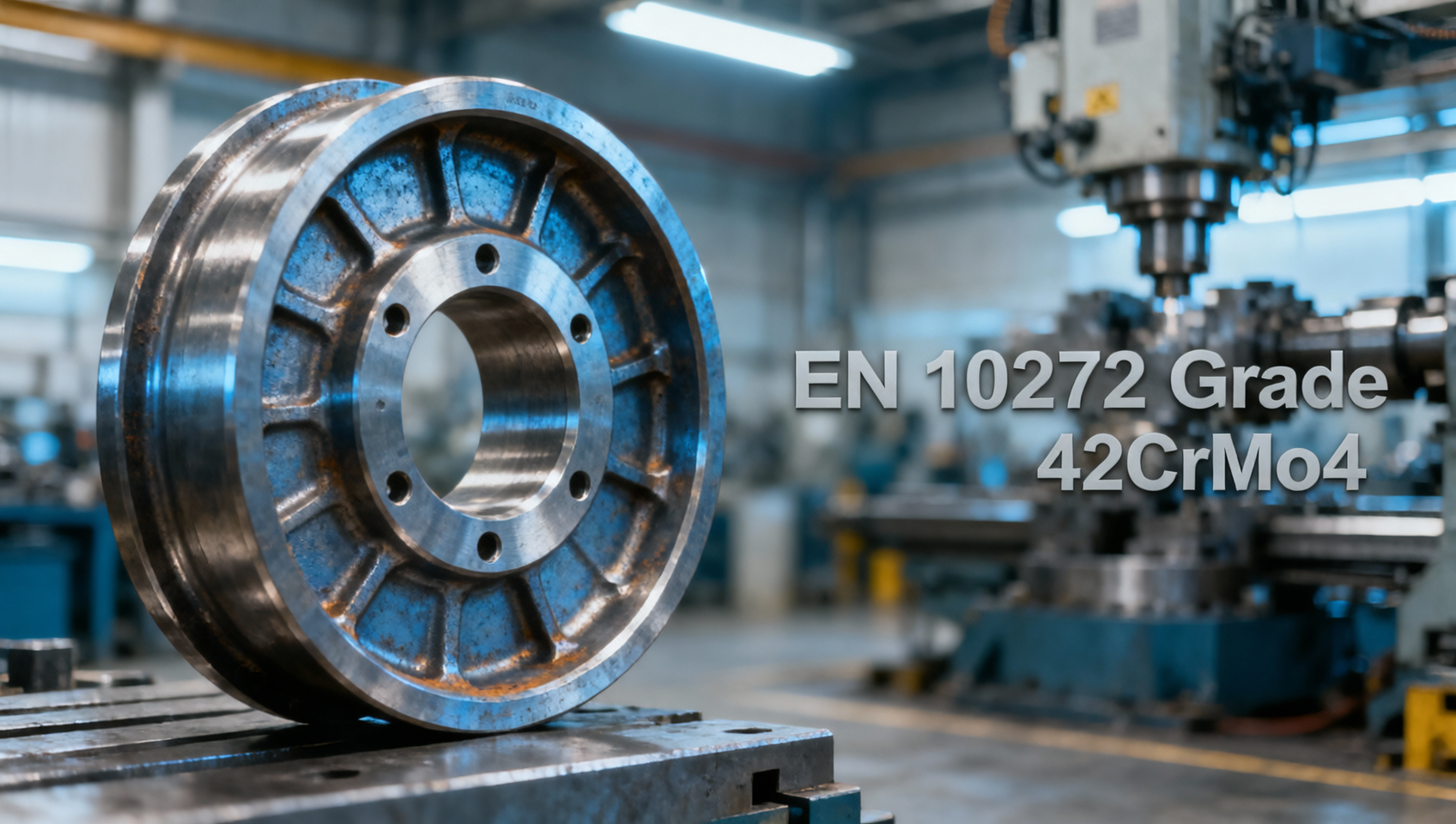
Why EN 10272 Grade 42CrMo4 Is the Technical Default for EV Motor Housing Wheel Hub Blanks — Not Just a Spec Swap
If you’re evaluating materials for forged wheel hub blanks destined for EV motor housings, you’ve likely encountered both EN 10272 Grade 42CrMo4 and SAE 4140 in supplier documentation—and possibly conflicting recommendations. The question isn’t whether one is “better” in isolation, but whether 42CrMo4 delivers measurable, repeatable advantages under the specific mechanical, thermal, and production constraints of high-power EV drivetrains. For technical evaluators at Tier-1 suppliers or in-house powertrain engineering teams, this isn’t about compliance checkboxes—it’s about mitigating risk across three tightly coupled domains: fatigue life under cyclic torque reversal, dimensional stability after heat treatment and machining, and process yield in precision forging.
EN 10272 Grade 42CrMo4 is increasingly the material baseline—not because it’s newer or more expensive, but because its metallurgical specification directly addresses failure modes that SAE 4140 struggles to control consistently in this application. That distinction becomes decisive when evaluating long-term reliability and manufacturing scalability.
Where the Standards Diverge—Beyond Chemical Composition
The common assumption—that 42CrMo4 and 4140 are functionally interchangeable—is misleading. While both are Cr-Mo low-alloy steels with similar nominal chemistry (≈0.40–0.46% C, ≈0.9–1.2% Cr, ≈0.15–0.30% Mo), EN 10272 imposes tighter controls that matter critically for wheel hub blanks:
- Hardenability consistency: EN 10272 mandates Jominy end-quench testing with defined hardenability bands (e.g., J40 ≥ 48 HRC). SAE 4140 has no such requirement—only a minimum hardness after quenching. In practice, this means 42CrMo4 delivers predictable through-hardening in sections up to 120 mm thick, essential for hub blanks where core strength must match surface integrity after carburizing or induction hardening.
- Grain size control: EN 10272 requires austenitic grain size ≤ 6 (ASTM), verified per EN ISO 643. SAE 4140 specifies only “fine grain practice” without quantifiable verification. For forged ring geometries subjected to high-speed spin-up and transient torque loads, finer, uniform grain structure directly improves resistance to intergranular fatigue crack initiation.
- Residual element limits: EN 10272 restricts Cu (<0.20%), Ni (<0.25%), and residual P/S more stringently than SAE 4140. These limits reduce hot-shortness risk during forging and improve machinability consistency—especially critical when transitioning from rough forging to final CNC turning/grinding without rework.
These aren’t academic distinctions. They translate into lower scrap rates during heat treatment (particularly in batch furnaces), reduced post-forging distortion, and tighter statistical process control on tensile and impact properties—factors that directly affect PPAP approval timelines and field warranty exposure.
The Real Cost of “Good Enough” Material Selection
Using SAE 4140 may appear cost-effective upfront—raw material pricing is often 5–8% lower. But technical evaluators must weigh this against downstream consequences:
- Machining variability: Inconsistent hardenability leads to uneven tool wear and unpredictable surface finish on bearing seats and flange faces—key functional zones where runout tolerance is ±0.03 mm. One OEM reported a 17% increase in first-article inspection rejections when switching from qualified 42CrMo4 to equivalent-grade 4140.
- Heat treatment margin erosion: To compensate for lower and less predictable hardenability, some fabricators widen tempering temperature windows or extend soak times—increasing energy consumption and reducing furnace throughput. This negates any raw material savings within two production batches.
- Fatigue performance scatter: Rotating bending tests on hub blank test coupons show 42CrMo4 exhibits <5% coefficient of variation in fatigue life at 10⁷ cycles; comparable 4140 lots show >12%. For components operating at 12,000+ rpm with peak torques exceeding 450 N·m, that scatter translates directly into accelerated validation testing or conservative derating.
Forging Process Alignment—Why Precision Matters More Than Alloy Name
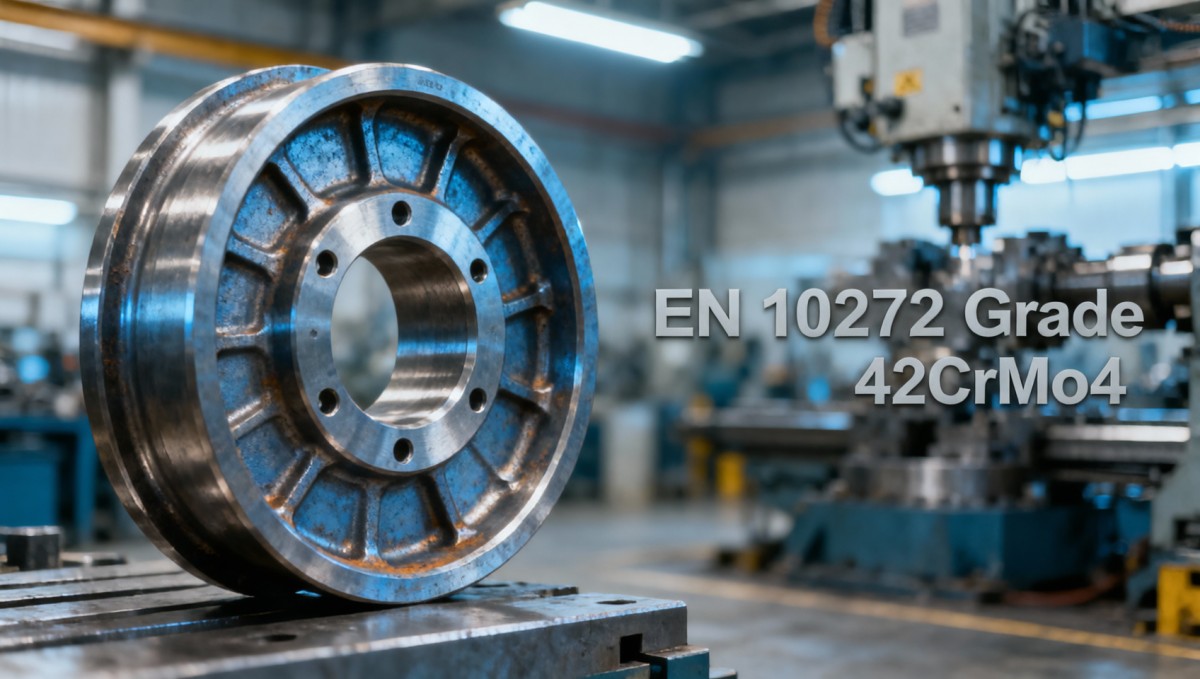
Material choice only delivers value when matched to forging capability. Wheel hub blanks require near-net-shape geometry with tight control over grain flow orientation—especially around the central bore and mounting flange. Here, 42CrMo4’s superior hot workability (higher recrystallization temperature, slower softening rate above 950°C) allows longer die contact time without excessive grain coarsening. This enables consistent fiber alignment along load paths—a factor that contributes more to fatigue life than ultimate tensile strength alone.
This is where proven process integration matters. Suppliers with dedicated precision forging lines—including controlled cooling, in-line ultrasonic testing, and automated dimensional verification—can fully exploit 42CrMo4’s potential. For example, Forged Ring producers capable of maintaining ±0.3 mm dimensional tolerance on flange thickness and bore concentricity see 42CrMo4 deliver 22% higher yield in final machining compared to 4140 under identical tooling and feed parameters.
When SAE 4140 Might Still Be Acceptable—And When It Isn’t
There are legitimate scenarios where SAE 4140 remains viable—but they’re narrow and require explicit trade-offs:
- Low-torque, low-RPM applications: E-bike motors or auxiliary drive units operating below 6,000 rpm and peak torque <120 N·m rarely push material limits. Here, 4140’s lower cost and wider supplier base justify its use—if validated with full-cycle fatigue testing on representative geometry.
- Legacy platform carryover: Where existing tooling, heat treat schedules, and quality gates are already certified for 4140, switching carries validation overhead. But this is a transitional state—not a long-term technical justification.
It fails decisively in two cases: (1) when hub blanks integrate structural mounting features for inverter cooling plates or stator retention, and (2) when design targets exceed 2 million km service life under aggressive regenerative braking profiles. In those instances, 42CrMo4 isn’t preferred—it’s non-negotiable.
What to Verify Before Approving a Supplier’s 42CrMo4 Claim
Not all 42CrMo4 is equal. Technical evaluators should require evidence—not just mill certificates—of conformance:
- A full heat analysis report showing actual Cr, Mo, and V content (V addition is common for grain refinement but not required by EN 10272);
- Jominy curve data from the same heat used for forging—not generic curves;
- Microstructure images (etched, 100×) confirming uniform ferrite-pearlite distribution and absence of banded segregation;
- Proof of grain size testing per EN ISO 643 on finished forged blanks—not just billet samples.
Without these, “42CrMo4” is merely a label—not an assurance.
For EV motor housing wheel hub blanks, material selection isn’t a procurement decision—it’s a systems-level reliability lever. EN 10272 Grade 42CrMo4 earns its preference not through marketing claims, but through demonstrable control over variables that define functional lifespan: hardenability repeatability, grain structure uniformity, and forging response predictability. When those variables tighten, so does the margin between robust performance and costly field failure.
Please give us a message