



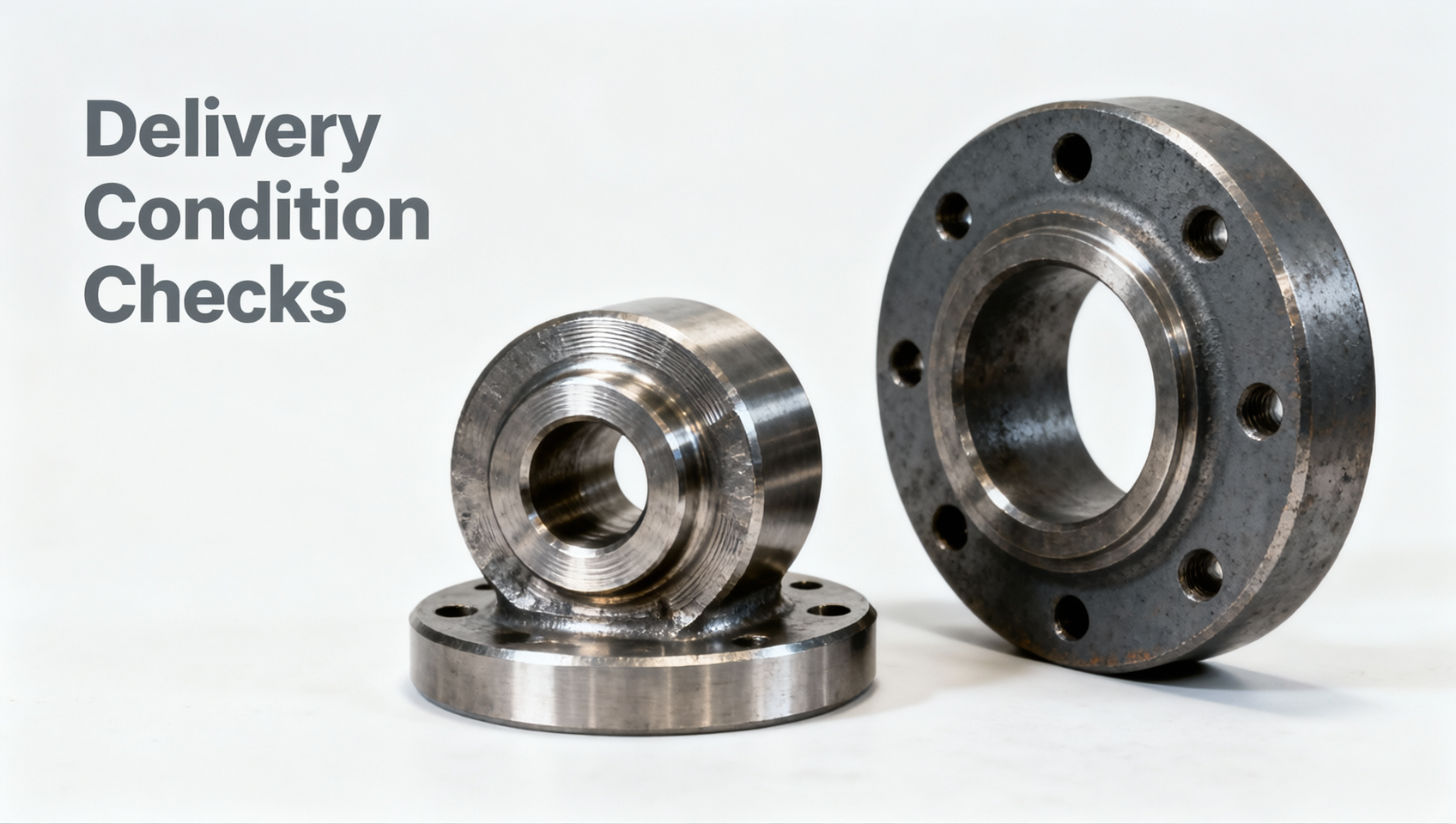
Ordering flange forgings involves more than confirming dimensions and price. Procurement teams should establish material, heat treatment, testing, and machining requirements before comparing supplier quotations.
Unclear requirements can cause machining difficulties, failed inspections, and production delays. A technically complete purchase order helps suppliers quote the same scope and prevents avoidable disputes.
Specify both the metallurgical condition and the manufacturing stage at delivery. “Normalized” describes heat treatment; “rough-machined” describes processing progress. Your order may require both.
This guide explains how to align supplier quotations, inspection records, and delivered parts with engineering requirements, helping buyers control purchasing risk and avoid unexpected rework.
What Does “Delivery Condition” Actually Include?
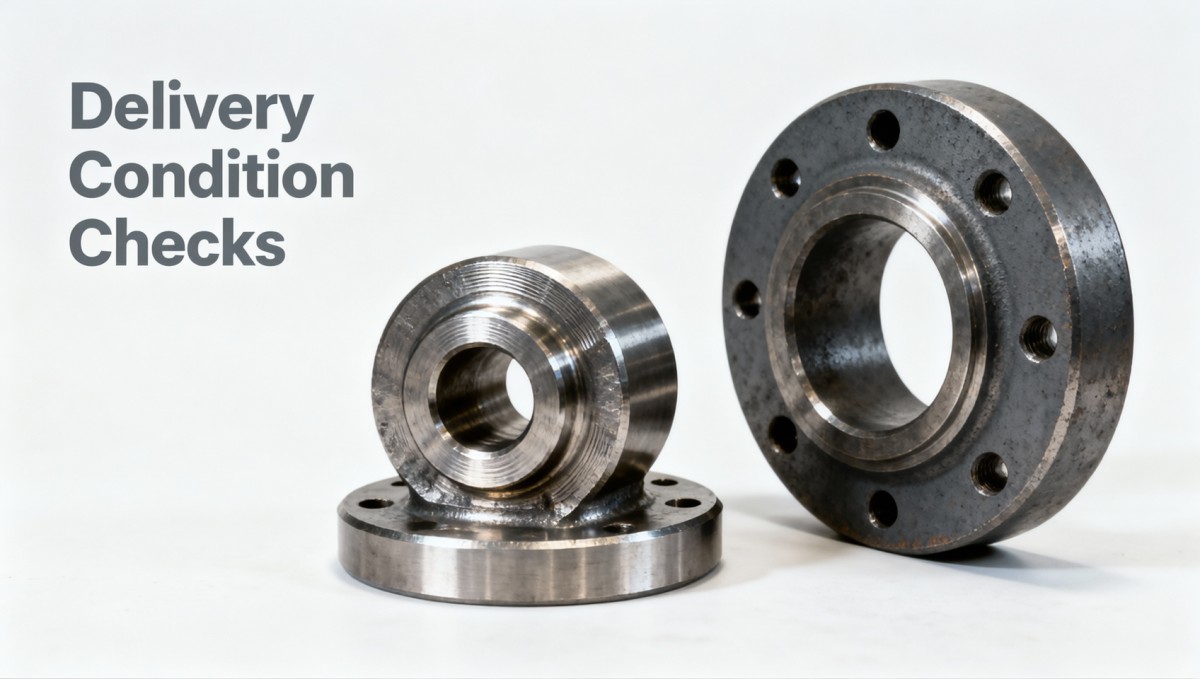
For procurement purposes, delivery condition has three elements: the material’s metallurgical state, the extent of machining, and the preservation applied before packing and shipment.
These elements affect different purchasing risks. Heat treatment influences properties and machinability, machining determines remaining work, and preservation protects surfaces during transportation and storage.
A quotation stating only “forged flange blanks” leaves significant uncertainty. It may describe parts supplied after forging, after heat treatment, or after preliminary machining.
Require suppliers to identify the actual process sequence. Rough machining before final heat treatment can produce a different dimensional outcome from machining after treatment.
Use separate purchase order fields for these requirements. A single phrase such as “ready for machining” cannot reliably communicate all three to a supplier.
Which Material and Heat Treatment Should the Purchase Order Specify?
Start with the drawing, service conditions, and governing specification. Procurement should obtain engineering approval for material selection instead of choosing solely through price comparisons.
Identify the complete material designation, applicable standard and edition, and supplementary requirements. Similar grade names across different standards do not automatically establish technical equivalence.
Pressure service flanges may require specific product standards, testing, and documentation. Mechanical flange blanks should follow their applicable drawing and material requirements without assuming interchangeability.
For example, ASTM A105/A105M and ASTM A182/A182M address different material families and requirements. Buyers should verify applicability rather than copy either designation into every order.
Annealing may be selected to obtain a suitable structure or improve machinability. Normalizing can refine structure, while quenching and tempering can establish specified strength and toughness.
These descriptions do not determine an acceptable production recipe. Grade, section thickness, required properties, and governing specifications determine whether a particular treatment is appropriate.
Ask the supplier to confirm the proposed treatment and process sequence. Resolve substitutions before order placement, including changes to grade, treatment, or testing arrangements.
Which Property Checks Matter More Than a Hardness Number?
Hardness is useful for checking consistency and assessing machining expectations, but it does not independently demonstrate compliance with every strength, ductility, or toughness requirement.
Where required, define tensile strength, yield strength, elongation, and impact properties through the applicable specification. Include test temperatures and acceptance criteria when they matter.
Do not add arbitrary property limits that conflict with the material standard. Engineering should approve additional requirements and confirm that they suit the intended application.
Specify the hardness method, permitted range, sampling frequency, and measurement location where necessary. Surface preparation and test position can influence interpretation of recorded values.
For thick flange forgings, surface hardness alone may not represent properties throughout the section. Ask how representative test specimens and locations satisfy the governing requirements.
Test coupons should have the relationship to the forging and heat treatment required by the specification. An unrelated laboratory result offers limited purchasing assurance.
If later welding, carburizing, induction hardening, or other thermal processing is planned, disclose it early. Subsequent processing can change properties, dimensions, or machining behavior.
How Much Machining Should the Supplier Complete Before Delivery?
Choose the delivery stage by comparing your machining capability, handling costs, inspection needs, and distortion risk. The lowest forging price may increase total processing expense.
As-forged parts require allowances for scale, surface variation, and dimensional cleanup. Confirm that adequate stock remains at critical faces, bores, hubs, and outside diameters.
Rough-machined parts can provide usable reference surfaces and reduce incoming workload. However, the order must define which surfaces are machined and how much stock remains.
Finish-machined flange forgings require tighter agreement on dimensions, geometric tolerances, surface texture, and inspection methods. Critical mating surfaces also need suitable protection during shipment.
Agree whether dimensional acceptance occurs before or after final heat treatment. Thermal processing can change shape, so inspection timing directly affects responsibility for correction.
Where stress relief is required, specify its position in the process sequence. Do not assume every supplier includes it between rough machining and finishing.
For related drivetrain purchases, such as a Bevel Gear, use the same discipline: define the supplied condition and remaining operations against the relevant component drawing.
What Evidence Should Accompany the Shipment?
Request a documentation package that connects the delivered parts to their material and processing history. A certificate is useful only when traceability remains intact.
The required material certificate should identify the applicable grade and specification, chemical analysis, mechanical results, and heat identification. Additional content depends on contractual requirements.
When specifying an inspection document under EN 10204, identify the required type explicitly. Different document types involve different validation arrangements and should not be treated interchangeably.
Material heat identification and heat treatment batch identification serve different purposes. Records should preserve the relationship between the steel source, processing batch, and supplied components.
Where required by the order, obtain heat treatment records showing relevant cycle information and batch identification. Acceptance should follow the specification and approved manufacturing requirements.
Specify nondestructive examination methods, coverage, timing, and acceptance criteria when needed. “Ultrasonic tested” alone does not establish what was inspected or which indications are acceptable.
Decide which records require approval before shipment and which accompany delivery. This avoids discovering missing evidence after the parts have entered your production schedule.
How Can Buyers Compare Quotations Without Missing Scope Differences?
Send every supplier the same technical package: drawing revision, material requirements, delivery condition, inspection scope, quantity, documentation, packaging, and required delivery date for quotation.
Ask suppliers to list deviations explicitly. Silence should not be interpreted as confirmation when a quotation omits heat treatment, testing, machining allowances, or certificate requirements.
Compare total delivered and usable cost. Include freight, duties where applicable, incoming inspection, remaining machining, subcontracted testing, and the likely cost of rejected material.
A supplier offering inexpensive untreated blanks may create more downstream expense than one supplying verified, rough-machined components. Evaluate the actual work your facility must complete.
Check whether the quoted lead time includes laboratory testing and document release. Forging completion alone does not mean the shipment is ready for acceptance.
Use a short purchase order schedule to make the agreement reviewable. Complete the following fields with approved values rather than leaving them as general expectations.
- Technical basis: Part number, drawing revision, quantity, material designation, applicable specification and edition, and any approved supplementary requirements.
- Processing: Required heat treatment, machining stage, process sequence restrictions, remaining stock, and final dimensional acceptance condition.
- Verification: Mechanical testing, hardness checks, nondestructive examination, sampling, acceptance criteria, traceability, and required inspection documents.
- Delivery: Document submission timing, identification, corrosion protection, packing, delivery date, and the process for approving deviations.
What Should Receiving Inspection Check Before Production Release?
At receipt, compare the shipment with the purchase order and packing list. Verify quantities, part numbers, drawing revisions, and visible identification before separating the batch.
Match component markings to certificates and batch records. Missing or inconsistent identification should be resolved before parts are mixed with previously accepted inventory onsite.
Check representative dimensions against the agreed delivery stage. A rough-machined component should retain specified stock while providing the reference surfaces promised in the order.
Inspect for corrosion, damage, unexpected scale, and surface conditions that obstruct required examinations. Distinguish cosmetic observations from defects using agreed criteria and qualified assessment.
Apply the specified hardness and other verification checks through your receiving plan. If results conflict with documentation, hold the affected material while investigating the discrepancy.
Record the disposition of nonconformities in writing. Rework, retesting, replacement, or concession should follow authorized procedures, with engineering involvement where technical compliance is affected.
Choose a Supplier by Process Fit and Verifiable Commitments
A suitable supplier should explain how its forging, heat treatment, machining, and inspection arrangements meet your order. Confirm which operations are performed by subcontractors.
Liaocheng Jiucheng Auto Parts Co., Ltd., established in 2015, combines research, production, and sales, with precision forging and machining workshops serving automotive and gearbox applications.
Its stated experience includes gears, shafts, and related precision forgings. For a flange inquiry, request confirmation of material capability, size range, treatment arrangements, and inspection scope.
Evaluate that response against your technical package. Experience with related components is useful context, while order acceptance still depends on demonstrated capability for your requirements.
Make the Delivery Condition an Acceptance Requirement
The strongest purchase orders connect five things: material grade, heat treatment, verified properties, machining condition, and traceable documentation. Each should have a clear acceptance basis.
Before releasing an order for flange forgings, confirm that engineering, procurement, quality, and the supplier interpret those requirements consistently. Resolve gaps while changes remain manageable.
That preparation makes quotations comparable, receiving decisions faster, and downstream production more predictable. Buyers gain confidence by purchasing a defined condition supported by verifiable evidence.