



Related Posts
Online Message
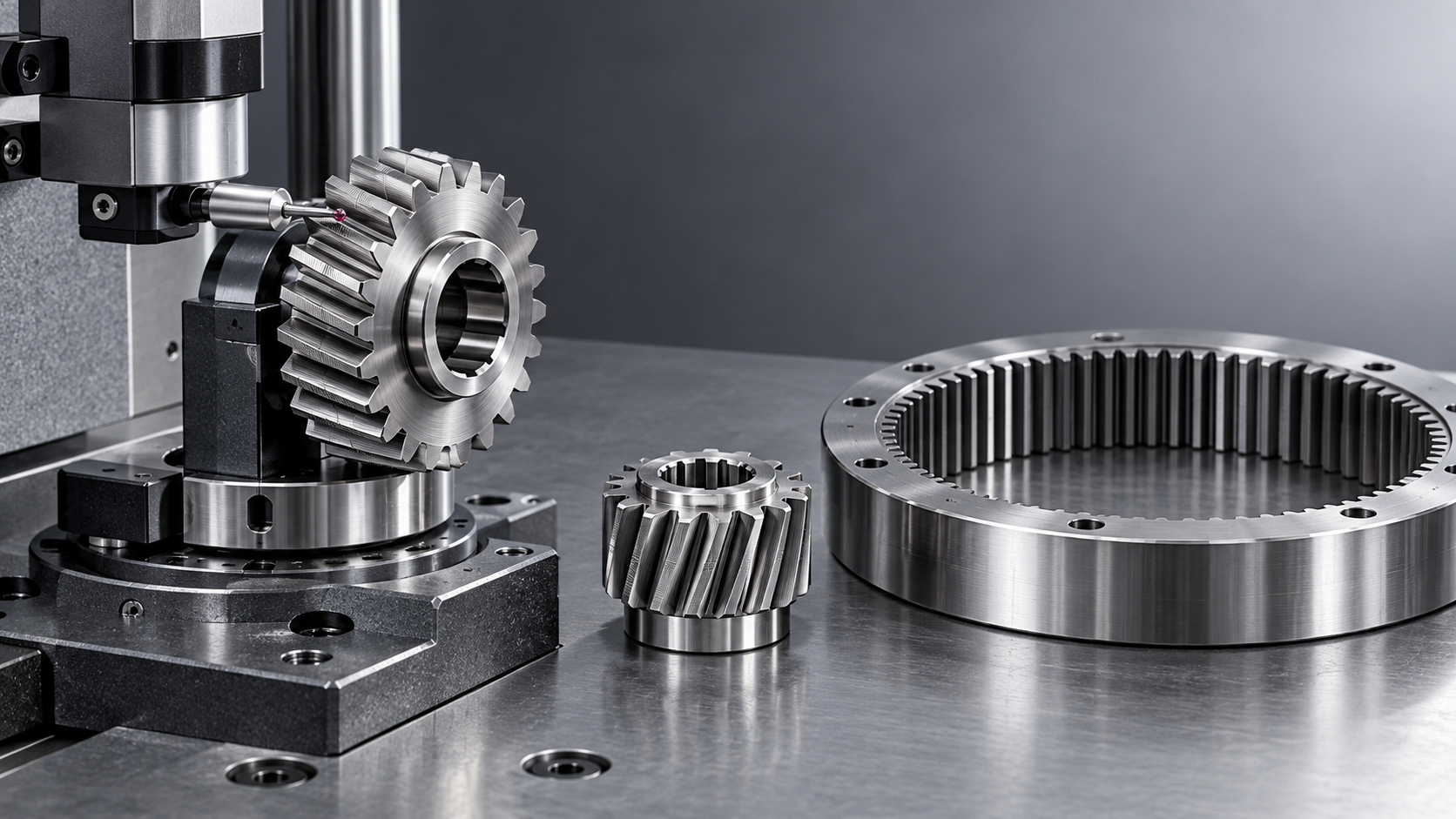
How gear accuracy requirements affect planetary gears price
Two planetary gear sets with identical dimensions can carry very different price tags when their accuracy requirements differ. Understanding planetary gears price means looking beyond material and size to tooth profile tolerances, pitch accuracy, surface finish, and inspection requirements. Tighter specifications can add finishing and verification costs without delivering proportional benefits in every application.
The useful question is not “What is the highest accuracy available?” It is “Which errors will limit this gearbox, and what will controlling them cost?” That distinction helps separate precision worth paying for from specifications that merely make a drawing harder to manufacture.
An accuracy grade is only part of the specification
A note such as “high-precision gears” gives a supplier little basis for a reliable quotation. Even a numerical grade needs an identified standard and edition. ISO 1328-1, for example, addresses flank tolerance classification for individual cylindrical involute gears. It does not, by itself, specify the backlash, positioning accuracy, or noise of an assembled planetary reducer.
Several characteristics influence manufacturing cost in different ways:
- Profile deviation: how the tooth flank departs from its specified profile, including any intentional modification.
- Helix or lead deviation: variation across the face width that can contribute to uneven contact.
- Pitch deviation: errors in tooth spacing that can affect transmission smoothness and load distribution.
- Runout and datum relationships: how the teeth relate to the bore, journals, and mounting surfaces.
- Surface texture: a separate requirement affecting contact conditions, not a substitute for geometric accuracy.
These requirements should reflect the operating problem. A demanding surface-finish limit will not correct poor tooth spacing. Likewise, precise flanks will not compensate for an inaccurate bearing seat. Quoting everything at the tightest tolerance often conceals which feature actually controls performance.
The largest price change often comes from a different process route
Accuracy does not have a simple, linear price relationship. A modest tightening of tolerance may be manageable within an established process. Another change may require hard finishing, different tooling, or a revised datum strategy. That process boundary is often where the quotation moves noticeably.
Consider a carburized gear. Tooth cutting before heat treatment must allow for dimensional changes during hardening. If the final requirement accommodates the resulting variation, the route may remain relatively straightforward. If it does not, the manufacturer may need grinding or another suitable finishing operation after heat treatment. This adds more than machine time: it can require grinding stock, bore correction, additional handling, and intermediate checks.
Not every gear requires grinding to achieve useful accuracy, and grinding alone does not guarantee a capable process. Geometry, material, heat treatment, equipment, and batch size all matter. Ask the supplier which operation changes when the tolerance tightens, rather than accepting an unexplained “precision premium.”
Internal ring gears deserve particular attention. Tool access and available finishing equipment differ from those used for external sun and planet gears. Applying the same demanding requirement to every member may create a disproportionate cost increase for the ring gear.
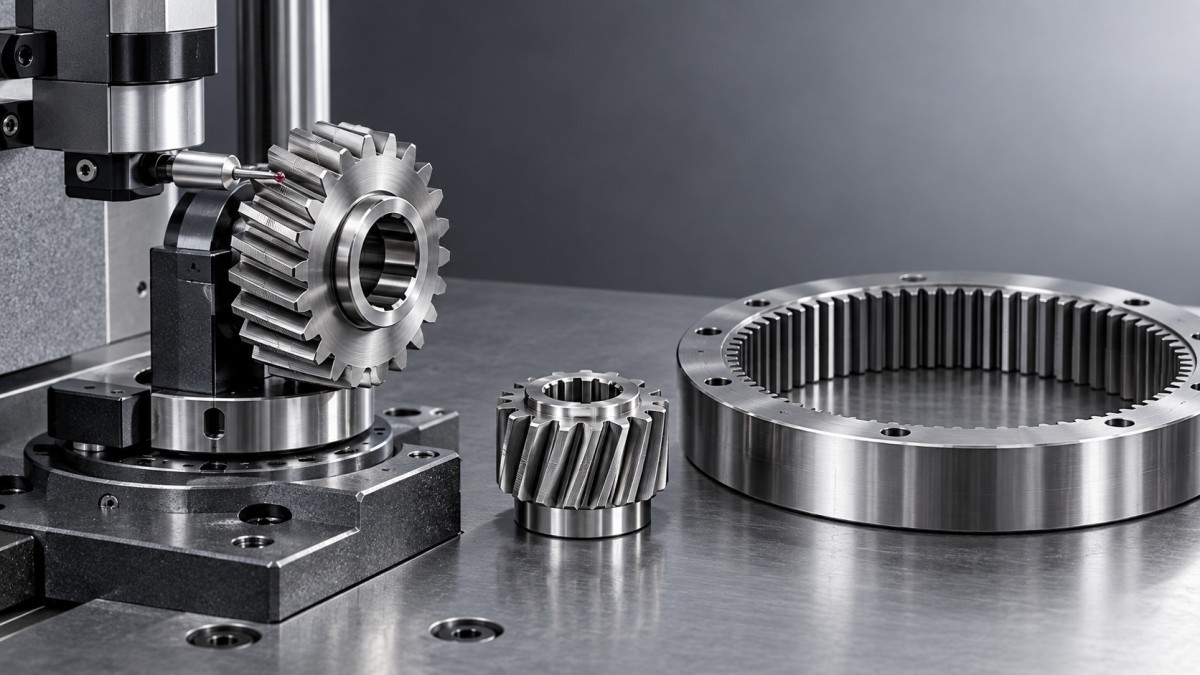
A useful quotation therefore identifies the proposed route for each gear member. “Finished after heat treatment” is more informative than a general promise of precision, but it still needs an agreed inspection method and acceptance limits.
Planetary load sharing makes assembly accuracy just as important
A planetary stage distributes torque through multiple planets, but equal load sharing is not automatic. Carrier pin-position errors, planet bore variation, bearing clearances, and ring-gear deformation can all disturb the intended distribution. Better tooth accuracy can help, but it cannot remove every assembly error.
This matters when evaluating an expensive upgrade. If the carrier or housing dominates misalignment, buying finer gears may produce little improvement. The same budget might be better spent controlling pin locations, bearing fits, or ring-gear support. Depending on the architecture, a floating member may also influence load sharing; its effect should be assessed within the actual design.
Backlash requires similar care. It depends on tooth thickness, operating center distances, assembly variation, and temperature—not simply the flank accuracy grade. For a reversing positioning axis, also distinguish backlash from elastic twist under load. A gearbox can have little clearance yet still deflect enough to affect positioning.
Where output motion is critical, specify the assembled acceptance test. State the applied torque, measurement location, direction changes, and temperature conditions. Otherwise, two suppliers may quote the same nominal backlash while testing different things.
Pay for the accuracy your duty cycle can use
Application conditions determine whether tighter tolerances are valuable. These comparisons are selection guides, not substitutes for load calculations or prototype validation.
Tooth modifications need particular judgment. Deliberate profile relief or lead crowning is not simply an error to eliminate. It can improve loaded contact under the intended conditions. The drawing and inspection program must distinguish the designed modification from unwanted deviation; otherwise, a nominally “more accurate” gear may not be better suited to its load.
Blank quality helps control cost, but it does not replace finishing
Cost control starts before tooth cutting. A suitable forged blank can reduce unnecessary stock removal and provide a practical basis for subsequent machining. However, blank geometry, machining allowances, and datum preparation must suit the final heat-treatment and finishing route.
Liaocheng Jiucheng Auto Parts Co., Ltd., established in 2015, combines precision-forging and mechanical-processing workshops and supplies gear-related parts for automotive, wind-power, machinery, and marine applications. For this type of integrated supplier, a useful technical discussion starts with the relationship between the blank and the finished drawing, rather than treating forging and gear machining as unrelated purchases.
When considering Wheel-type forgings as potential starting blanks, confirm material suitability, machining allowance, and datum strategy for the intended component. Forging is not a guarantee of final tooth accuracy. Excessively small allowances can also leave insufficient stock to correct distortion later.
Inspection requirements belong in the price comparison
A quotation for sampled production checks is not equivalent to one covering individual analytical gear reports. Both may be appropriate, but they represent different commitments. Measuring profile, helix, and pitch takes equipment time, setup work, and interpretation; traceability and retained records add further obligations.
Specify which features require full inspection and which may be sampled under an agreed plan. Also establish whether measurements apply before or after heat treatment and final finishing. A pre-hardening report cannot demonstrate compliance with a final hardened-gear requirement.
For tight tolerances, ask how measurement uncertainty is handled in acceptance decisions. Results close to a limit can create disputes if the supplier and buyer use different datums, evaluation settings, or decision rules. Settling those details before production is usually easier than arguing over a completed batch.
Batch quantity matters too. Dedicated fixtures, programming, and first-article verification are spread over fewer parts in a small order. Compare prototype and recurring production prices separately, particularly if the initial order includes process development.
Build an RFQ that exposes the real precision premium
To compare planetary gears price meaningfully, give suppliers the same technical boundary: individual gears, matched sets, or a complete assembled stage. Then include the material and heat-treatment specification, governing accuracy standard, critical datums, tooth modifications, surface requirements, inspection scope, and order quantities.
Where the design is not frozen, request two technically defined alternatives: the proposed requirement and a supplier-recommended option. Ask what changes in manufacturing route, verification, lead time, and expected functional behavior. Do not relax strength or service-life requirements merely to obtain a lower unit price.
The decisive question is whether the additional expense addresses a demonstrated limitation. If tighter gear tolerances control transmission error or contact distribution, the premium may be justified. If housing deflection or carrier accuracy remains the dominant problem, correct that first. Before approving the drawing, make sure every costly precision requirement has a functional reason and a measurable acceptance condition.
Please give us a message